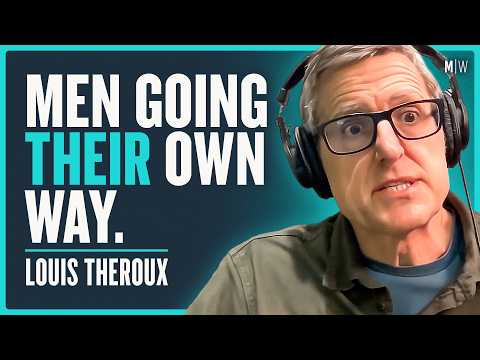
Is The Manosphere Really That Dangerous? - Louis Theroux
Chris Williamson (host), Louis Theroux (guest)
In this episode of Modern Wisdom, featuring Chris Williamson and Louis Theroux, Is The Manosphere Really That Dangerous? - Louis Theroux explores louis Theroux on manosphere harms, incentives, and men’s empathy needs Theroux describes making his Netflix documentary after seeing his sons exposed to Andrew Tate-style clips and noticing how rapidly manosphere content exploits algorithms, clipping culture, and outrage to spread.
Louis Theroux on manosphere harms, incentives, and men’s empathy needs
Theroux describes making his Netflix documentary after seeing his sons exposed to Andrew Tate-style clips and noticing how rapidly manosphere content exploits algorithms, clipping culture, and outrage to spread.
He argues much of the “mission” is commercial: creators monetize attention through upsells (courses, crypto/FX schemes) while using provocative claims, irony, and conspiracy as engagement engines.
The conversation explores how livestreaming, real-time metrics, and audience capture push creators toward escalating antisocial behavior, while viewers—especially boys—struggle to distinguish performance from belief.
Both discuss the difficulty of addressing legitimate male pain and self-improvement without being conflated with extremist manosphere figures, and they converge on the need for clearer distinctions, better role models, and more sympathy for boys and men.
Key Takeaways
Manosphere virality is engineered as much as it is believed.
Theroux frames Tate’s rise as a repeatable distribution strategy—outrageous podcast moments plus an army of clippers feeding TikTok—more than a purely organic ideological movement.
Get the full analysis with uListen AI
The entertainment–reality blur is the core danger.
Like pro-wrestling kayfabe, creators can hide behind “it’s a joke” while still normalizing misogyny or conspiracies; the audience may absorb the ‘masked truth’ even when the speaker backtracks.
Get the full analysis with uListen AI
Monetization incentives often drive the ideology, not the reverse.
Theroux repeatedly returns to the “upsell behind it all”—courses, trading platforms, crypto—arguing that the worldview functions as a funnel from attention to purchase.
Get the full analysis with uListen AI
Algorithms don’t just predict preferences; they can shape them.
Williamson relays Stuart Russell’s point: recommendation systems may ‘nudge’ users toward more predictable, often more extreme, stances—while simultaneously shaping creators through retention and engagement feedback loops.
Get the full analysis with uListen AI
Livestreaming creates a constant escalation treadmill.
Real-time viewer counts, chat pressure, and cliffhanger pacing reward conflict and spectacle; Theroux’s example of a “pred sting” shows how content can drift into vigilante humiliation and violence for clicks.
Get the full analysis with uListen AI
A lot of ‘alpha’ posturing looks like compensating for insecurity and trauma.
Theroux notes patterns of instability, absent/abusive fathers, and ‘apocalyptic’ home environments; he interprets the anger and dominance as protection against being exposed as fearful or inadequate.
Get the full analysis with uListen AI
Men’s self-improvement is being unfairly conflated with extremist manosphere content.
Both argue that talking about exercise, self-reliance, or boys’ outcomes (Reeves/Galloway/Huberman) shouldn’t be treated as equivalent to Fresh & Fit/Fuentes/Tate; the lack of precision fuels moral panic and bad-faith smears.
Get the full analysis with uListen AI
Looksmaxxing may signal a shift toward male–male status competition over winning women.
Williamson suggests a new wave (via Clavicular) focused on aesthetics, surgery, and ‘mogging’ rather than dating ‘game’; Theroux adds that live streaming reduces the need for an explicit ‘message’—the persona becomes the product.
Get the full analysis with uListen AI
Empathy is necessary, but it can’t become absolution.
Theroux agrees difficult childhoods warrant sympathy and rejects simplistic ‘victim vs perpetrator’ binaries, while still emphasizing harms: misogyny, conspiracism, and exploitation of vulnerable young audiences.
Get the full analysis with uListen AI
Notable Quotes
“I sometimes say puckishly like there’s no such thing as a joke.”
— Louis Theroux
“Behind all of that is an upsell… an attempt to convert your eyeballs into sales for some crappy product.”
— Louis Theroux
“He’s been raised by an algorithm.”
— Louis Theroux
“The algorithm can… nudge your preferences to be easier to predict.”
— Chris Williamson
“In life as a man, you’re born without value.”
— Louis Theroux (recounting young fans’ talking point)
Questions Answered in This Episode
In your view, what specific ‘guardrails’ would reduce harm: platform moderation, age-gating, demonetization, or changes to recommender systems—and which is most realistic?
Theroux describes making his Netflix documentary after seeing his sons exposed to Andrew Tate-style clips and noticing how rapidly manosphere content exploits algorithms, clipping culture, and outrage to spread.
Get the full analysis with uListen AI
Where is the practical line between ‘kayfabe’ provocation and genuine ideological radicalization—what signals tell you it has crossed over?
He argues much of the “mission” is commercial: creators monetize attention through upsells (courses, crypto/FX schemes) while using provocative claims, irony, and conspiracy as engagement engines.
Get the full analysis with uListen AI
You describe the manosphere as grift-plus-outrage; what evidence would change your mind and convince you a creator is primarily mission-driven?
The conversation explores how livestreaming, real-time metrics, and audience capture push creators toward escalating antisocial behavior, while viewers—especially boys—struggle to distinguish performance from belief.
Get the full analysis with uListen AI
How much responsibility should clippers, editors, and affiliate marketers bear, given they industrialize the spread of the most inflammatory moments?
Both discuss the difficulty of addressing legitimate male pain and self-improvement without being conflated with extremist manosphere figures, and they converge on the need for clearer distinctions, better role models, and more sympathy for boys and men.
Get the full analysis with uListen AI
Your ‘pred sting’ example shows vigilante escalation—should platforms treat this as harassment/violence content even when framed as protecting minors?
Get the full analysis with uListen AI
Transcript Preview
Louis, you've got three sons, 20, 18, and 11. Why were you interested in doing this documentary?
Uh, well, for, for reasons closely related to that. I mean, yeah, that's obviously part of it. Uh, as a dad, I saw my kids were consuming... I mean, consuming s- maybe sounds more active than it was. They were being exposed to influencer content, manosphere-type content, specifically Andrew Tate back in the sort of post-COVID era when he first blew up. And, and I remember kids saying, the, you know, the, the boys saying, um, "Oh, Andrew Tate said this or that," and, and thinking like, "Well, who, who is Andrew Tate?" Like, that's not ever, wasn't someone I'd ever heard of. And then the content obviously turned out to be things like, oh, women can't drive or shouldn't be allowed to drive, or women shouldn't be allowed to vote. Um, and it was hard to, you know, the- they were sort of saying like, "Well, he just says it as a joke," like everyone's freaking out about this and, but, you know, we, we know what it is, like it's clearly, uh, clickbait or rage bait. But nevertheless, its level of virality was kind of, I, I, I w- I w- it would be too far to say at this stage it was concerning, but it was kinda weird. It was just weird to see someone blow up like that, that quickly, and to sort of commandeer swathes of the internet so purposefully. Like, he kinda hacked, he sort of figured something out about the algorithm, about, about, uh, Twitter and, and, and social media in general, TikTok really specifically, doing podcasts, saying outrageous things, having an army of clippers repurpose those into short snippets, and those being picked up by the algorithm so that everyone, literally millions were being, worldwide were being exposed to his content. So fast-forward a few years, and he continued to become famous. Other people in his stead or, or in associated contexts were putting out similarly viral clickbait content, and the whole culture felt like it was being inundated. I say the whole cu- li- like swathes of, uh, male-skewing internet spaces were being inundated with it. And then meanwhile, I'm, you know, as a program maker of 30 years standing, uh, I'm always looking for ideas, and I was with, I was talking to Netflix about making a program, and it seemed front and center of what I should be covering. As both someone-- I mean, I've been joking that it's like the final boss battle of the Louis Theroux subject. You know, like I, I, someone who specialized over the years, I've done stuff about racists, cults, s- sex workers of different stripes, um, people involved in pro wrestling and gangster rap. The manis- this aspect of the manosphere, like this subset section of the manosphere feels like all those things mixed together. You know what I mean? They look a bit like wrestlers. They speak a little bit like rappers. And, and the content is clearly highly dubious at best. You know, whether or not it's sincere is a, is a different question. So I was like, well, this is, this is made to measure for whatever my skill set is in terms of making documentaries.
Install uListen to search the full transcript and get AI-powered insights
Get Full TranscriptGet more from every podcast
AI summaries, searchable transcripts, and fact-checking. Free forever.
Add to Chrome