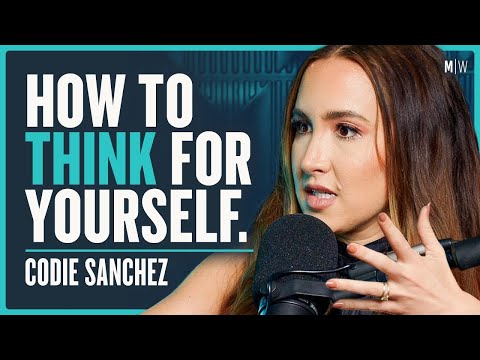
The Weird Mental Frameworks Of The Super Rich - Codie Sanchez
Chris Williamson (host), Codie Sanchez (guest)
In this episode of Modern Wisdom, featuring Chris Williamson and Codie Sanchez, The Weird Mental Frameworks Of The Super Rich - Codie Sanchez explores inside the Contrarian Minds and Money Frameworks of the Ultra-Rich Chris Williamson and Codie Sanchez unpack how the super rich think differently: questioning norms, embracing calculated risk, and obsessing over a narrow set of high‑leverage actions. They explore contrarianism, intention around wealth and ‘enough’, and why different skills are needed at each income level from $100K to $100M+. The conversation ranges from content diets and personal brand controversy to marriage dynamics, power couples, and the loneliness of fast growth. Throughout, Codie shares mental models from billionaires, Navy SEAL culture, and her own investing career to show how to design a life and strategy that’s non‑conformist but sustainable.
Inside the Contrarian Minds and Money Frameworks of the Ultra-Rich
Chris Williamson and Codie Sanchez unpack how the super rich think differently: questioning norms, embracing calculated risk, and obsessing over a narrow set of high‑leverage actions. They explore contrarianism, intention around wealth and ‘enough’, and why different skills are needed at each income level from $100K to $100M+. The conversation ranges from content diets and personal brand controversy to marriage dynamics, power couples, and the loneliness of fast growth. Throughout, Codie shares mental models from billionaires, Navy SEAL culture, and her own investing career to show how to design a life and strategy that’s non‑conformist but sustainable.
They also examine status games online, the costs of people‑pleasing, and the value of dissent and honest feedback in relationships and companies. The throughline is intentionality: curating what goes into your mind, who you surround yourself with, and which forms of controversy, ambition and sacrifice are actually worth it.
Key Takeaways
True contrarians question from first principles, they don’t just reflexively disagree.
Codie distinguishes between performative contrarians and genuine independent thinkers who reason from the ground up, resist social pressure, and still manage to be right more often than not—especially critical in investing and wealth building.
Get the full analysis with uListen AI
Each wealth tier requires different behaviors; employee logic breaks after ~$1–10M.
She argues the skills that get you from $0 to $100K (learning, being a great employee) can carry you to ~$1M, but the jump to $10M, $100M, or a billion demands ownership, leverage, and fundamentally different risk and decision frameworks.
Get the full analysis with uListen AI
Intentionally define ‘enough’ or you’ll be trapped in endless escalation.
Using Taleb’s line about people not knowing when to stop, Codie contrasts the glamorous billionaire grind (e. ...
Get the full analysis with uListen AI
Curate your ‘content diet’ as aggressively as your food diet.
They liken your brain to a body built from what you consume: rage‑bait and trash content become ‘fast food for your amygdala’, whereas books, thoughtful podcasts and high‑quality inputs act as “spirulina for the soul” and can measurably change your thinking.
Get the full analysis with uListen AI
Boredom and white space are prerequisites for high‑leverage thinking.
Codie protects long, call‑free blocks in her mornings and multiple no‑meeting days, arguing that big ideas are ‘needle in a haystack work’. ...
Get the full analysis with uListen AI
Seek dissent, not sycophants—yes‑men are lethal to leaders and companies.
She screens hires for negativity/victim mindsets, values teammates who poke holes in her plans, and notes that leaders without internal critics become increasingly blind just as their decisions scale up, creating an ‘emperor has no clothes’ risk.
Get the full analysis with uListen AI
Stop over‑optimizing routines; focus on the 10–20% that drives 80% of results.
Using Warren Buffett’s simple daily life as an example, Codie pushes back on hyper‑optimized lifestyles; in fitness and business alike, she looks for a couple of ‘snowball’ actions (standard meals, fixed workouts, key strategic work) that make everything else easier.
Get the full analysis with uListen AI
Intentional relationships require competence, honesty, and aligned ambition—not clichés about alpha roles.
She describes power‑couple dynamics, why competence in any domain is deeply attractive, and why both partners being ‘A‑players’ in their respective games beats simplistic alpha/beta gender scripts, especially over decades.
Get the full analysis with uListen AI
Notable Quotes
“A contrarian is not one who always disagrees, but one who questions everything.”
— Codie Sanchez (quoting Christopher Hitchens)
“If you invest just like everybody else, on average you lose money over time to inflation.”
— Codie Sanchez
“What if your intellect is measured by how much truth you can tolerate?”
— Codie Sanchez
“Most people spend their time stacking haystacks instead of looking for the needle.”
— Codie Sanchez
“Your fears about perfection will kill you more quickly than your imperfections.”
— Chris Williamson (referencing Alex Hormozi)
Questions Answered in This Episode
How can someone practically start thinking more contrarian without drifting into reflexive disagreement or empty edginess?
Chris Williamson and Codie Sanchez unpack how the super rich think differently: questioning norms, embracing calculated risk, and obsessing over a narrow set of high‑leverage actions. ...
Get the full analysis with uListen AI
At which income or career stage should a person seriously consider shifting from ‘high‑earning employee’ to owner/operator, and how can they de‑risk that transition?
They also examine status games online, the costs of people‑pleasing, and the value of dissent and honest feedback in relationships and companies. ...
Get the full analysis with uListen AI
What concrete steps would you recommend for auditing and upgrading a ‘content diet’ that’s currently dominated by outrage and low‑quality entertainment?
Get the full analysis with uListen AI
In fast‑growing relationships or careers, how do you deliberately cultivate honest dissent and avoid becoming surrounded by yes‑men?
Get the full analysis with uListen AI
Where is the real line between healthy ambition and ‘small thinking infected by comfort’—and how do you know when you’ve reached ‘enough’ for yourself?
Get the full analysis with uListen AI
Transcript Preview
What's a contrarian to you?
I think I wanna steal a quote for this one, which is Christopher Hitchens, and his quote was, "A contrarian is not one who always disagrees, but one who questions everything." And so my idea is in the world that we have right now, it's probably pretty smart to question assumptions continuously, and the humans who do that are the ones that win over time. Uh, I don't think the goal is to just be ornery or to counter culture, but to actually use your brain to come up with a formulation of thoughts that is unique to you.
Is that not antithetical to moving quickly? If you've got to question everything, super effortful, that means you can't make decisions quite as fast.
It's interesting you say that. We were talking about a mutual friend of ours, Bill Perkins, and Bill told me, uh, his two superpowers that have led to every single dollar he's made, and he goes, uh, "It is that I'm willing to take wi- risk, and I move faster than everybody else. So by the time they've even pondered an idea, I've already done it, made five mistakes, and learned five lessons." And every time I meet with Bill, I realize that's exactly right, and that's why he's one of the most successful people that I've ever met. And yet, I think if you don't question things, and you don't have a brilliant mind like he seems to, you're just gonna be on the wrong road path, and if you don't actually know the goal that you wanna hit, if you don't actually know where you're going, most people move forward towards things that they actually don't want in life, and I've done it many, many times. And so in my mind, if you don't question up front, then you might not actually like the answer you get to when you find it.
Mm. Yeah, the intentionality point, I think, is so important, and it comes up in dating. It comes up in business. It comes up in, where are you gonna live? What sort of lifestyle are you gonna have? How much success do you want? Ooh, that's a fucking big one. So this really cool quote that I saw from, uh, Nassim Taleb, "The world is split between those who don't know how to start making money and those who don't know when to stop."
Ooh, yeah, that hits home, huh?
(laughs) Are you feeling that one?
I'm feeling that one.
(laughs) Just-
That was kinda deep.
Yeah.
Yeah, well, I- I think he's- he's right, but thank God there are some humans that don't stop. Like, sometimes I think about, you couldn't pay me enough money to switch places with Elon Musk. There's not enough money out there. I am so glad that he exists as a human in the world because we get to benefit from the creations that he makes, but I don't think he looks very happy, and sometimes the person that I actually, you know, lust after from an exchange of life perspective is the person who owns a couple of cash flowing businesses, happily married, couple of kids, in good shape, has tons of free time, and is really close to their community, and, uh, it's not the person who has built multiple billions of dollars 'cause at the end of the day, what are you gonna do with it? And so, uh, unfortunately, I'm wired as one of those freakish humans that loves the game, does not know when to stop, and finds everything else pales by nature, but I do think he's- he's right, don't you?
Install uListen to search the full transcript and get AI-powered insights
Get Full TranscriptGet more from every podcast
AI summaries, searchable transcripts, and fact-checking. Free forever.
Add to Chrome