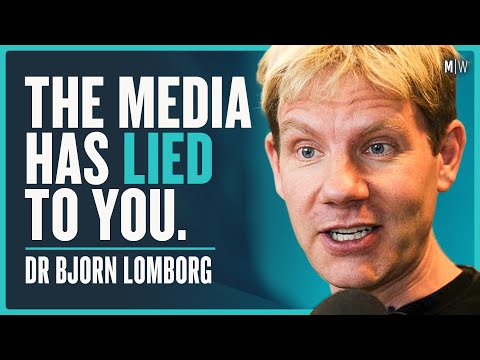
Climate Alarmists Are Getting This All Wrong - Dr Bjorn Lomborg
Bjorn Lomborg (guest), Chris Williamson (host)
In this episode of Modern Wisdom, featuring Bjorn Lomborg and Chris Williamson, Climate Alarmists Are Getting This All Wrong - Dr Bjorn Lomborg explores rethinking Climate Panic: Smarter Ways To Improve Global Wellbeing Fast Bjorn Lomborg argues that climate change is a serious but manageable problem, not an existential threat that will end humanity, and that current alarmism distorts public priorities.
Rethinking Climate Panic: Smarter Ways To Improve Global Wellbeing Fast
Bjorn Lomborg argues that climate change is a serious but manageable problem, not an existential threat that will end humanity, and that current alarmism distorts public priorities.
He contends that we massively overinvest in high-cost, low-impact climate policies while neglecting cheap, high-impact interventions that save millions of lives and dramatically reduce poverty today.
Using cost–benefit analysis, Lomborg highlights a set of 12 top interventions—such as basic education reform, maternal and newborn care, tuberculosis control, and green energy R&D—that yield enormous social returns per dollar.
He calls for reframing global efforts away from symbolic gestures and politically attractive but inefficient goals like near‑term net zero, towards evidence-based spending that maximizes real human flourishing now and in the future.
Key Takeaways
Treat climate change as a serious problem, not the end of the world.
Mainstream scientific estimates suggest climate change will make us somewhat poorer and create real localized harms, but not cause permanent, unrecoverable collapse of civilization; framing it as an existential risk crowds out attention to other urgent issues.
Get the full analysis with uListen AI
Use cost–benefit analysis to prioritize global spending.
Lomborg argues that policy should be guided by how much social good each dollar buys—across health, education, environment—not by what generates the scariest headlines; many beloved climate policies return only cents on the dollar, while some health and education interventions return 40–80 times their cost.
Get the full analysis with uListen AI
Invest in basic education reform with targeted learning technology.
Providing structured, tablet-based, level‑appropriate instruction for about $30 per child per year can triple learning outcomes in developing countries, yielding an estimated $600 billion in lifetime benefits from a $10 billion annual cost.
Get the full analysis with uListen AI
Scale simple maternal and newborn care to save millions cheaply.
Low-cost measures—clean facilities, basic obstetric emergency care, neonatal resuscitation bags—could save roughly 1. ...
Get the full analysis with uListen AI
Target neglected killers like tuberculosis for high-impact gains.
Improved diagnosis, medication adherence, and stigma reduction in low-income countries could avert hundreds of thousands of TB deaths annually, with benefit–cost ratios around 46:1, far outperforming typical climate mitigation investments.
Get the full analysis with uListen AI
Focus climate spending on innovation, especially green energy R&D.
Rather than forcing expensive, suboptimal transitions now, Lomborg advocates funding breakthroughs that make low‑carbon energy genuinely cheaper than fossil fuels for everyone; expert panels estimate about $11 in long-run climate benefit per $1 invested in such R&D.
Get the full analysis with uListen AI
Recognize that poverty reduction increases climate resilience and concern.
As countries grow richer, they become far less vulnerable to weather disasters and more willing and able to invest in environmental protection, suggesting that lifting people out of poverty may indirectly be one of the best long-term climate strategies.
Get the full analysis with uListen AI
Notable Quotes
“Climate change is a problem, not the end of the world.”
— Bjorn Lomborg
“Do you want to do a lot of good, or do you just want to feel good?”
— Bjorn Lomborg
“If you’re worried about polar bears, stop shooting polar bears.”
— Bjorn Lomborg
“We’ve quadrupled in size, and deaths from climate-related disasters have dropped 98%.”
— Bjorn Lomborg
“Net zero by 2050 is absolutely bonkers—an impossible and fantastically expensive policy.”
— Bjorn Lomborg
Questions Answered in This Episode
How should policymakers balance present-day human suffering against long-term climate risks when allocating limited resources?
Bjorn Lomborg argues that climate change is a serious but manageable problem, not an existential threat that will end humanity, and that current alarmism distorts public priorities.
Get the full analysis with uListen AI
What practical steps can ordinary citizens take if they want their climate concern to translate into genuinely high-impact action rather than symbolic gestures?
He contends that we massively overinvest in high-cost, low-impact climate policies while neglecting cheap, high-impact interventions that save millions of lives and dramatically reduce poverty today.
Get the full analysis with uListen AI
How can communicators shift public perception from climate apocalypse narratives to a more accurate “serious but solvable problem” framing without triggering complacency?
Using cost–benefit analysis, Lomborg highlights a set of 12 top interventions—such as basic education reform, maternal and newborn care, tuberculosis control, and green energy R&D—that yield enormous social returns per dollar.
Get the full analysis with uListen AI
What governance and incentive changes would be needed to redirect billions from low-yield climate policies into high-return interventions like education and maternal health?
He calls for reframing global efforts away from symbolic gestures and politically attractive but inefficient goals like near‑term net zero, towards evidence-based spending that maximizes real human flourishing now and in the future.
Get the full analysis with uListen AI
How do we reconcile Lomborg’s present-focused, human-centric framework with effective altruism’s emphasis on the far future and non-human animals?
Get the full analysis with uListen AI
Transcript Preview
Climate change will affect the poorest the most. That's absolutely true. (laughs) But what you have to remember is everything bad affects poor people the most. So they're most affected by infectious diseases or bad environments. The main point is there's something slightly odd about the whole idea of us saying, "You know what? I see you. I really care about you. I wanna help you. I'm not gonna drive to work tomorrow. And that will actually mean that I won't emit CO2, which will mean in a 100 years, your descendants will be much warmer, but slightly less much warm." That just seems almost careless.
(wind blows) Five years ago, Greta Thunberg tweeted, "Climate change will wipe out all of humanity in five years." Now she's deleted it. What's going on?
Well, so Greta Thunberg is doing what I think most n- rational people should really be doing. She's listening to what the media is telling us, and they're telling us climate change is not just a problem, it's not just dangerous, it's actually likely to wipe us all out. And, and so, you know, she's scared, like many, many other people. Uh, but of course, it isn't actually a problem that's gonna end humanity. Climate change is a problem, not the end of the world. If it's a problem, it's something that we should fix along with all the other problems in the world. If it's the end of the world, of course, that's the only thing we should be focused on. So I understand why there's such a focus on making us believe this is really the end of the world. There's a new survey of the, uh, all the rich countries in the world, the OCD. It said 60% of all people now believe that it's likely global warming will lead to the end of mankind. That's terrifying because that's not what the UN Climate Panel is telling us. So problem, yes, not the end of the world. And that's what, you know, Greta, uh, she, she tweeted this. It was, it was a bad tweet in the first place, because it didn't actually reflect what the author said. And it just, it felt right, I'm sure, at the time, but of course you can't actually get away with saying that and then, you know, realizing five years later, we're still here.
For the people who haven't been, uh, fully red-pilled on the X-risk definition and why climate change doesn't meet that criteria, what's the 30,000-foot view of that?
I'm a little worried I never remember whether it's the blue or the red pill. What, what is the, (laughs) what is that?
The red pill is seeing, uh, why, why is, (laughs) why is climate change not a genuine existential risk?
So fundamentally, if you see temperatures rise or if you saw them drop for that matter, our societies will be ill-prepared. So, you know, uh, look at, uh, you live in Austin, right?
Install uListen to search the full transcript and get AI-powered insights
Get Full TranscriptGet more from every podcast
AI summaries, searchable transcripts, and fact-checking. Free forever.
Add to Chrome