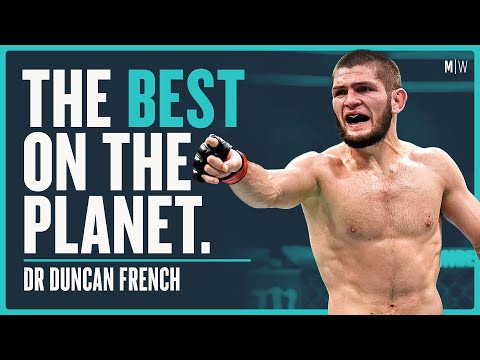
The UFC's Cutting-Edge Strength Training - Dr Duncan French
Dr Duncan French (guest), Chris Williamson (host), Narrator, Narrator
In this episode of Modern Wisdom, featuring Dr Duncan French and Chris Williamson, The UFC's Cutting-Edge Strength Training - Dr Duncan French explores inside UFC’s Performance Revolution: Data, Mindset, and Relentless Grit Dr. Duncan French, VP of Performance at the UFC Performance Institute, explains how modern sports science, data, and psychology are transforming MMA while still respecting its martial arts roots and culture.
Inside UFC’s Performance Revolution: Data, Mindset, and Relentless Grit
Dr. Duncan French, VP of Performance at the UFC Performance Institute, explains how modern sports science, data, and psychology are transforming MMA while still respecting its martial arts roots and culture.
He details the unique physical and mental demands of UFC athletes, the complexity of training for multiple disciplines, and how the PI raises the global “waterline” of fighter preparation without taking sides.
Topics include load management, injury prevention, weight cutting, tech like instrumented mouthguards and VR, potential neuroprotective use of psychedelics, and the central role of mindfulness and mental toughness.
French also covers practical strength-training and hypertrophy principles, nutrient timing, and what differentiates truly elite, long‑lasting UFC champions from fighters who simply make it onto the roster.
Key Takeaways
Elite MMA success requires simultaneous mastery of body, skill, and mind.
French frames fighters as martial artists, fighters, and athletes, each with distinct demands—technical skill, psychological resilience, and physical qualities all need to be developed in parallel.
Get the full analysis with uListen AI
Raising the sport’s baseline comes from systems, not just star coaching.
The Performance Institute measures success via global KPIs like safer weight cuts, fewer preventable injuries, and better training methods across the roster, rather than wins and losses of individual fighters.
Get the full analysis with uListen AI
Data and tech are reshaping combat sports, but context is everything.
Tools like GPS-style mouthguards, impact sensors, and future VR/AR with haptics can quantify load and head trauma, but MMA still lacks fully robust competition data, so training loads are partially extrapolated from sparring.
Get the full analysis with uListen AI
Mental skills and mindfulness are critical differentiators on fight day.
Performance psychology at the PI focuses on helping fighters block out “white noise,” stay present, and execute their game plan despite trash talk, public pressure, and severe consequences of mistakes.
Get the full analysis with uListen AI
For hypertrophy, volume, muscle damage, metabolic stress, and protein timing matter most.
French emphasizes sufficient weekly volume (roughly 12–30 sets per muscle), tempo/eccentric work, metabolically stressful sets (e. ...
Get the full analysis with uListen AI
Intensity and structure of strength work influence hormonal responses and adaptations.
Protocols like high-volume, relatively heavy compound lifts with short rests (e. ...
Get the full analysis with uListen AI
The best fighters aren’t just the hardest workers—they’re the most consistently available workers.
French argues that what separates champions is the ability to train at a very high technical level day after day without breaking down, accumulating far more high-quality skill work over years than their peers.
Get the full analysis with uListen AI
Notable Quotes
“MMA is 90% mental, apart from the 60% that's physical.”
— Dr. Duncan French
“These guys will do a three-hour, fifty-five-minute grappling match—the warrior spirit will take them through that.”
— Dr. Duncan French
“If you’re in the UFC, you’re not training harder than anybody else. Everybody trains hard. The difference at the top is who can get back on the mats every single day.”
— Dr. Duncan French
“You have to remove the white noise and pursue the signal of your mindfulness of being present in the moment.”
— Dr. Duncan French
“It’s truly a decathlon of combat sport… there are so many variables that go into success.”
— Dr. Duncan French
Questions Answered in This Episode
How far can emerging tech like VR, haptics, and instrumented mouthguards realistically go in making MMA safer without diluting the essence of fighting?
Dr. ...
Get the full analysis with uListen AI
What specific psychological practices (e.g., routines, exercises) do top UFC athletes use to stay present under extreme pressure, and how could non-athletes adopt them?
He details the unique physical and mental demands of UFC athletes, the complexity of training for multiple disciplines, and how the PI raises the global “waterline” of fighter preparation without taking sides.
Get the full analysis with uListen AI
Where is the ethical line between optimizing performance and overexposing fighters to risk, given the incentives of promotion, popularity, and pay?
Topics include load management, injury prevention, weight cutting, tech like instrumented mouthguards and VR, potential neuroprotective use of psychedelics, and the central role of mindfulness and mental toughness.
Get the full analysis with uListen AI
As more fighters grow up as ‘pure’ mixed martial artists instead of specialists, how do you expect the style and strategy of UFC fights to change?
French also covers practical strength-training and hypertrophy principles, nutrient timing, and what differentiates truly elite, long‑lasting UFC champions from fighters who simply make it onto the roster.
Get the full analysis with uListen AI
How might potential neuroprotective interventions like psychedelics or new rules alter the long-term health landscape of combat sports athletes?
Get the full analysis with uListen AI
Transcript Preview
... being able to internalize, what is your game plan? You know that you've done the work, you know that you're technically and tactically proficient in what you need to do, so how do you remove the white noise and pursue the signal of your mindfulness of being present in the moment? MMA is 90% mental, apart from the 60% that's physical.
Dr. Duncan French, welcome to the show.
Hi, mate. How are you doing? Good to hear from you.
I know. It's nice to hear a familiar Northeastern voice while we're over in-
I know.
... the States.
I know, right? It's, uh, there's nothing like home when it comes down to it. Actually-
Harrogate for you, right?
Originally North Yorkshire, yeah, Harrogate, Knaresborough region, and then, uh, moved to Newcastle for college and, uh, I kind of call Newcastle home now.
Wow.
I'm an ados- adopted Geordie, let's say.
Okay. Yeah, yeah, yeah. Well, the number of times that I get accused of being Australian while I'm over here, I was at a big meetup yesterday and I got accused of being Australian more times than I got accused of being British. I'm not sure if that's a good thing or not.
Oh, mate, I get, uh, I, I mean, what? I'm in my fifth year, well, four years for my PhD, and then now five years since I came back to the States. I get everything from South African, to Australian, to New Zealand, to Arkansas, you name it. (laughs)
Wow. So you've been working with, is it over 30 professional or Olympic sports since you started?
Yeah, I think 37, I think, was the last time I counted. So yeah, been, uh, been blessed. It's been good. Lots of, uh, lots of variety and lots of opportunity. But yeah, whether it's, you know, pro sport or the Olympic movement, um, I've, uh, I've been around the block, let's say. (laughs)
And it was three full Olympic cycles with Team GB as well?
Yeah, through the English Institute of Sport, which is obviously the high performance service provider to British Olympic programs, um, as well as Commonwealth programs like netball and things like that. But, um, I was a, a strength and conditioning coach and, you know, sports scientist through the, through the, um, the English Institute for about 14 years. So, as you say, a variety of different, um, sporting backgrounds. So it's been, it's been cool, cool ride right to now.
What's the common thread between all of those? Have you moved into specialties since you've been there? Was it always strength and conditioning? Was it performance?
Yeah, no, I mean, I've always been a, a strength and conditioning physical preparation coach. You know, that's, that's kind of what I would call my, you know, my, my primary area of expertise. Um, you know, with, with some sport science weaved into there. You know, I, I, uh, my degrees and things, PhDs are in sport science, um, but I certainly went round the coaching route, um, and then, uh, could call upon my strength and conditioning and, uh, my sport science throughout that. So, um, yeah, it's, uh, let's say many, many hats, many, uh, many strings to the bow when you need it, you know, that's kind of part of the deal.
Install uListen to search the full transcript and get AI-powered insights
Get Full TranscriptGet more from every podcast
AI summaries, searchable transcripts, and fact-checking. Free forever.
Add to Chrome