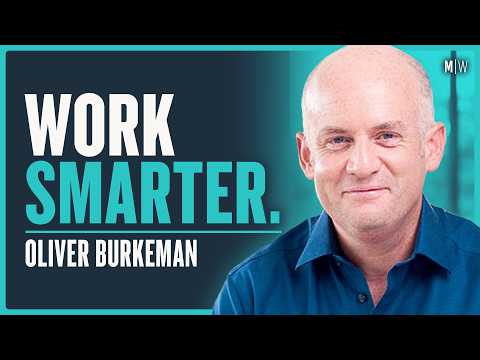
The Savage Irony Of Trying To Be Productive - Oliver Burkeman
Chris Williamson (host), Oliver Burkeman (guest), Narrator
In this episode of Modern Wisdom, featuring Chris Williamson and Oliver Burkeman, The Savage Irony Of Trying To Be Productive - Oliver Burkeman explores oliver Burkeman Explains Why Embracing Limits Makes Life More Productive Oliver Burkeman and Chris Williamson discuss “imperfectionism”: the idea that accepting our finite time, energy, and attention is the real gateway to a meaningful, productive life. They argue that much productivity culture and perfectionism are disguised avoidance strategies to escape our mortality, vulnerability, and lack of control over the future. The conversation explores insecure overachievement, information overload, the futility of trying to “sort life out,” and the irony of turning even leisure, self-help, and habit-building into anxious projects. Burkeman offers a counter-approach built on accepting impossibility, choosing a few priorities, being kinder to ourselves, and grounding productivity in completion, daily-ish consistency, and a few hours of focused work.
Oliver Burkeman Explains Why Embracing Limits Makes Life More Productive
Oliver Burkeman and Chris Williamson discuss “imperfectionism”: the idea that accepting our finite time, energy, and attention is the real gateway to a meaningful, productive life. They argue that much productivity culture and perfectionism are disguised avoidance strategies to escape our mortality, vulnerability, and lack of control over the future. The conversation explores insecure overachievement, information overload, the futility of trying to “sort life out,” and the irony of turning even leisure, self-help, and habit-building into anxious projects. Burkeman offers a counter-approach built on accepting impossibility, choosing a few priorities, being kinder to ourselves, and grounding productivity in completion, daily-ish consistency, and a few hours of focused work.
Key Takeaways
Accept your limitations instead of fighting them endlessly.
Burkeman’s ‘imperfectionism’ reframes finite time, energy, and talent as the starting point for a good life, not flaws to be overcome. ...
Get the full analysis with uListen AI
Notice when ‘self-improvement’ is actually avoidance.
Many productivity systems, habit projects, and self-optimization efforts are ways of dodging anxiety about death, uncertainty, and emotional vulnerability. ...
Get the full analysis with uListen AI
You’ll never get to everything—treat that as liberating, not disastrous.
From email to books to business ideas, the inputs are effectively infinite and you are not. ...
Get the full analysis with uListen AI
Don’t make being present or ‘seizing the moment’ another perfection project.
The sense that ‘real life hasn’t started yet’ is nearly universal and often protective; you can’t just flip a switch to live fully in the present. ...
Get the full analysis with uListen AI
Treat yourself at least as kindly as you treat your friends.
Using the ‘reverse golden rule,’ Burkeman suggests you stop speaking to yourself in ways you’d never use on anyone else. ...
Get the full analysis with uListen AI
Productivity tools help—until you expect them to ‘save your soul.’
Methods like GTD, time-blocking, and habits are useful, but they become harmful when you load them with the expectation that they’ll fix your basic sense of inadequacy and finally make life easy. ...
Get the full analysis with uListen AI
Anchor your day in realistic completion and modest, consistent deep work.
Burkeman recommends defining small, concrete ‘deliverables,’ finishing things frequently, and aiming for roughly 3–4 hours of deep work a day at most. ...
Get the full analysis with uListen AI
Notable Quotes
“The world opens up when you realize you’re never going to sort your life out.”
— Oliver Burkeman
“There is something mortally hilarious about being a finite human with infinite tasks to do.”
— Oliver Burkeman
“It’s almost religious: I thought the new system was going to save my soul.”
— Oliver Burkeman
“Insecure overachievers achieve a lot, but they don’t have fun while they’re doing it.”
— Chris Williamson
“Reality doesn’t need you to operate it.”
— Oliver Burkeman (quoting Michael Singer)
Questions Answered in This Episode
In my own life, where am I postponing ‘real life’ until some vague future moment when things are finally ‘sorted’?
Oliver Burkeman and Chris Williamson discuss “imperfectionism”: the idea that accepting our finite time, energy, and attention is the real gateway to a meaningful, productive life. ...
Get the full analysis with uListen AI
Which of my productivity habits or systems are genuinely helping me live now, and which are elaborate ways of avoiding difficult feelings or realities?
Get the full analysis with uListen AI
If I fully accepted that I will never get to all my tasks, opportunities, and reading, what few things would I choose to prioritize this month?
Get the full analysis with uListen AI
How would my day-to-day experience change if I spoke to myself only in ways I’d consider acceptable to use with a close friend?
Get the full analysis with uListen AI
What might a ‘daily-ish’ version of my most important practice (e.g., writing, exercise, meditation) look like, and how can I make it forgiving rather than fragile?
Get the full analysis with uListen AI
Transcript Preview
What is imperfectionism?
(laughs) This is my proprietary term, 'cause I think you gotta have a proprietary term for a, a sort of umbrella term for, uh, this whole approach that has sort of been taking... getting clearer and clearer in my mind over the last few years. And I guess it is, the simplest way to talk about it is, understanding your built-in limitations as a human, your finite time and finite talents, finite energy, finite attention, as, um, not things you have to spend your whole life struggling to do away with. But actually like the portal to a sort of energized and accomplished and interesting life. So it's, it's about embracing limitations of all kinds including, you know, the fact that we can't ever produce anything perfectly.
I was gonna say, what's an alternative perspective? Um, um, what do people... What's the opposite of imperfectionism railing against, that can't be beaten?
Well, obviously perfectionism is one way of putting it, but I think the... There's a... The problem with that is that people think about perfectionism as meaning something very narrow which is like, you know, "I'm so obsessed with producing perfect work or something-"
High standards.
But... Right, right. And I really wanna say that that's one example of something broader which I think is everywhere in, like, productivity advice and personal development culture and all the rest of it, which is that what looks like an attempt to, like, improve and do better and reach new heights, is very often just a kind of psychological avoidance. A way of, a way of, um, a, a way of helping you not have to think about the fact that time is short. That good relationships and an interesting life involve emotional vulnerability. And, uh, you know, that, um, that you can't control the future and, and it's generally a stress-inducing challenge to try. So, you know, all these different ways in which we, we think we're sort of getting more control over our lives, I think very often what we're doing is enabling this avoidance of, of, uh, really confronting what it actually is to key alive.
There is something sort of, uh, uh, mortally hilarious about being a finite human with infinite tasks to do. You know, in my (laughs) ... Like, the, the 21st century memento mori is me thinking about the fact that one day I'll be dead, but my email address will still continue to receive emails.
(laughs)
(laughs)
So true.
(laughs)
Yeah, it's, it's terrifying. I mean, it's terrifying at first. I guess that, you know, the email example is so powerful because it is just the obvious example of an incoming supply of things that is, to all intents and purposes, infinite. Um, and we're surrounded by these, right? There is an infinite, effectively infinite number of things that would be useful and interesting to read. Of places that would be interesting to go. Of, uh, hobbies or business ventures or anything that would be interesting to, to launch and get, and get involved in. Money you could earn, right? None of it has an end point. But we have end points. (laughs) Uh, and, and so I think... And of course we've got... I- it's not just the, the supplies are infinite but the, uh... We have minds that are capable of conceiving of the infinite and of more that, or at least of, of much more than what we could do. So like, you know, you can have 20 completely incompatible dreams for the next five years of your life, there's no problem with that at all. The problem is when you try to bring them into, in, into reality. So I think that's just the thing that I'm always coming back and back around to from a million different angles, it's just like, what does it mean to actually drop into that reality that you're gonna have to choose? And that, uh, most of the things you never get around to doing are not gonna have been, like, tedious second tier things that you should have abandoned. They're gonna have been good things as well but you just didn't get to do them. And arguing that this is good news and really empowering and really in favor of productivity-
Install uListen to search the full transcript and get AI-powered insights
Get Full TranscriptGet more from every podcast
AI summaries, searchable transcripts, and fact-checking. Free forever.
Add to Chrome