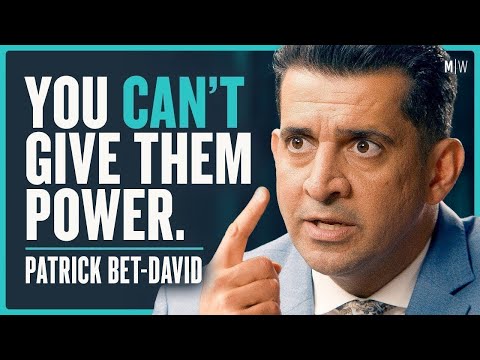
How To Succeed When The System Is Rigged Against You - Patrick Bet-David (4K)
Chris Williamson (host), Patrick Bet-David (guest), Narrator, Narrator
In this episode of Modern Wisdom, featuring Chris Williamson and Patrick Bet-David, How To Succeed When The System Is Rigged Against You - Patrick Bet-David (4K) explores how Enemies, Pain, And Power Fuel Extraordinary Success In Life Patrick Bet-David and Chris Williamson explore why having "enemies" and targeted adversity can be a powerful, if dangerous, motivator for high achievers. They distinguish between healthy, chosen enemies that fuel growth versus toxic resentments that corrode character and relationships.
How Enemies, Pain, And Power Fuel Extraordinary Success In Life
Patrick Bet-David and Chris Williamson explore why having "enemies" and targeted adversity can be a powerful, if dangerous, motivator for high achievers. They distinguish between healthy, chosen enemies that fuel growth versus toxic resentments that corrode character and relationships.
The conversation ranges across historical and modern examples—from Churchill, Musk, Jobs, Dana White, and Elon, to Ben Shapiro and Daily Wire—to illustrate how great performers harness pain, paranoia, and competition while evolving their motivations over time.
They also examine cultural conflicts (feminism, Disney, Daily Wire’s culture war), declining trust in institutions, parenting, immigration, generational wealth, and what truly matters: standards, character, and choosing both enemies and allies wisely.
Underlying it all is a tension between ambition and peace: how to pursue dominance and impact without being destroyed by the very fuel that made you successful.
Key Takeaways
Enemies are tools—if you choose them deliberately.
Bet-David argues everyone has enemies, but the key is to select enemies that pull a better version of you out, rather than petty grudges that trap you in victimhood or entitlement. ...
Get the full analysis with uListen AI
Elite performers are driven by a specific psychological cocktail.
The pattern he sees in top achievers: unconditional love from at least one person, deep pain from another loved one they could never win over, and a set of carefully chosen enemies. ...
Get the full analysis with uListen AI
Competitive fuel based on hate is potent but time-limited.
Both men note that using anger, resentment, and pain can drive massive output—especially in “war-time” phases—but becomes toxic if relied on for decades. ...
Get the full analysis with uListen AI
Competition is logical; enmity is emotional and existential.
Studying competitors is about strategy and market share; enemies live in the emotional domain and can unlock “controlled madness” and extra gears of performance (as with Kobe or Jordan). ...
Get the full analysis with uListen AI
Modern culture often misidentifies its ‘enemy’ and pays dearly.
Bet-David cites feminism that frames men as the enemy and Disney’s ideological pivots as examples of movements and corporations choosing the wrong adversary (e. ...
Get the full analysis with uListen AI
Powerful media and political actors are constrained—and corrupted—by incentives.
Mainstream media’s dependence on pharma ad spend and aging audiences, plus the scripted nature of legacy TV, contrast with the relative freedom and authenticity of podcasters and independent commentators. ...
Get the full analysis with uListen AI
High standards and earned rewards beat unconditional ease.
Through stories on parenting, estate planning, immigrants vs. ...
Get the full analysis with uListen AI
Notable Quotes
“The problem isn’t having enemies; it’s choosing the wrong ones.”
— Patrick Bet-David
“People don’t mind you doing well; they just don’t want you to do better than them.”
— Patrick Bet-David
“Only the paranoid survive, but burden is a hard thing to sell.”
— Patrick Bet-David
“We want the world to love us for who we are, but we usually only love ourselves for what we do.”
— Chris Williamson
“The market is brutal. Form is temporary; class is permanent.”
— Chris Williamson
Questions Answered in This Episode
How can someone practically identify and ‘choose’ an enemy that will elevate them rather than embitter them?
Patrick Bet-David and Chris Williamson explore why having "enemies" and targeted adversity can be a powerful, if dangerous, motivator for high achievers. ...
Get the full analysis with uListen AI
At what point should a high performer consciously transition away from fuel based on resentment or pain, and what should replace it?
The conversation ranges across historical and modern examples—from Churchill, Musk, Jobs, Dana White, and Elon, to Ben Shapiro and Daily Wire—to illustrate how great performers harness pain, paranoia, and competition while evolving their motivations over time.
Get the full analysis with uListen AI
Where is the line between healthy paranoia that protects excellence and unhealthy paranoia that ruins peace of mind?
They also examine cultural conflicts (feminism, Disney, Daily Wire’s culture war), declining trust in institutions, parenting, immigration, generational wealth, and what truly matters: standards, character, and choosing both enemies and allies wisely.
Get the full analysis with uListen AI
Given declining trust in institutions, what responsibilities do large podcasters and creators have when commenting—or refusing to comment—on global crises?
Underlying it all is a tension between ambition and peace: how to pursue dominance and impact without being destroyed by the very fuel that made you successful.
Get the full analysis with uListen AI
How can ambitious parents give their children opportunity without making them soft, and what concrete standards actually work in practice?
Get the full analysis with uListen AI
Transcript Preview
You say that you're useless to the world if you're not competing and you need enemies to drive you. Why?
Um, I think most people who say they don't have enemies, they probably don't want to tell others they have the enemy or they don't want to disclose it. They're great poker players. I don't know a single person that doesn't have an enemy. Uh, everybody does. Uh, we're, we're very good at concealing our insecurities, our emotions, our fears, our wildest desires, our, uh, uh, enemies or comments that rub us the wrong way, that wire us. Uh, we are very good actors, incredible actors, right? Now, if you have a long time of talking to somebody and you kind of watch them closely and the more they talk and then eventually you're going to find some leaks. You're like, "Ooh, I just found one right there. Boom, I found one contradiction right there. Boom, I found one..." And you're like, "Okay, interesting." We all have a little bit of that. But I do think that when you study the people that do something very big, I'm not talking about small, I'm talking really, really big. We're talking about some interesting people today. You and I have somebody we both respect a lot, Robert Greene. His books, you, I, I'm sure you love his books, I love his books. 33 Strategies of War, I couldn't put it down for two years straight. I listened to that book every day in my car straight every day. It was on repeat for two years straight. Why though? Because I innocently got into sales and I had a good time in sales and business after I got out of the military, and I wanted to be a body builder and then I realized I'm 6'4", it's not going to work for body building to win Mr. Olympia because everybody's 5'8", 5'9", 5'10". Maybe 5'11", Ronnie Coleman, but the 6'4" days are behind us. Even Lou Ferrigno didn't win at that height. Arnold did. And then when I got into sales and everybody was a fan, then I started competing, still a little bit a fan, but when I started the insurance company and then I started growing market share really, then a lot of those people that were fans then started undermining. And I said, "Got it. This is how it works. You can't be this naïve. You can't be this innocent." Competition's out there. If you want to kind of go out there and take market share from others and you want to get bigger, you can't expect for people to sit there and like everything you're doing. That's when I realized you got to choose your enemies wisely.
People want you to do well, they just don't want you to do better than them.
Yes. Yes.
Yeah, it's interesting. There's this story of Churchill and he's showing a young MP around the House of Lords in the UK. This is before World War II. You can imagine that they're wandering through these dusty hallways. "Over there's the toilets and over there's where we have a cigar and blah, blah, blah, blah." Anyway, they go into the chamber, they go into the, the House of Lords, right? Uh, the difference, actually the distance between the two front benches is the same distance as a long sword held out at arm's length from both sides, which is a kind of a, a funny vestige of evidently what they were worried about in the Middle Ages and they've just continued to update, but they've never changed the distance of the front benches. Anyway, got this young guy who's probably full of testosterone and, you know, he's finally, he's here with Winston Churchill. They go in and this young MP starts gesticulating at the other side and he keeps referring to them as the enemy. Churchill turns to him and he says, "That's the opposition, dear boy. The enemy's behind you." And I love that story and the reason that I love that story is that it often reminds us that symbolically we believe that the biggest obstacle we have to overcome is out there and many times the call is coming from inside of our own house. I think that the worst enemy that many people have is the voice that's inside of their own head. Now this voice has probably maybe come-
Install uListen to search the full transcript and get AI-powered insights
Get Full TranscriptGet more from every podcast
AI summaries, searchable transcripts, and fact-checking. Free forever.
Add to Chrome