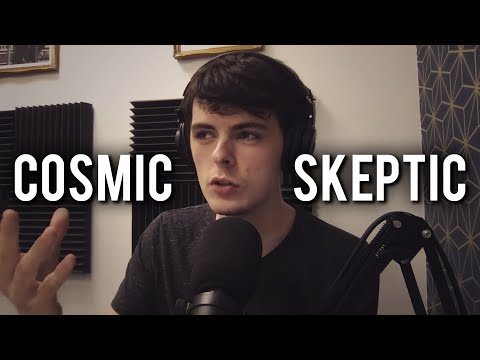
Veganism, Atheism and Morality | Cosmic Skeptic | Modern Wisdom Podcast 103
Alex O'Connor (Cosmic Skeptic) (guest), Chris Williamson (host), Narrator
In this episode of Modern Wisdom, featuring Alex O'Connor (Cosmic Skeptic) and Chris Williamson, Veganism, Atheism and Morality | Cosmic Skeptic | Modern Wisdom Podcast 103 explores cosmic Skeptic Defends Veganism, Secular Morality And Consistent Ethics Alex O’Connor (Cosmic Skeptic) explains how Peter Singer’s work and a single emotional moment with a frightened cat pushed him from ‘meat eater with doubts’ to fully committing to veganism. He frames veganism as a straightforward implication of a suffering-based, secular morality and argues that most people already accept its premises but avoid the logical conclusion.
Cosmic Skeptic Defends Veganism, Secular Morality And Consistent Ethics
Alex O’Connor (Cosmic Skeptic) explains how Peter Singer’s work and a single emotional moment with a frightened cat pushed him from ‘meat eater with doubts’ to fully committing to veganism. He frames veganism as a straightforward implication of a suffering-based, secular morality and argues that most people already accept its premises but avoid the logical conclusion.
A core theme is consistency: if we reject racism, sexism and slavery because they cause unjustifiable suffering, O’Connor maintains we must also reject speciesism and factory farming, especially given the sheer scale of animal suffering. He answers common objections (plants feeling pain, lab-grown meat, animals eating animals) by returning to minimization of suffering as the only relevant moral criterion.
The conversation broadens into how secular societies ground morality without God, whether declining religiosity diminishes virtue, and why people often fill the ‘religion-shaped hole’ with fandoms, diets or causes. O’Connor argues that morality and meaning can be coherently grounded in facts about conscious experience rather than divine command.
He positions himself not as an activist tactician but as a philosophical ‘absolutist’ who wants to supply clear arguments, leaving incremental campaigns (like Meatless Mondays) and emotive activism to others while insisting that, in the long run, animal agriculture will be viewed as a major moral blind spot of our era.
Key Takeaways
If you already think needless suffering is wrong, veganism follows logically.
O’Connor argues most people accept that causing suffering without sufficient justification is immoral and that animals clearly suffer in factory farms; the burden of proof lies on anyone who wants to justify continuing that harm for taste or convenience.
Get the full analysis with uListen AI
Ethical consistency demands we scrutinize speciesism like racism or sexism.
He challenges listeners to identify what trait animals lack that would also justify similar treatment of some humans; if intelligence, self-awareness or social status don’t license enslaving low-IQ humans, they also can’t justify industrial animal exploitation.
Get the full analysis with uListen AI
Minimizing suffering—not abstract ‘sanctity of life’—is the key moral criterion.
O’Connor grounds his ethics purely in pleasure and pain, rejecting appeals to ‘preference’ or ‘life itself’ as independently morally binding; this lets him endorse pain-free lab-grown meat and reject painless killing of humans on broader social-suffering grounds.
Get the full analysis with uListen AI
Even if plants felt pain, veganism would still reduce total suffering.
Since the majority of crops go to feed livestock rather than humans, cutting out animal products would drastically reduce both animal and hypothetical plant suffering, undermining a common ‘gotcha’ objection to veganism.
Get the full analysis with uListen AI
Appealing to animal behavior doesn’t justify human behavior.
Pointing out that lions eat gazelles fails morally for the same reason we don’t copy lions’ infanticide or sexual coercion; animals aren’t moral agents, but humans are, so ‘nature does it’ is not a defensible ethical standard.
Get the full analysis with uListen AI
Partial measures (like Meatless Mondays) reduce suffering but don’t solve the core injustice.
He supports net harm reduction but personally refuses to endorse half-measures as an end-state, likening them to suggesting slave-owners only free slaves on weekends—politically useful perhaps, but morally insufficient if the practice itself is wrong.
Get the full analysis with uListen AI
Secular morality can be coherently grounded without God, despite religious rhetoric.
O’Connor contends that basing ethics on conscious experience and suffering avoids the same grounding problems that divine-command theories face, and that if atheists are drifting morally it’s largely because religion has convinced people they’re ‘nothing without God.’
Get the full analysis with uListen AI
Notable Quotes
“If you’re against racism and sexism, you should probably be against speciesism too.”
— Alex O’Connor (Cosmic Skeptic)
“Fifty billion animals are tortured and killed every year, not for war or some social progress, just because people think they taste nice.”
— Alex O’Connor (Cosmic Skeptic)
“If someone says, ‘Yeah, I accept veganism is the moral thing to do, but I just can’t be arsed,’ that’s the one question I can’t really answer: why be moral?”
— Alex O’Connor (Cosmic Skeptic)
“My moral system is based on rational thought processes, not trying to mirror the animal kingdom.”
— Alex O’Connor (Cosmic Skeptic)
“If people feel a God-shaped hole when they leave religion, it’s only because they’ve been told their whole lives they’re nothing without it.”
— Alex O’Connor (Cosmic Skeptic)
Questions Answered in This Episode
If we accept that suffering is the core moral metric, what concrete thresholds—if any—would justify causing it for human benefit?
Alex O’Connor (Cosmic Skeptic) explains how Peter Singer’s work and a single emotional moment with a frightened cat pushed him from ‘meat eater with doubts’ to fully committing to veganism. ...
Get the full analysis with uListen AI
How far should ethical consistency go in everyday life before moral demands become practically unsustainable for most people?
A core theme is consistency: if we reject racism, sexism and slavery because they cause unjustifiable suffering, O’Connor maintains we must also reject speciesism and factory farming, especially given the sheer scale of animal suffering. ...
Get the full analysis with uListen AI
Can a society realistically achieve large-scale moral changes like ending animal agriculture without first changing its economic and cultural incentives?
The conversation broadens into how secular societies ground morality without God, whether declining religiosity diminishes virtue, and why people often fill the ‘religion-shaped hole’ with fandoms, diets or causes. ...
Get the full analysis with uListen AI
Is a purely suffering-based ethics enough to account for intuitions about rights, justice, and individual autonomy, or is something missing?
He positions himself not as an activist tactician but as a philosophical ‘absolutist’ who wants to supply clear arguments, leaving incremental campaigns (like Meatless Mondays) and emotive activism to others while insisting that, in the long run, animal agriculture will be viewed as a major moral blind spot of our era.
Get the full analysis with uListen AI
If secular communities can provide meaning, cohesion, and moral guidance, what distinct role—if any—remains for traditional religion?
Get the full analysis with uListen AI
Transcript Preview
If I say, like, what is it about an animal, a non-human animal that allows you to kill them and torture them, in fact, and put them through factory farm processes? Like, what- what is the, what is the thing that they have or the thing that they lack that if a human were to have or to lack, you'd be okay with doing it to the human as well? Like, what is it? Is it intelligence? If it's intelligence, then can we throw people with, under a certain IQ into factory farms? Like, probably not. Or maybe it's, maybe it's self-awareness. It's like, well, is a dog self-aware? Probably. Well, well, a pig is just as self-aware as the dog is, so why aren't you this... It's- it's just about consistency, right? If someone turns around and says, "Actually, yeah, I do think it'd be a good idea to throw people with an IQ under a certain amount into factory farms," then I'd be like, "Well, at least you're being consistent."
(wind blowing) I am joined by Alex O'Connor, otherwise known as Cosmic Skeptic. Alex, welcome to the show.
Thank you for having me.
It's a pleasure to have you on. We'll have a lot of your fans tuning in, I'm sure, as well. Uh, been a, a lot of changes recently. We've been talking about booking this appointment in with yourself for a little while, and the topics I've wanted to talk about have moved as the (laughs) as the year's-
Yeah.
... gone on. Um, first thing's first, you've recently become vegan.
That's right, yeah.
Can you tell us the story behind that, please?
Yeah, sure. Uh, well, you say, I mean, you say recently. It's recent in the, in the long scheme of things, but, uh, it- it's been maybe four or five months now. Coming on half a year soon. Um, for- for a very long time I'd been thinking about it, and when you talk about philosophy, and for some reason, atheism, it seems to lend itself, uh, your audience will always kind of say, "What do you think about this?" It, I've always found it very strange. Someone likes what you have to say on one topic and they're desperate to hear on what you have to say on- on Brexit or on veganism or whatever it is. And I've never quite understood that. It's like really enjoying a- a- a footballer's commentary on- on a game or something and say, "Oh, yeah, but what do you think about this political issue?" It's like, well, that's not what I- I- I do, I do philosophy of religion. But people wanted me to talk about veganism, so I did it in the past. And you find yourself kind of jumping through hoops, and if you listen to, um, people like Sam Harris or someone when they're asked about morality, especially because his veganism ... h- his moral, uh, philosophy is based on suffering, someone says, "Why aren't you a vegan?" And he just kind of, he- he just, he answers like a politician, you know. He's like, "Well, we have to, you know, we have to have an honest conversation about the precepts of this stuff." And it's like, man, just- just admit that- that you, you know you should be a vegan.
Install uListen to search the full transcript and get AI-powered insights
Get Full TranscriptGet more from every podcast
AI summaries, searchable transcripts, and fact-checking. Free forever.
Add to Chrome