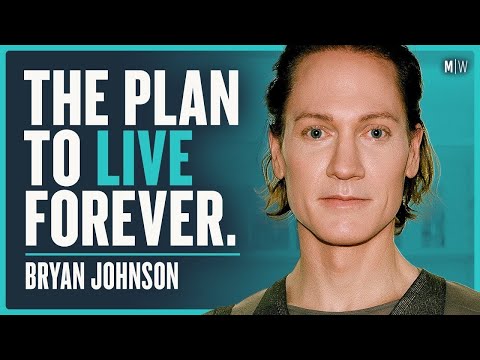
The $2M Plan To Age In Reverse - Bryan Johnson
Bryan Johnson (guest), Chris Williamson (host)
In this episode of Modern Wisdom, featuring Bryan Johnson and Chris Williamson, The $2M Plan To Age In Reverse - Bryan Johnson explores bryan Johnson’s Algorithmic Blueprint To Radically Slow Human Aging Bryan Johnson describes “Blueprint,” a highly measured, algorithm-driven lifestyle protocol that he claims has slowed his biological aging to the pace of a child and left him in near-perfect health at 45.
Bryan Johnson’s Algorithmic Blueprint To Radically Slow Human Aging
Bryan Johnson describes “Blueprint,” a highly measured, algorithm-driven lifestyle protocol that he claims has slowed his biological aging to the pace of a child and left him in near-perfect health at 45.
He argues that algorithms can already manage his body better than his own mind can, framing this as the beginning of a larger shift where human decision-making about health, behavior, and even meaning gives way to data and computation.
Johnson defines self-destructive behavior as anything that increases his speed of aging, and details how he used measurement, strict routines, and psychological reframing (e.g., “Evening Bryan”) to eliminate binge eating and other harmful habits.
Beyond personal longevity, he positions Blueprint as a prototype for large-scale “goal alignment” between humans, AI, and the biosphere, suggesting that our traditional assumptions about autonomy, discipline, and the role of the mind may soon be obsolete.
Key Takeaways
Treat aging rate as the central metric for lifestyle decisions.
Johnson defines anything that speeds up aging as self-destructive and anything that slows it as rejuvenative, simplifying choices around food, sleep, and habits into one binary: does this increase or decrease my speed of aging?
Get the full analysis with uListen AI
Outsource self-regulation to an evidence-based “algorithm,” not mood or willpower.
His Blueprint process is measure → evaluate evidence → implement protocol → repeat; he follows the protocol even when he doesn’t feel like it, arguing that data-driven routines manage his body more reliably than his fluctuating preferences.
Get the full analysis with uListen AI
Name and externalize your most sabotaging “selves” to disarm them.
Johnson beat binge eating by personifying “Evening Bryan,” listing his persuasion tactics, and explicitly revoking his authority; this creates psychological distance between current cravings and long-term goals.
Get the full analysis with uListen AI
Use a single, clear organizing principle to enable real discipline.
Borrowing from examples like Bezos (“Does this improve customer experience? ...
Get the full analysis with uListen AI
Leverage measurement depth to guide training and recovery instead of trends.
He trains about an hour a day (strength, cardio, flexibility) and tunes volume/intensity based on VO2 max, tendons, muscle imaging, body fat, HRV, and DNA methylation, rejecting popular practices like ice baths or sauna when they don’t move his primary endpoint.
Get the full analysis with uListen AI
Recognize that much social conversation spreads unexamined lore, not truth.
Through a hydration thought experiment, Johnson shows how people confidently repeat rules (“eight glasses of water”) without data, arguing that we must distinguish between social bonding talk and genuine truth-seeking.
Get the full analysis with uListen AI
See personal mastery as a prerequisite for broader species-level goal alignment.
He frames his 35 trillion cells as a microcosm of humanity, AI, and the planet: if we can’t align our own internal agents, we’re unlikely to solve global coordination problems like climate stability or safe AI.
Get the full analysis with uListen AI
Notable Quotes
“We’ve built an algorithm that takes better care of me than I can.”
— Bryan Johnson
“If I can measure the 35 trillion cells in my body and an algorithm can better manage entropy than I can, of course I’m going to opt into it and free myself up to do other things.”
— Bryan Johnson
“Anything that increases my speed of aging, I label as self-destructive. Anything that slows my speed of aging is rejuvenative.”
— Bryan Johnson
“I’m not one person, I am many. Evening Bryan showed up at 7 p.m. every night, and I had to revoke his authority.”
— Bryan Johnson
“The only problem we have to solve as a species, really, is goal alignment.”
— Bryan Johnson
Questions Answered in This Episode
If an algorithm demonstrably knows what’s best for your health better than you do, how much autonomy are you truly willing to surrender to it?
Bryan Johnson describes “Blueprint,” a highly measured, algorithm-driven lifestyle protocol that he claims has slowed his biological aging to the pace of a child and left him in near-perfect health at 45.
Get the full analysis with uListen AI
Should slowing your speed of aging ever be subordinated to other life goals like adventure, relationships, or creative risk, and if so, how do you decide those trade-offs?
He argues that algorithms can already manage his body better than his own mind can, framing this as the beginning of a larger shift where human decision-making about health, behavior, and even meaning gives way to data and computation.
Get the full analysis with uListen AI
How might Johnson’s concept of aligning 35 trillion cells scale to aligning eight billion humans, nation-states, and advanced AI systems without crushing individual freedom?
Johnson defines self-destructive behavior as anything that increases his speed of aging, and details how he used measurement, strict routines, and psychological reframing (e. ...
Get the full analysis with uListen AI
Is defining all self-destructive behavior purely by its impact on aging too narrow, or does it provide the clarity people need to escape their worst habits?
Beyond personal longevity, he positions Blueprint as a prototype for large-scale “goal alignment” between humans, AI, and the biosphere, suggesting that our traditional assumptions about autonomy, discipline, and the role of the mind may soon be obsolete.
Get the full analysis with uListen AI
What social and psychological costs might arise if more people adopt strict, algorithmic lifestyles like Blueprint in a culture built around shared indulgence and “normal” self-sabotage?
Get the full analysis with uListen AI
Transcript Preview
My body's aging extremely slowly. I have 50 biomarkers, the things you would normally expect like cholesterol and triglycerides and things like that, that are in the perfect optimal clinical outcome range. I have 100 biomarkers that are less than my chronological age. Several fitness tests where I test out at, as an elite 18 year old. My body runs three degrees Fahrenheit cooler than normal. So, no matter how you're looking at it, whether it's my DNA methylation, my fitness test, my biomarkers, my phenotypic markers, whatever you're looking at, the data says the same thing. I'm in near perfect health. (jet engine roars)
Brian Johnson, welcome to the show.
Thank you for having me.
Do you fear death?
No. I love life.
Is there a distinction between those two?
I- I do not have a ... I- I know what fear feels like, and I don't experience that emotion when contemplating death.
I spent a good bit of time looking at the longevity, uh, Subreddit many, many years ago when David Sinclair first came on the scene. And, um, one of the things that I kind of realized, or I thought I might have realized, was it seemed like a little bit of a rehabilitated denial of death, in a way.
Mm-hmm.
Uh, it seems like there are certain elements of the longevity community that, that do see that. Uh, but based on what I've looked at from what you're doing, it seems like a very enjoyable, fun experiment where you're trying to-
(laughs)
... see how far you can push your body. But I'm trying to work out, you know, is there, deeper down in the recesses, is there something ... Is there a denial of death? Is there a fear from, from what's coming in the future driving you at all?
My, my main source of inspiration is having read hundreds of biographies. I love learning about people in their time and place that were able to work on impossibly hard things. So talent is the ability to hit the target no one else can. Genius hits the target no one else can see. And the majority of us in life, we play the games that society gives us, so that's hitting the target. So currently, you know, it's social media followers and, you know, this and that. Uh, so people like to play games where points can be kept and you can be compared to people and ranked. Uh, genius is a different game. It's trying to find things that don't exist. And you need to have the stamina and fortitude to go out and pave your own path and do things that are not recognized, appreciated, or valued even in your lifetime. And so to me that ... Reading biographies is about people who do that, is they really try to survey all of existence. They are somehow immune to their time and place, and are able to see these things. That's really ... So in my- in my understanding of my reality, I seek to be like those people.
Install uListen to search the full transcript and get AI-powered insights
Get Full TranscriptGet more from every podcast
AI summaries, searchable transcripts, and fact-checking. Free forever.
Add to Chrome