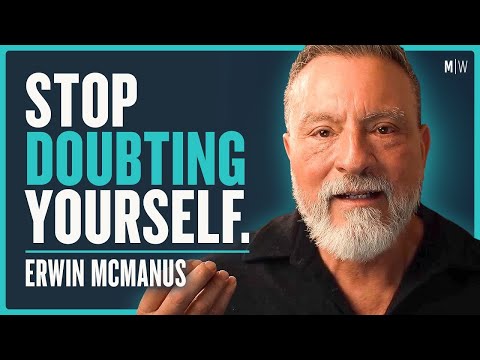
Fear Is Running Your Life. Here's How To Break Free - Erwin McManus
Chris Williamson (host), Erwin McManus (guest), Narrator
In this episode of Modern Wisdom, featuring Chris Williamson and Erwin McManus, Fear Is Running Your Life. Here's How To Break Free - Erwin McManus explores transforming Fear Into Fuel: Erwin McManus On True Inner Freedom Erwin McManus explains how fear once dominated his life and how he consciously turned it into a compass—moving toward what scared him to build courage and impact. He and Chris Williamson explore the psychology of fear, overthinking, depression, and our innate tendency to ruminate on negatives more than positives. McManus connects self-belief and fearlessness with action, purpose, faith, and an unconditional sense of self-worth rather than achievement. The conversation also examines ambition vs. gratitude, the burden and responsibility of talent, and why many outwardly successful people are internally tormented.
Transforming Fear Into Fuel: Erwin McManus On True Inner Freedom
Erwin McManus explains how fear once dominated his life and how he consciously turned it into a compass—moving toward what scared him to build courage and impact. He and Chris Williamson explore the psychology of fear, overthinking, depression, and our innate tendency to ruminate on negatives more than positives. McManus connects self-belief and fearlessness with action, purpose, faith, and an unconditional sense of self-worth rather than achievement. The conversation also examines ambition vs. gratitude, the burden and responsibility of talent, and why many outwardly successful people are internally tormented.
Key Takeaways
Treat fear as a directional signal, not a stop sign.
McManus chose to move directly toward what scared him—roller coasters, dogs, dangerous places—and found that the imagined fear was far worse than reality, gradually earning a reputation for fearlessness despite being deeply fearful by nature.
Get the full analysis with uListen AI
Avoidance strengthens fear; exposure dissolves it.
He notes that if you want to be permanently paralyzed, stay away from what you fear, because the anticipation is more powerful than the experience. ...
Get the full analysis with uListen AI
Action is the antidote to anxiety, overthinking, and depression.
Both speakers emphasize that forward movement—any step toward your ideal self or goal—quickly changes internal state, breaks rumination loops, and replaces helplessness with exhilaration, even before results appear.
Get the full analysis with uListen AI
Your freedom lies on the other side of your fears.
Fear quietly sets the boundaries of your life: fear of heights keeps you low, fear of people keeps you alone. ...
Get the full analysis with uListen AI
Positive states require work; negativity is the default drift.
McManus argues that if you do nothing, you become the worst version of yourself—sliding into anxiety, bitterness, and loss of integrity—because positive emotions and virtues dissipate quickly while negative ones cling and compound.
Get the full analysis with uListen AI
Self-worth should be a starting point, not a prize for performance.
He distinguishes loving yourself from being in love with yourself, and insists that a healthy life comes from accepting intrinsic worth (for him, grounded in God’s unconditional love) and acting from it, rather than trying to earn value through success.
Get the full analysis with uListen AI
Ambition and gratitude are allies, not enemies.
Contrary to the idea that ambition undermines humility or contentment, McManus frames true humility as knowing your power and using it, and true gratitude as fueling generative ambition that serves others rather than just feeding ego.
Get the full analysis with uListen AI
Notable Quotes
“Your freedom is on the other side of your fear.”
— Erwin McManus
“When you live a life of fear, you're moving toward safety and security, but you make every decision that will extract from you life.”
— Erwin McManus
“We suffer more in imagination than reality… all my worries were a waste of time.”
— Chris Williamson
“If I do nothing, I become the worst version of me.”
— Erwin McManus
“It's so much better to accept your worth and to move from your worth, rather than trying to move toward your worth.”
— Erwin McManus
Questions Answered in This Episode
Where in my life am I mistaking fear for safety and allowing it to quietly set the limits on my freedom?
Erwin McManus explains how fear once dominated his life and how he consciously turned it into a compass—moving toward what scared him to build courage and impact. ...
Get the full analysis with uListen AI
What is one specific fear I could deliberately move toward this week to begin shrinking its power over me?
Get the full analysis with uListen AI
Am I trying to earn my self-worth through achievement, and how would my decisions change if I believed my value was unconditional?
Get the full analysis with uListen AI
How can I harness my tendency to overthink by turning it into structured planning and solution-finding instead of paralysis?
Get the full analysis with uListen AI
In what ways could I better align my ambition with service to others so that success feels meaningful rather than hollow?
Get the full analysis with uListen AI
Transcript Preview
You said you've limited your impact in the world because of a lack of self-belief. Tell me the story then.
Mm. Well, y- you know, I think when I was young, I had the view that some people were just naturally heroic, and some people were just naturally born cowards, and I fell into that category. Uh, you know, if I look back when I was young, I was afraid of everything, and some of it was experiential. Uh, you know, my... W- we got attacked by a dog, so I was afraid by... uh, you know, I was terrified by dogs all my life. I- we- I had a seatbelt break on a roller coaster and almost flew off the, the, uh, the roller coaster, and so I was afraid of, of roller coasters or anything fast. And, and I began realizing that I began accumulating fear. And the problem with fear is that it doesn't stay in a category. It, it, it permeates throughout your, your whole soul, your psychological well-being. And I began realizing that I was more defined by fear than I was by almost any other emotion, and I... And I didn't really have a strategy. We didn't have what we have today, so many ways of accessing insight and ways of understanding mental structures and mind shifts. But, so I had to make my own decision. I had to decide how would I affect this, how would I change this? And so I developed a strategy to use fear as my, um, my life compass. Whenever I felt fear, I just moved toward it. Whenever I felt afraid of something, I actually moved more aggressively in that direction, and what I discovered by the time I'd finished my 20s is that, uh, there were actually international magazines and documentaries that were flying in to see what I was doing because they felt I was fearless. And I thought, "This is so ironic that I was being defined as someone who was fearless." And in fact my, my favorite superhero is Daredevil, the man without fear, and it was because I iconically longed to become that person because I knew how my whole life was captured by fear. And so I learned how to take negative material and turn it into a positive asset, and I think that, for me, is the key, is that I- I've lived a pretty adventurous life, traveled to nearly 100 countries, gone to some most dangerous places in the world, you know, walked the streets of Damascus, you know, dropped into, uh, Pakistan and, and, uh, throughout the Middle East, different parts of the world that, uh, very few people ever go to and very few people ever survive. And one of the most interesting things for me is that in those moments, I, I didn't feel captured by fear at all, and a huge part of that was because I'd learned how to take this emotion, this experience called fear, turned it into a positive fuel and used it as a way to motivate me to move forward in life.
Install uListen to search the full transcript and get AI-powered insights
Get Full TranscriptGet more from every podcast
AI summaries, searchable transcripts, and fact-checking. Free forever.
Add to Chrome