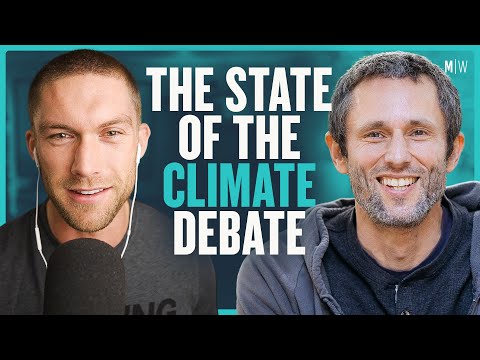
Why Is The Climate Debate Such A Mess? - Charles Eisenstein | Modern Wisdom Podcast 382
Charles Eisenstein (guest), Chris Williamson (host)
In this episode of Modern Wisdom, featuring Charles Eisenstein and Chris Williamson, Why Is The Climate Debate Such A Mess? - Charles Eisenstein | Modern Wisdom Podcast 382 explores climate Debate Chaos: Beyond Carbon, Fear, and Fundamentalism Toward Humility Chris Williamson and Charles Eisenstein explore why the climate debate has become so polarized, tribal, and emotionally charged that many people no longer know what to believe. Eisenstein argues that both climate alarmists and skeptics share a narrow, carbon-obsessed frame and miss the deeper issue: treating Earth as a living, sacred system whose organs—forests, soils, waters, species—are being destroyed. They link this dysfunction to a wider crisis of meaning, the collapse of shared narratives like religion and blind faith in science, and the human need for belonging that drives people into rigid ideological camps. The conversation concludes with a call for a new way of speaking and acting—grounded in love of life, humility, and genuine listening—rather than fear, shame, and the need to be on the “right” side.
Climate Debate Chaos: Beyond Carbon, Fear, and Fundamentalism Toward Humility
Chris Williamson and Charles Eisenstein explore why the climate debate has become so polarized, tribal, and emotionally charged that many people no longer know what to believe. Eisenstein argues that both climate alarmists and skeptics share a narrow, carbon-obsessed frame and miss the deeper issue: treating Earth as a living, sacred system whose organs—forests, soils, waters, species—are being destroyed. They link this dysfunction to a wider crisis of meaning, the collapse of shared narratives like religion and blind faith in science, and the human need for belonging that drives people into rigid ideological camps. The conversation concludes with a call for a new way of speaking and acting—grounded in love of life, humility, and genuine listening—rather than fear, shame, and the need to be on the “right” side.
Key Takeaways
Broaden the environmental focus beyond carbon emissions.
Eisenstein argues that even if carbon emissions dropped to zero, ongoing destruction of forests, soils, wetlands, oceans, and species would still push Earth toward collapse; environmental priorities should center on preserving and restoring living ecosystems, not just CO2 metrics.
Get the full analysis with uListen AI
Recognize how fear and moral superiority sabotage climate advocacy.
When activists frame their mission as “saving the world” and shame others as villains, they radiate self-righteousness, trigger defensiveness, and push people away from the cause instead of inspiring genuine, voluntary support.
Get the full analysis with uListen AI
Treat the climate clash as a symptom of a deeper meaning crisis.
The intensity of the debate reflects the collapse of old unifying stories—religion, faith in progress, and unquestioned trust in science—leaving people grasping for certainty and identity in rigid ideological positions, whether alarmist or skeptical.
Get the full analysis with uListen AI
Acknowledge that most beliefs are socially convenient, not purely rational.
People usually adopt views that fit their community, self-image, and need to feel like a ‘good person,’ rather than conclusions from neutral data analysis; you cannot reason someone out of a belief they never reasoned themselves into.
Get the full analysis with uListen AI
Cultivate comfort with uncertainty instead of demanding totalizing explanations.
Both “CO2 explains everything” and “it’s all a hoax” are forms of fundamentalism; Eisenstein suggests accepting that some official narratives are true, some false, and many ambiguous, and learning to live and act responsibly without perfect certainty.
Get the full analysis with uListen AI
Reframe environmentalism around love of life, not self-interest or apocalypse.
He advocates returning to an ethic of caring for whales, forests, and local places because they are beautiful and alive, not only because they serve human survival or economic calculations; this love-based motivation is more stable and less polarizing.
Get the full analysis with uListen AI
Change how we talk: assume others care and seek common purpose.
Approaching even an oil executive with the sincere belief that they, at some level, care about life creates the possibility of trust and real conversation, unlike treating them as enemies to be defeated with ‘better facts’ and public shaming.
Get the full analysis with uListen AI
Notable Quotes
“When you think that you are saving the world, you become a fundamentalist, because that's the most important thing and it's worth sacrificing everything else.”
— Charles Eisenstein
“If we continue to cut down the forests, overfish the oceans, develop the wetlands, drain the swamps, destroy the soil, poison the water, then it doesn't matter if we cut emissions to zero because Earth will still die a death of a million cuts.”
— Charles Eisenstein
“Environmentalism fundamentally has to be motivated by love. And love of what? Love of life. Love of this Earth.”
— Charles Eisenstein
“You cannot reason somebody out of a belief that they didn't reason themselves into to begin with.”
— Charles Eisenstein
“The world isn't right and wrong anymore; it's in-groups and out-groups all the way down.”
— Chris Williamson
Questions Answered in This Episode
If we moved away from a carbon-centric lens, how would climate policy, activism, and funding priorities concretely change over the next decade?
Chris Williamson and Charles Eisenstein explore why the climate debate has become so polarized, tribal, and emotionally charged that many people no longer know what to believe. ...
Get the full analysis with uListen AI
What practical methods can individuals and institutions use to foster comfort with uncertainty while still making urgent environmental decisions?
Get the full analysis with uListen AI
How can media and educators present climate science in ways that reduce tribalism and moral shaming rather than inflame it?
Get the full analysis with uListen AI
What would a love-based, ecosystem-centered environmental movement look like in cities and everyday life, not just in pristine wilderness?
Get the full analysis with uListen AI
Given that belonging strongly shapes belief, how can we create communities where changing your mind about climate or politics is socially safe rather than punished?
Get the full analysis with uListen AI
Transcript Preview
When you think that you are saving the world, you become a fundamentalist, because that's the most important thing and it's worth sacrificing everything else. People who adopt that, okay, we're saving the world. You, because you're not with us, you are a threat to the world, to the planet itself. So people who believe that, they emanate this stink of self-righteousness that just turns other people off. (whoosh)
Charles Eisenstein, welcome to the show.
Happy to be here, Chris.
Right. So I wanted to get you on because recently I had a discussion around climate with Patrick Moore, who is the ex-president of Greenpeace. And as a part of that, it- it- it really got me thinking about the state of the climate debate at the moment, seeing the way that the comments kicked off, seeing how it makes people sort of very viscerally involved. And what it kind of taught me was the climate debate is mostly fucked. Like, it's mostly just a mess. And I think that it's obvious a lot of people have tied their colors to particular flagpoles, that this is something which is very, very tribal in a way that I don't think climate should be. And obviously I've seen this, right? I've watched people get crazy about climate and glue their breasts to the street and block down motorways in the UK and throw pig's blood on people coming out of Canada Goose stores. But I'd never been, uh, as close to the conversation as I have been with this and I wanted to get someone on. I mean, even this one. So I tweeted out saying, "I want to get an impartial climate scientist on. Any suggestions?" Most of the suggestions from people were, "Impartial climate scientists don't exist, no one that does that." I- someone said that, "By using the word impartial, you're already adding... y- y- you're already trying to put some sort of a spin on it. We should just be bothered about the data." I'm like, "Hang on a second. Like, that's what impartial means." Like, I'm... so-
Yeah. But if- if- if you call it impartial, then you're going to get criticized for, uh, uh, suggesting that there are even two viable sides to be had.
Correct. Yes. Yeah, yeah, yeah, exactly.
Which is (overlapping dialogue)
That there's some sort of narrative and counter-narrative, which anyone that can't see that there is... so I was just like, "Look, I need to get somebody on that I can just thrash this out with and can kind of help me understand the state of the climate debate at the moment." So, um-
Yeah.
... yeah, give me a hand.
Yep. Well, what I'm going to say is true in pretty much any polarized debate, which is that the key to unlocking it lies in the questions neither side is asking and the secret assumptions that both sides share. So they get stuck in a debate that is defined by the terms of the debate and- and not what they're not looking at. So in the term... in- in the case of climate, you have one side that says, uh, "Because of, uh, carbon emissions and greenhouse gas emissions, we're at the... at or past multiple tipping points that are going to cause runaway global warming and the end of civilization as we know it, or worse." That's what one side essentially says. And there's some that are more alarmist than others. And the other side basically says, "No, uh, carbon dioxide really isn't a problem. The warming, if there is any, it's not runaway and there's nothing to worry about as far as the environment goes because global warming's not an issue." Okay. What both sides agree on is that the conversation, the primary environmental conversation is about carbon dioxide and greenhouse gases. So I wrote a book about this topic, uh, called Climate: A New Story. And what I came to in the research and in the- the meditation and in the, uh, whatever legal and illegal investigations I did into the nature of life, um, what I came to is that the planet Earth is alive. Its organs are things like soil, water, uh, forests, wetlands, uh, species, fish, whales. Every ecosystem, every species is an organ of a living being. Therefore, if we continue to cut down the forests, overfish the oceans, develop the wetlands, drain the swamps, destroy the soil, et cetera, et cetera, poison the water, then it doesn't matter if we cut emissions to zero because Earth will still die a death of a million cuts. Because it would be like if you had... like, suppose you had a runaway temperature and it was because your organs are all getting eaten alive by a... some... you know, by a flesh-eating bacteria and you're like, "Oh, man, temperature's rising. Better take some, you know, medicine to reduce my temperature." It's like, no, your- your organs are- are being destroyed. So what I came to is that where our attention as environmentalists needs to go is to the- the sacred living nature of this planet and to devote our care into protecting and healing all that's been damaged, which is a completely different emphasis than the standard narrative of climate change. And I could say way more about it, but I don't want to, like, you know, just talk for a whole hour. So maybe it's a starting point.
Install uListen to search the full transcript and get AI-powered insights
Get Full TranscriptGet more from every podcast
AI summaries, searchable transcripts, and fact-checking. Free forever.
Add to Chrome