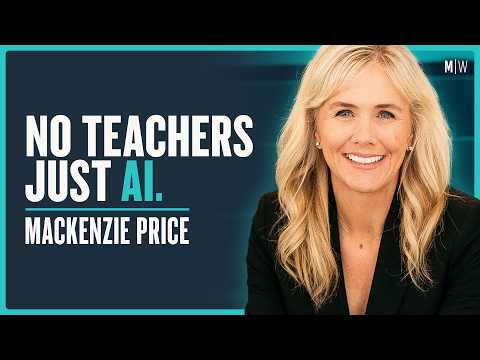
Alpha School: A New Approach To Education - MacKenzie Price
Chris Williamson (host), MacKenzie Price (guest)
In this episode of Modern Wisdom, featuring Chris Williamson and MacKenzie Price, Alpha School: A New Approach To Education - MacKenzie Price explores aI-Powered Alpha School Reimagines Education Beyond Traditional Classrooms And Grades MacKenzie Price argues that the traditional teacher-in-front, time-based classroom model is fundamentally broken—inefficient academically, demotivating for students, and unsustainable for teachers.
AI-Powered Alpha School Reimagines Education Beyond Traditional Classrooms And Grades
MacKenzie Price argues that the traditional teacher-in-front, time-based classroom model is fundamentally broken—inefficient academically, demotivating for students, and unsustainable for teachers.
She describes Alpha School’s alternative: AI-driven, one-to-one mastery learning for core academics in about two hours each morning, followed by afternoons devoted to project-based life skills, entrepreneurship, physical challenges, and leadership.
In this model, teachers become high-paid coaches and mentors focused on motivation, mindset, and accountability while AI systems handle personalization, pacing, and diagnostics.
Early results show Alpha students testing in the top 1% nationally, excelling on standardized exams and in college, and—crucially—reporting that they love school, often preferring it to vacation.
Key Takeaways
Replace one-size-fits-all lectures with mastery-based, personalized learning.
Traditional classrooms advance everyone at the same pace, leaving advanced students bored and struggling students lost. ...
Get the full analysis with uListen AI
Treat student motivation as the primary driver of learning outcomes.
Price claims only about 10% of learning effectiveness is instruction quality and 90% is motivation. ...
Get the full analysis with uListen AI
Use AI to handle personalization so humans can focus on coaching.
At Alpha, AI builds individualized lesson plans, monitors accuracy and pace, and routes kids to the right tools, while teachers focus on emotional support, high expectations, growth mindset, and understanding each student’s “why.”
Get the full analysis with uListen AI
Condense academics to free time for high-impact life skills.
By compressing core subjects into roughly two focused hours, Alpha uses the rest of the day for projects that build grit, public speaking, entrepreneurship, financial literacy, collaboration, and real-world problem-solving.
Get the full analysis with uListen AI
Redefine assessment to include ‘tests to pass’ for life skills.
Beyond standardized exams and SATs, Alpha designs concrete performance tests—like a triathlon of solving a Rubik’s Cube, juggling, and running a mile—to verify students have actually built grit and other non-academic capacities.
Get the full analysis with uListen AI
Elevate teaching by narrowing scope and raising compensation.
Alpha pays teachers six-figure salaries and narrows their job to what only humans can do—relationship-building and coaching—countering burnout and attracting higher-caliber educators compared to the overburdened traditional model.
Get the full analysis with uListen AI
Shift kids from passive consumption to active creation with technology.
Instead of merely limiting screen time, Alpha channels it into building products, audiences, and tools (e. ...
Get the full analysis with uListen AI
Notable Quotes
“Teachers have been given a bucket with holes in it and told to empty the ocean.”
— MacKenzie Price
“Ninety percent of what creates a great learner is motivation.”
— MacKenzie Price
“There’s never been a more exciting time to be a five-year-old than right now.”
— MacKenzie Price
“You can really look at four years of high school as basically a waste of time for average kids.”
— MacKenzie Price
“Kids should love school. If your kids don’t love school, something’s got to change.”
— MacKenzie Price
Questions Answered in This Episode
How could public schools realistically transition teachers from content delivery to true coaching roles without massive disruption?
MacKenzie Price argues that the traditional teacher-in-front, time-based classroom model is fundamentally broken—inefficient academically, demotivating for students, and unsustainable for teachers.
Get the full analysis with uListen AI
What safeguards and standards are needed to ensure AI-driven mastery learning remains rigorous, unbiased, and resistant to gaming or cheating?
She describes Alpha School’s alternative: AI-driven, one-to-one mastery learning for core academics in about two hours each morning, followed by afternoons devoted to project-based life skills, entrepreneurship, physical challenges, and leadership.
Get the full analysis with uListen AI
How can models like Alpha’s be adapted for lower-income districts where resources, family stability, and community infrastructure differ dramatically?
In this model, teachers become high-paid coaches and mentors focused on motivation, mindset, and accountability while AI systems handle personalization, pacing, and diagnostics.
Get the full analysis with uListen AI
What are the long-term social and psychological impacts of students growing up in highly personalized, project-based systems compared to traditional schooling?
Early results show Alpha students testing in the top 1% nationally, excelling on standardized exams and in college, and—crucially—reporting that they love school, often preferring it to vacation.
Get the full analysis with uListen AI
How do we balance the proven efficiencies of AI-enabled academics with the cultural, civic, and communal functions that neighborhood schools currently serve?
Get the full analysis with uListen AI
Transcript Preview
What's fundamentally broken about the current school model?
Oh, boy. I don't know how long your podcast is, but let me tell you the fundamental issue. Uh, the teacher in front of the classroom model of, uh, one person trying to educate many kids who are at wildly different levels of understanding, uh, just fundamentally doesn't work. And, uh, that would be the summary. Uh, there's a lot of sub-points in there. Uh, I think the other thing that we really wanna fundamentally change in our culture is the attitude about school. I think people think school is like spinach. It's good for you, but you kind of just gotta, gotta, you know, get it through and, and do that. And, uh, what I truly believe is that kids should love school, because when kids love school, it opens up the possibility to... Uh, it opens up the possibility to do so many incredible things. Uh, and that's what we're doing at our schools.
Dig deeper. What's wrong with the one person lecturing to 20, 30, 40?
Yeah. Well, you know, if you wanna go back in history, think 1,000 years ago when Socrates was tutoring Plato, who tutored Aristotle, who tutored Alexander the Great, who went on to go, uh, take over the known world at the age of 22. That tutoring system, uh, was phenomenal. But it was reserved for the very, very elite. And, uh, and, you know, education was not given to the masses. You know, fast-forward, uh, many years, uh, to the 1800s with the Industrial Revolution. Uh, we had to figure out a way to educate the masses. How could you get education to as many people as possible? But there was also another goal in mind at that point. How could you raise up compliant citizens who would listen to instruction and do as they're told so that they could go to work in the factories and, and make industry work? Um, and, you know, so that system of education, a teacher leading a group of students in a classroom, you know, came out in the 1800s. And you think about all of the industry changes across the board, except in the area of education. And if you went and visited a rural school in India or you went to the most posh boarding school in the East Coast, you would really see the same thing. You would see a teacher leading a group of students, uh, in a time-based classroom. You know, the building's nicer in one versus the other. But otherwise, you know, our education system has not changed. Uh, and we're seeing all of the kind of bad fruit that is coming from that, especially in recent years where our world is changing so quickly. And we fundamentally need to create a different type of citizen, uh, that's able to have critical s- thinking skills, is able to develop life skills. And, you know, we're not even in the traditional system developing great academic skills at this point.
Install uListen to search the full transcript and get AI-powered insights
Get Full TranscriptGet more from every podcast
AI summaries, searchable transcripts, and fact-checking. Free forever.
Add to Chrome