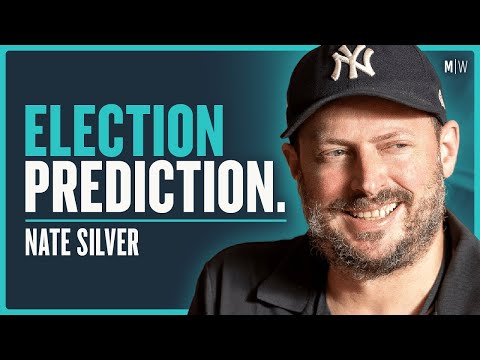
The Hidden Factors Influencing The Election - Nate Silver
Chris Williamson (host), Nate Silver (guest)
In this episode of Modern Wisdom, featuring Chris Williamson and Nate Silver, The Hidden Factors Influencing The Election - Nate Silver explores nate Silver Dissects 2024 Election Chaos, Polling, Risk, And Power Nate Silver joins Chris Williamson to unpack the 2024 U.S. election, focusing on Trump vs. Harris, how polling and forecasting actually work, and why the race is effectively a coin flip. He explains structural advantages in the Electoral College, systematic polling problems, and why negative partisanship and a tiny sliver of undecided voters now drive outcomes. Beyond politics, Silver explores risk-taking cultures in America—his “village” vs “river” framework—through examples from sports betting, Vegas casinos, crypto, Sam Bankman-Fried, and poker psychology. Throughout, he emphasizes probabilistic thinking, regulation’s underrated role, and how to stay rational under pressure in a world that increasingly resembles a casino.
Nate Silver Dissects 2024 Election Chaos, Polling, Risk, And Power
Nate Silver joins Chris Williamson to unpack the 2024 U.S. election, focusing on Trump vs. Harris, how polling and forecasting actually work, and why the race is effectively a coin flip. He explains structural advantages in the Electoral College, systematic polling problems, and why negative partisanship and a tiny sliver of undecided voters now drive outcomes. Beyond politics, Silver explores risk-taking cultures in America—his “village” vs “river” framework—through examples from sports betting, Vegas casinos, crypto, Sam Bankman-Fried, and poker psychology. Throughout, he emphasizes probabilistic thinking, regulation’s underrated role, and how to stay rational under pressure in a world that increasingly resembles a casino.
Key Takeaways
The 2024 election is structurally a near coin flip despite noise.
Trump and Harris each have roughly even chances in the Electoral College, with Democrats likely favored in the popular vote but disadvantaged by vote distribution across states, making a narrow, state-level finish decisive.
Get the full analysis with uListen AI
Polling is still useful, but response bias is its Achilles’ heel.
You don’t need huge samples to estimate national sentiment, but the people willing to answer polls are increasingly unrepresentative—more educated, politically engaged, and often more Democratic—forcing pollsters to make aggressive adjustments that can misfire.
Get the full analysis with uListen AI
Negative partisanship now drives voting more than positive enthusiasm.
Most voters aren’t choosing someone they love; they’re voting to block the other side, with each party tailoring fear-based messages to their base’s psychological traits (e. ...
Get the full analysis with uListen AI
Campaign strategy should target marginal voters with broad, moderate signals.
With only 3–4% of voters truly undecided, small shifts (1 percentage point) can decide the election, so choices like VP picks, debate appearances, and media strategy—especially for Harris—should be evaluated on how they move the center, not the base.
Get the full analysis with uListen AI
Media bias is complex and less determinative than many assume.
Legacy outlets skew center-left on framing and culture-war issues, but are counterbalanced by Fox News, social platforms, and widespread distrust; people are more stubborn and less easily persuaded by one news cycle than operatives like to believe.
Get the full analysis with uListen AI
Risk-taking cultures (“the river”) and establishment institutions (“the village”) shape modern power.
Silver argues the progressive, credentialed East Coast ‘village’ values status and cohesion, while the analytics-obsessed, hyper-competitive ‘river’ (tech, finance, casinos, crypto) optimizes for winning and disruption, with each having distinct strengths and pathologies.
Get the full analysis with uListen AI
Managing stress and cognition under pressure is a learnable advantage.
Borrowing from poker and pro sports, Silver notes that high-stakes situations trigger different ‘operating systems’ in the brain; success comes from recognizing the stress response, simplifying decisions, relying on practiced routines, and avoiding the urge to be a hero.
Get the full analysis with uListen AI
Notable Quotes
“Betting is not a fair game that’s supposed to give you a crack at winning money. It’s rigged, as rigged as it can be.”
— Chris Williamson (endorsed by Nate Silver’s explanation)
“In principle, if you poll 800 people, that can give you—with a margin of error—a good indication of how the whole country would vote. The problem is that the people who respond to polls are weird.”
— Nate Silver
“This is the third election in a row with Donald Trump as the Republican nominee. From my naïve perspective, you might say, ‘Okay, well, the odds are probably about 50–50 again.’”
— Nate Silver
“Most people are not sitting down and working in a spreadsheet to calculate who they think will be the best party for their country. They feel excluded by some parties and included by others.”
— Nate Silver
“If you’re not willing to risk ruining your life, you’re doing something wrong—that’s what Sam Bankman-Fried told me. Which seems crazy.”
— Nate Silver
Questions Answered in This Episode
If most voters are locked in and negative partisanship dominates, what realistic levers are left for campaigns to meaningfully shift outcomes?
Nate Silver joins Chris Williamson to unpack the 2024 U. ...
Get the full analysis with uListen AI
Given persistent structural advantages for Republicans in the Electoral College, should Democrats reconsider their geographic and demographic strategy, or even push for systemic reforms?
Get the full analysis with uListen AI
How should citizens interpret polls responsibly when they know about nonresponse bias and recent polling misses, without simply dismissing all data as unreliable?
Get the full analysis with uListen AI
In a world increasingly shaped by ‘river’ risk-takers in tech, finance, and crypto, how can societies preserve the ‘village’ virtues of competent institutions and broad-based legitimacy?
Get the full analysis with uListen AI
What practical steps can ordinary people take to improve their own probabilistic thinking and risk management, beyond poker tables and financial markets?
Get the full analysis with uListen AI
Transcript Preview
What is this period of the cycle like for you?
It's pretty insane. I mean, I liken it to if you're, like, running some lobster stand in Maine, then in August you're gonna be really busy day and night. That's kind of your, your busy season. Um, I mean, I try to stay relatively grounded. It's not my first rodeo covering an election campaign, not my first involving Trump even.
Oh, I meant, I, I meant Shohei Ohtani's current run for the Dodgers.
Oh.
I, we can talk politics if you like, but.
Okay, perfect.
Uh...
No, all this crazy stuff's happening, 50-50 and like...
(laughs)
But no, I try to, I try to watch a little baseball and football and basketball and all that stuff and, and stay sane. But definitely, I mean, the compression of events we had in the summer with Biden dropping out and then the assassination attempt and then the conventions, uh, will maybe never be replicated in American political history again.
I was g... How much of an outlier is that, do you think? To have s- the, the speed of news and incidents occurring so quickly?
I mean, let's keep in mind that, like, two, th- a lot of elections are crazy now, right? We had the recount in 2000. We had the pandemic in 2020. But yeah, nothing, nothing quite like that I don't think.
Yeah. I heard that you've been limited on sports betting websites, by maybe, uh, something in the teens. 15 different sports betting pages have stopped you from playing the game?
More like five or six, yeah.
Okay.
There are about, like, n- there are nine or 10 legal ones in New York and I only have a clean bill of health at, like, two and a half of them anymore. (laughs)
How do you g- I'm a, a Brit which means that sort of sports betting is in our blood. There's the high street, uh, sports betting shops that you can go into and bet on horse races and everything else. How do American sports betting organizations ensure that the house doesn't lose?
Well, that's by, they do it by banning players who are perceived winning players. Or not banning, they'll, they'll say they're limiting players, right? So at DraftKings, if I wanna bet on, um, a random NBA game, it might only let me bet 80 bucks or something. Whereas my friend who's considered a degen, degenerate gambler, or the term whale is sometimes used, he's allowed to bet $25,000 on a random NBA game. Um, and the reason is because DraftKings thinks I have the hallmarks of a winning bettor. Um, whether they're actually a winning bettor or not, they don't care, they don't wanna take that risk. So if, for example, that you bet early, um, the lines are easier to beat early than late when everybody has weighed in. Um, if you're giving big action on games that aren't very popular, right? I don't know if you're an NBA fan, but, like, if you're betting, like, the Charlotte Hornets or Washington Wizards game, then that's a sign that you're, you're trying to actually win and you're a sharp and not a degen.
Install uListen to search the full transcript and get AI-powered insights
Get Full TranscriptGet more from every podcast
AI summaries, searchable transcripts, and fact-checking. Free forever.
Add to Chrome