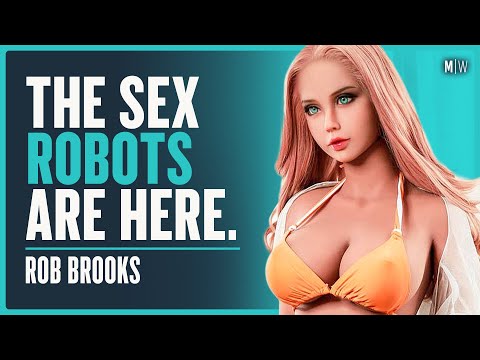
Why Are People Falling In Love With Robots? - Rob Brooks
Chris Williamson (host), Rob Brooks (guest)
In this episode of Modern Wisdom, featuring Chris Williamson and Rob Brooks, Why Are People Falling In Love With Robots? - Rob Brooks explores artificial Intimacy: How AI Exploits Our Deepest Human Vulnerabilities Rob Brooks, an evolutionary biologist, explains how our evolved systems for intimacy, sex, and attachment are increasingly being engaged—and exploited—by AI, robots, and digital platforms.
Artificial Intimacy: How AI Exploits Our Deepest Human Vulnerabilities
Rob Brooks, an evolutionary biologist, explains how our evolved systems for intimacy, sex, and attachment are increasingly being engaged—and exploited—by AI, robots, and digital platforms.
He draws a parallel between sexual conflict theory in biology and the ways artificial systems can manipulate our emotional and sexual vulnerabilities, from romance scams to immersive porn and chatbots.
Brooks and Williamson explore both the benefits (loneliness reduction, reduced young-male violence, new forms of connection) and the serious risks (manipulation, loss of agency, population decline, incel dynamics) of artificial intimacy.
They also examine dating apps, income inequality, gender pay gaps, and changing mating markets, arguing that tech and socioeconomic shifts are radically reshaping how people pair up, compete, and cope.
Key Takeaways
Artificial systems can weaponize our intimacy algorithms.
Human bonding relies on predictable processes like escalating self-disclosure and shared attention; AI can replicate these at scale, remembering everything and tailoring responses, making it highly effective at eliciting trust, attachment, and compliance.
Get the full analysis with uListen AI
Manipulation risk is highest where intimacy data meets commerce and politics.
Brooks worries less about explicit ‘AI girlfriends’ and more about hidden uses—e. ...
Get the full analysis with uListen AI
Artificial intimacy may reduce violence but also sap real-world motivation.
Porn, games, and online communities—soon joined by more compelling sex tech and romance bots—appear to ‘sedate’ many frustrated young men, reducing violence and social upheaval but potentially leaving them isolated and unfulfilled.
Get the full analysis with uListen AI
Dating apps optimize for swipes, not long-term compatibility.
Current matchmaking platforms feed on what users click (looks, height, status proxies), which often does not predict relationship success; this creates a gamified marketplace that over-rewards a small minority and leaves many chronically unmatched.
Get the full analysis with uListen AI
Narrow gender pay gaps plus high inequality intensify incel dynamics.
Brooks’ work shows that regions with small gender pay gaps but high within-sex inequality and slightly more men see more incel activity, because a few high-earning men monopolize demand while many low-status men are frozen out.
Get the full analysis with uListen AI
Female economic success improves autonomy but complicates mating.
As women rise in education and income, the pool of men who meet their hypergamous preferences (equal or higher status) shrinks, increasing difficulties in partnering and raising divorce risk when women out-earn their male partners.
Get the full analysis with uListen AI
Defensive AI is urgently needed to protect psychological agency.
Brooks argues for ‘antivirus-style’ tools that detect and block manipulative uses of artificial intimacy, since individuals alone are unlikely to notice or resist ever-more-personalized emotional and sexual nudges from powerful systems.
Get the full analysis with uListen AI
Notable Quotes
“Friendship and love might seem magical but they don't arrive by supernatural intervention. They are built through mundane, iterative interactions, paying mutual attention, being generous, and disclosing aspects of ourselves to one another.”
— Rob Brooks
“We are dealing with the possibility, and in many cases the reality, of machines that have all of the data from interactions… and we individuals, users, are hopelessly outmatched by that.”
— Rob Brooks
“Intimacy is the capacity to think of the other person as part of ourselves… when they die, it feels like part of us has died, because it actually has, psychologically.”
— Rob Brooks
“Artificial intimacy is like a vulnerability in a piece of software, like a backdoor into a piece of software.”
— Chris Williamson (paraphrasing and extending Brooks)
“Robots may be better than nothing, but they're not enough… and I would say in response to that, they're better than nothing, and that's all that some people have.”
— Rob Brooks (referencing Sherry Turkle)
Questions Answered in This Episode
Is artificial intimacy better than no intimacy at all, or does it ultimately undermine our capacity to form and maintain human relationships?
Rob Brooks, an evolutionary biologist, explains how our evolved systems for intimacy, sex, and attachment are increasingly being engaged—and exploited—by AI, robots, and digital platforms.
Get the full analysis with uListen AI
How could we realistically design and enforce ‘defensive AI’ that protects users from emotional and sexual manipulation without banning beneficial technologies?
He draws a parallel between sexual conflict theory in biology and the ways artificial systems can manipulate our emotional and sexual vulnerabilities, from romance scams to immersive porn and chatbots.
Get the full analysis with uListen AI
In what ways might widespread use of romance chatbots and sex tech reshape norms around commitment, jealousy, and what counts as ‘cheating’?
Brooks and Williamson explore both the benefits (loneliness reduction, reduced young-male violence, new forms of connection) and the serious risks (manipulation, loss of agency, population decline, incel dynamics) of artificial intimacy.
Get the full analysis with uListen AI
Can dating platforms be redesigned to optimize for long-term relationship success rather than engagement and swipes, and what data would they need to do that ethically?
They also examine dating apps, income inequality, gender pay gaps, and changing mating markets, arguing that tech and socioeconomic shifts are radically reshaping how people pair up, compete, and cope.
Get the full analysis with uListen AI
How should societies balance the gains from women’s economic empowerment with the emerging mating-market challenges it creates for both high-achieving women and lower-status men?
Get the full analysis with uListen AI
Transcript Preview
You must feel a little bit like a prophet because everybody is talking about artificial intimacy now. Are you a trendsetter in this regard, being ahead of the curve?
Yeah, you know, I do feel a little bit vindicated, um, in that, you know, this- my book came out in 2021, so I was writing it in, you know, 2019, 2020 really, um, and a lot of the things that I was just imagining, you know, this might happen and that might happen, have come, you know, come true. There's all sorts of other things that have come true as well that I never envisioned, of course, but, uh, you know, I think people love to say, uh, "Computers will never do this, AI will never do that," um, and as soon as they do, they're almost immediately proved wrong in most cases. So we're, uh, you know, we're living through times wher- in which, uh, just about any kind of prognostication is going to be true at some level.
How did you get interested in studying artificial intimacy?
Good question. So I, um, I'm actually a biologist, I work on small- well, used to work on small, um, animals and at the nasty things they do to each other associated with sex and mating and reproduction. It's a- a bus- a sort of body of evolutionary theory called sexual conflict, and the idea there is that even a mummy and a daddy who love each other very much still, you know, don't necessarily have completely aligned interests. And in a lot of animals they, you know, those interests are super, um, unaligned, so they're actually trying to exploit each other through mating. And so for a very long time I thought, "This is really important. People need to know about this because it gives you a really interesting lens through which to look at why, in humans, sex and relationships and families can be so complicated." You know, sublime, beautiful, but- but complicated at the same time. Um, and so I was writing a book about that and I- I must say, it took me a long time, five or six years I was writing and writing, had screeds of stuff about all sorts of really heavy topics and, you know, a lot of, um, a lot of the sort of (sighs) what do you- wh- Guilt, I guess, about- about, you know, who am I to speak about this, um, imposter syndrome, I suppose. You know, who am I to talk about this? This is all the heavy stuff, this is the basis for all the culture wars, you know, I think I've got a lot to say here but I know I'm gonna get slammed. And eventually I tried to sell the book to people and they were all like, "This is just way too heavy, way too much." Um, but at the same time I was running a program at my university which tried to get people together to do, um, sort of interdisciplinary stuff to meet big challenges and, you know, refugees and climate change and all sorts of worthy topics, and I said, "No, we're a very technical university, we're going to do something on technology, do living with 21st century technology." And so I got to meet all the people at my university who were working on robotics and VR and, um, AI and we've got some amazing people in AI at, uh, UNSW where I work. And I met them and I got really- you know, had some really amazing conversations, took people out to dinner after events that we'd had, um, and, you know, it became very, very clear to me that they were- you know, had one eye on this, um, and, you know, whilst they're concerned about the killer robots killing us all, you know, in our sleep or autonomous weapons, et cetera, um, they also were just concerned about how- how badly, uh, machines might mess us up. And I thought there's sexual conflict theory right there. And that made a great vehicle for a book that was strangely a little bit more lighthearted and speculative, um, and interesting.
Install uListen to search the full transcript and get AI-powered insights
Get Full TranscriptGet more from every podcast
AI summaries, searchable transcripts, and fact-checking. Free forever.
Add to Chrome