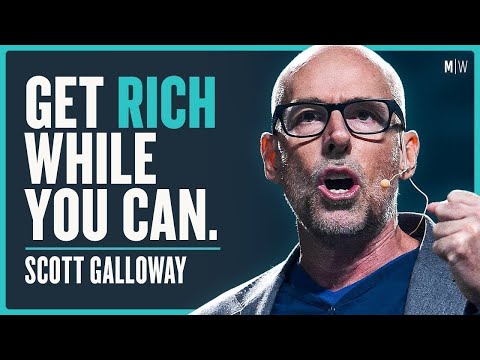
The Smartest Path to Financial Freedom - Scott Galloway
Chris Williamson (host), Scott Galloway (guest), Narrator
In this episode of Modern Wisdom, featuring Chris Williamson and Scott Galloway, The Smartest Path to Financial Freedom - Scott Galloway explores scott Galloway Explains Mastery, Money, and Meaningful Modern Success Scott Galloway argues that “follow your passion” is bad advice for most people; instead, you should find a marketable talent, become top-tier in it, and let competence and rewards generate passion. He defines true wealth as passive income exceeding your living costs, achieved through focus on a main career, disciplined saving, compounding, and diversification rather than risky vanity paths. The conversation explores how money radically shapes life quality in modern capitalism, particularly for men, and why economic responsibility, resilience, networking, and fitness are key levers for both financial and personal wellbeing. Galloway also reflects on mental health, self-forgiveness, spending on experiences, and the importance of character and relationships in building a rich, meaningful life.
Scott Galloway Explains Mastery, Money, and Meaningful Modern Success
Scott Galloway argues that “follow your passion” is bad advice for most people; instead, you should find a marketable talent, become top-tier in it, and let competence and rewards generate passion. He defines true wealth as passive income exceeding your living costs, achieved through focus on a main career, disciplined saving, compounding, and diversification rather than risky vanity paths. The conversation explores how money radically shapes life quality in modern capitalism, particularly for men, and why economic responsibility, resilience, networking, and fitness are key levers for both financial and personal wellbeing. Galloway also reflects on mental health, self-forgiveness, spending on experiences, and the importance of character and relationships in building a rich, meaningful life.
Key Takeaways
Let competence, not hobbies, be the foundation of your passion.
Instead of chasing glamorous fields with terrible odds (acting, pro sports, nightlife), identify something you have natural aptitude for in a high-employment industry and become top 10–1% through focused effort; the status, income, and mastery will make you passionate over time.
Get the full analysis with uListen AI
Choose industries where being top 10% pays, not just looks cool.
Galloway contrasts tax lawyers and niche craftsmen with actors and athletes to show that in some sectors, being very good still leads to poverty; aim for ‘great waves’—fields where competence reliably converts to stable, high income.
Get the full analysis with uListen AI
Define ‘rich’ as passive income exceeding your burn rate.
Wealth isn’t a headline salary; it’s having investments and pensions that cover your lifestyle so work becomes a choice, not an obligation. ...
Get the full analysis with uListen AI
Exploit time and compounding by starting early and saving consistently.
Young people underestimate how fast decades pass and how powerful compounding is; small, regular investments into low-cost index funds over long periods can massively outperform expensive ‘best’ schools or lifestyle upgrades.
Get the full analysis with uListen AI
Diversification is emotional Kevlar against inevitable failures.
Never put more than a small percentage of your net worth into any single bet; most outcomes are driven by market forces, not your brilliance, so spreading risk protects both your finances and mental health when things go to zero.
Get the full analysis with uListen AI
Resilience to rejection is a competitive superpower.
Whether selling consulting, promoting clubs, or canvassing, repeatedly putting yourself in uncomfortable situations and enduring ‘no’ is how you punch above your weight class; most people simply won’t tolerate this discomfort, which creates opportunity for those who do.
Get the full analysis with uListen AI
Prioritize health, relationships, and experiences once you hit ‘enough’.
Beyond a certain wealth level, extra money adds little happiness; Galloway advocates spending on travel and shared experiences, giving money away where you can feel its impact, maintaining fitness as an antidepressant and signal of discipline, and cultivating affection and presence rather than obsessing over marginal gains.
Get the full analysis with uListen AI
Notable Quotes
“Find something you're good at that you can become great at in an industry with a 90-plus percent employment rate, and trust me, you’ll become passionate about it.”
— Scott Galloway
“I define rich as passive income that's greater than your burn.”
— Scott Galloway
“I know how to get you rich—the good news. The bad news is: slowly.”
— Scott Galloway
“Unless you’re willing to take uncomfortable risks, you’re never going to put yourself in a position of economic, professional, or romantic success.”
— Scott Galloway
“One of the biggest regrets of the dying is that they wish they’d been less hard on themselves.”
— Scott Galloway
Questions Answered in This Episode
How should a 20-something practically identify their real talents versus mere interests when choosing an industry?
Scott Galloway argues that “follow your passion” is bad advice for most people; instead, you should find a marketable talent, become top-tier in it, and let competence and rewards generate passion. ...
Get the full analysis with uListen AI
At what point should someone abandon a dream in a low-odds ‘vanity’ field and pivot to a more economically rational path?
Get the full analysis with uListen AI
How can people with average incomes realistically transition from ‘earner’ to ‘owner’ when the cost of living is already high?
Get the full analysis with uListen AI
What concrete steps can chronically risk-averse or conflict-avoidant people take to build the ‘rejection resilience’ Galloway describes?
Get the full analysis with uListen AI
How should individuals decide their own ‘enough’ number and balance responsible saving with enjoying life and giving money away?
Get the full analysis with uListen AI
Transcript Preview
What is the problem with following your passion? Everyone's told that they should follow their passion. What's up with that?
Well, sure. But just keep in mind that the person telling you to follow your passion is already rich usually and they made their billions in iron ore smelting, and I think a lot of young people mistake their hobbies for passion. And my suggestion is that you try and find your talent, and that is something that you think you have some natural ability around and that with a requisite 10,000 hours of commitment, training, discipline, that you could become in the top 10% or even maybe the top 1%. And here's the key part. In an industry that has a 90+% employment rate, because the top 10% of tax lawyers fly private and have a broader selection set of mates than they deserve, the top 10% of basketball players, like me, get cut from JV basketball, like me, in the 10th grade. So you want to go where, um, uh, you know, um, a modest surfer can look amazing, where the waves are great and the waves are great in 98% of industries. 98% of industries have a 90+% employment rate right now. But if you want to be in modeling, sports, open a nightclub, open a restaurant, be in acting, be in the arts, I don't want to crush anyone's dream, but you better be getting pretty bright green lights from a very young age that you're in the top 1% because there are 180,000 actors in the SAG-AFTRA union. These are the most talented actors in the world and last year, 87% of them didn't qualify for health insurance 'cause they made less than $23,000. And what I have found as I've gotten older is that the, the ability to master something and become a ninja at it and then the accoutrements of that mastery, relevance, camaraderie, prestige, economic security, whatever provides you with those things makes you passionate about whatever it is. And the example I use is I'm renovating a house and this Iraqi immigrant is the soapstone guy. Everyone renovating houses in Marylebone knows the soapstone guy and he knows all the quarries, he's very passionate about the different marbling and the different colors and he talks to you and it's almost like poetry listening to him and he installs a soapstone counter for 18,000 pounds, right? And we all have to use him 'cause he's the soapstone guy and I talk to him very openly and I told him I wrote a book on financial literacy and I asked him about his, his business. He makes 1.2 million pounds a year and that type of... And he's just really passionate about soapstone and I have noticed... I'm sure he'd be interested in it, but I think this has given him such an extraordinary living that he's become really passionate about it and what I would argue is that as you get older, you become really passionate about taking care of your kids. You become really passionate about, um, doing wonderful things with your spouse, taking care of your parents and your priorities change and I, I feel like, okay, if I could change spots with Federer or Nadal, I would. I think they have a more interesting life than me but the number seven player on the men's tennis tour, I have a better life than him because I get to go to Wimbledon and buy my way in and I don't throw up before matches or have to put up with the insecurity of like, "Okay, if I don't make it to number one, does that haunt me the rest of my life? Am I gonna have enough money?" So guarantee that you might be the seventh or eighth best tennis player or football player in the world by developing mastery in a business where there's not an over-investment of human capital. And so, y- you know, your 20s is for workshopping. I thought I was gonna be an athlete. Got to UCLA and found out, no, these are real athletes, Scott. Being in the top 10% in high school is in the bottom 10% of every college D1 team in America and then I thought, well, I'll be a pediatrician and chemistry just abused me of that notion and then I thought I'll be an investment banker and I just wasn't very good at it and then I found something else. I found analytics and business intelligence. I didn't even know those things existed and I became great at it and now I'm passionate about it 'cause it's afforded me with an amazing life. And what I would just say is find... Use your 20s to try and lean into your talent and recognize that a lot of times these vanity industries just have an inverse correlation in terms of ROI. The sexier the industry, the lower the return on investment and if you can get good or great at anything and start making real money at it and be... j- just develop that pride of ninja mastery, trust me on this, you're gonna become passionate about it. So find your talent.
Install uListen to search the full transcript and get AI-powered insights
Get Full TranscriptGet more from every podcast
AI summaries, searchable transcripts, and fact-checking. Free forever.
Add to Chrome