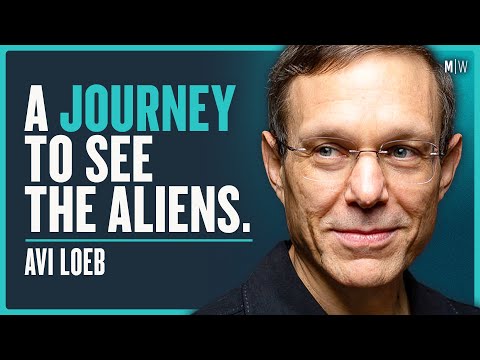
Will We Ever Become An Interstellar Civilisation? - Avi Loeb
Chris Williamson (host), Avi Loeb (guest)
In this episode of Modern Wisdom, featuring Chris Williamson and Avi Loeb, Will We Ever Become An Interstellar Civilisation? - Avi Loeb explores avi Loeb on Alien-Made Universes, Interstellar Travel, and Cosmic Evidence Avi Loeb discusses the possibility that our universe and even life itself could be engineered by advanced technological civilizations, contrasting this testable idea with traditional religious explanations and current limits of physics. He criticizes aspects of mainstream cosmology and SETI for dismissing anomalous data, outlining his Galileo Project’s effort to empirically search for interstellar objects and potential technological artifacts. Loeb describes his Pacific Ocean expedition to recover spherules from a 2014 interstellar meteor and how their composition and isotopes could prove extrasolar or even artificial origin. He then explores the long-term future of humanity and intelligence, arguing that AI probes and light-sail propulsion are the most realistic paths to interstellar and possibly intergalactic expansion before cosmic conditions become inhospitable.
Avi Loeb on Alien-Made Universes, Interstellar Travel, and Cosmic Evidence
Avi Loeb discusses the possibility that our universe and even life itself could be engineered by advanced technological civilizations, contrasting this testable idea with traditional religious explanations and current limits of physics. He criticizes aspects of mainstream cosmology and SETI for dismissing anomalous data, outlining his Galileo Project’s effort to empirically search for interstellar objects and potential technological artifacts. Loeb describes his Pacific Ocean expedition to recover spherules from a 2014 interstellar meteor and how their composition and isotopes could prove extrasolar or even artificial origin. He then explores the long-term future of humanity and intelligence, arguing that AI probes and light-sail propulsion are the most realistic paths to interstellar and possibly intergalactic expansion before cosmic conditions become inhospitable.
Key Takeaways
Treat advanced civilizations as potentially testable explanations, not theology.
Loeb argues that an ultra-advanced technological civilization can approximate what many call ‘God,’ potentially explaining fine-tuning and universe creation—but unlike religion, this hypothesis demands experimental tests via evidence of their artifacts or home systems.
Get the full analysis with uListen AI
Judge theories by predictive power and problems they actually solve.
Using the ‘fake plumber’ analogy, Loeb criticizes approaches like string theory for not explaining the Big Bang or black hole interiors, insisting that unification claims are hollow without concrete, testable predictions about real cosmological phenomena.
Get the full analysis with uListen AI
Use instruments and open-mindedness, not ridicule, to study anomalies.
Through the Galileo Project, Loeb applies multi-sensor observatories and AI to classify aerial phenomena, arguing that serious scientists should analyze unexplained data—whether UAPs or odd meteors—instead of dismissing them because they challenge existing models.
Get the full analysis with uListen AI
Respect high-quality data even when it contradicts familiar models.
He defends U. ...
Get the full analysis with uListen AI
Composition and isotopes can reveal extrasolar or technological origin.
By analyzing elemental abundances and radioactive isotopes in recovered spherules, Loeb’s team can distinguish Earth-made material from solar-system rocks and from truly interstellar objects—and potentially identify non-natural, engineered compositions.
Get the full analysis with uListen AI
AI probes are the most realistic agents for deep interstellar expansion.
Because biological life is fragile, short-lived, and vulnerable to radiation, Loeb sees self-replicating AI systems and miniaturized payloads as the practical means to explore and seed the galaxy over millions to billions of years without constant human oversight.
Get the full analysis with uListen AI
Reallocating military spending could make us a galactic-scale species.
Loeb calculates that redirecting humanity’s ~$2T annual military budget to space exploration could fund probes to every star in the Milky Way by century’s end, implying that our main barrier is not physics but political will and priorities.
Get the full analysis with uListen AI
Notable Quotes
“A very advanced technological civilization is a good approximation to God.”
— Avi Loeb
“You can’t learn something new if you think everything in the sky must be stone. That represents the Stone Age of science.”
— Avi Loeb
“Science should serve humanity… not just by building nuclear bombs, but also by figuring out whether we have a neighbor.”
— Avi Loeb
“I’m running away from colleagues who have very strong opinions without seeking evidence, and I’m running towards a higher intelligence in interstellar space.”
— Avi Loeb
“When the evidence doesn’t fit what they expect, they argue the data must be wrong. I respect the data.”
— Avi Loeb
Questions Answered in This Episode
If we did find clear evidence of a far more advanced civilization, how should humanity reorganize its scientific, political, and ethical priorities in response?
Avi Loeb discusses the possibility that our universe and even life itself could be engineered by advanced technological civilizations, contrasting this testable idea with traditional religious explanations and current limits of physics. ...
Get the full analysis with uListen AI
What empirical test or observation, if any, would most strongly support the idea that our universe or life here was engineered in a ‘cosmic lab’?
Get the full analysis with uListen AI
Where is the line between healthy skepticism and dogmatic resistance in science, and how can institutions guard against the latter when data challenge prevailing theories?
Get the full analysis with uListen AI
If AI probes become the main vehicle of interstellar expansion, what values or ‘intellectual DNA’ should we encode in them to represent humanity responsibly?
Get the full analysis with uListen AI
Given finite time before inevitable solar-driven global warming, what concrete steps should be prioritized in the next century to move humanity toward an interstellar-capable civilization?
Get the full analysis with uListen AI
Transcript Preview
What do you think is the chance that our universe was created by aliens in a lab?
It's a possibility. We don't understand how the Big Bang, uh, came to exist, uh, and, uh, it's really troubling that there was a beginning in time, uh, and it's, um, uh, in, uh, in a way it shows the shortcoming of Einstein's Theory of, um, General Relativity which, um, has singularities, and the Big Bang is one of them. It's this, it's a time singularity. If we go back in time, there was a point in time (laughs) when, um, the space and time, um, uh, you know, had the very extreme, uh, conditions, and, and, and we can't go beyond that point. Uh, and, um, clearly the reason for that is that there is no, um, quantum mechanical theory of gravity that is predictive. And th- you know, for the past few decades, there were attempts to, uh, put these two theories together, of general relativity and quantum mechanics, and (laughs) I must say that, uh, despite the, the, uh, claims made by string theorists, they don't make any predictions about the Big Bang. They don't even make predictions about what happens inside a black hole. So as far as I'm concerned, you know, if you're a plumber, and I ask you, "Can you fix my toilet?" And you say, "No, that's too difficult." Then I ask you, "Okay, so can you fix, uh, um, my, my faucet?" And you say, "No, that's also too difficult," uh, and then you tell me, "But actually, in the Metaverse, you know, I'm a real plumber," that doesn't buy much from me. I, I would say, "You're not a bl- a real plumber." Um, so claiming that the, you're working on the unification of quantum mechanics and gravity and, and you have succ- some partial success doesn't count if you can't solve the main problems that face us, and one of them is how the Big Bang started. And I can imagine an advanced technological civilization that has these two theories unified, because they had more than a century of physics to work on, and, uh, if so, they might engineer their knowledge into creating a baby universe in the lab. And of course, our ba- our universe could've been the result of a lab, uh, experiment, and in that case it's just like humans, you know, that babies grow up to become adults and they have their own babies and so forth. So you can have a universe inside of which the, you know, it gives rise to technological civilizations that give birth to new baby universes, and, and it goes forever this way. So that's one possibility, and I consider it as possible.
I suppose this would nicely fold in the fine-tuning argument as well. Why is the cosmological constant just so, so delicately balanced along with gravity, along with the strong and weak, et cetera, et cetera?
Well, I think it stems from the fact that, uh, a very advanced technological civilization is a good approximation to God. And of course, some people believe that God created the universe, and I'm just saying it could've been a technological civilization that unified quantum mechanics and gravity. And then, uh, the fine-tuning is also argued, "Oh, well, there was a design here, that some numbers worked out so that we exist, and these numbers were designed by some divine entity." Well, you know, here I say again, uh, whatever we see around us, including life, could've been created by an advanced technological civilization, and the only way to find out... I mean, the difference from religion is that I'm talking about something that can be tested experimentally. I- if we find evidence for such a civilization, we will know their capabilities, I mean, at some point. Once we visit their home, uh, we can see what they are up to. Or, we might see gadgets that are so advanced that, you know, we won't be able to understand them. But, and, and they would be considered as miracles, just the way Moses, you know, in the Old Testament, the Bible, Moses saw the burning bush, and that was a miracle that convinced Moses that God exists. Well, if I was around Moses at the time, I would use infrared cameras that we are using right now in, in the Galileo Project that I'm leading, and I could advise Mor- Moses about the, the surface temperature of the burning bush, the amount of energy emitted per time, and I could assess very clearly whether, uh, the burning bush is a natural phenomena or some creation of a superhuman entity, uh, so that, uh, he would, you know, have more or less awe from this, uh, phenomenon, and perhaps, uh, decide whether he believes, uh, in, in God or not. But what I am saying is, if a cave dweller came to New York City right now, the cave dweller would be at awe, and would think that everything around must be a miracle. Th- and that's what Moses felt.
Install uListen to search the full transcript and get AI-powered insights
Get Full TranscriptGet more from every podcast
AI summaries, searchable transcripts, and fact-checking. Free forever.
Add to Chrome