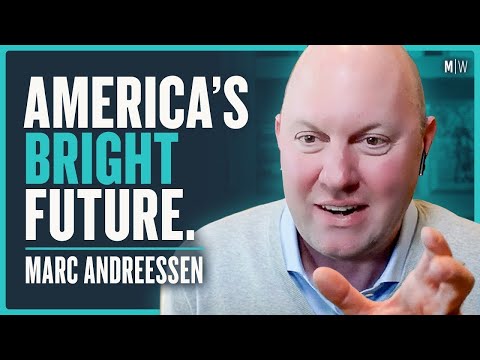
Elon Musk, The Changing World Order & America’s Future - Marc Andreessen
Chris Williamson (host), Marc Andreessen (guest), Narrator
In this episode of Modern Wisdom, featuring Chris Williamson and Marc Andreessen, Elon Musk, The Changing World Order & America’s Future - Marc Andreessen explores marc Andreessen Dissects Politics, Elon Musk, AI, And Government Transformation Marc Andreessen and Chris Williamson explore how recent political events have created a “new timeline,” shifting institutional attitudes from virtue signaling and identity-based politics toward effectiveness, tolerance, and centrist coalitions. Andreessen argues that many leaders, including some on the left, feel liberated to unwind a decade of chaos, rethink cancel culture, and refocus universities, companies, and parties on their core missions. They then pivot to Elon Musk’s unique operating style, describing why his first‑principles, bottleneck‑focused management makes his companies ‘shocking zones of competence’ and how similar methods could radically improve governmental efficiency. The conversation broadens into AI, robotics, self‑driving, quantum computing, Western free‑speech regimes, Europe and the UK’s identity crisis, and why America’s and Britain’s political systems may now need FDR‑style structural overhauls rather than just new personnel.
Marc Andreessen Dissects Politics, Elon Musk, AI, And Government Transformation
Marc Andreessen and Chris Williamson explore how recent political events have created a “new timeline,” shifting institutional attitudes from virtue signaling and identity-based politics toward effectiveness, tolerance, and centrist coalitions. Andreessen argues that many leaders, including some on the left, feel liberated to unwind a decade of chaos, rethink cancel culture, and refocus universities, companies, and parties on their core missions. They then pivot to Elon Musk’s unique operating style, describing why his first‑principles, bottleneck‑focused management makes his companies ‘shocking zones of competence’ and how similar methods could radically improve governmental efficiency. The conversation broadens into AI, robotics, self‑driving, quantum computing, Western free‑speech regimes, Europe and the UK’s identity crisis, and why America’s and Britain’s political systems may now need FDR‑style structural overhauls rather than just new personnel.
Key Takeaways
Shrinking coalitions built on exclusion and moral purity are politically self‑defeating.
Andreessen argues that weaponizing the ‘paradox of tolerance’ into ever‑expanding lists of unforgivable sins drives people out of parties, companies, and universities, making them electorally weaker and organizationally dysfunctional.
Get the full analysis with uListen AI
Many leaders now feel permission to prioritize effectiveness over optics.
In the wake of political shifts, he sees business and institutional heads—including some who didn’t support Trump—quietly rolling back DEI‑style performative policies and focusing again on core outputs: building products, teaching, and governing competently.
Get the full analysis with uListen AI
Elon Musk’s operating model is to fix the biggest bottleneck every week.
Rather than micromanaging everything, Musk dives deeply into the single most critical constraint at each company, solves it directly with frontline engineers, then moves on—compounding 52 key fixes a year while attracting top talent that thrives in high‑competence environments.
Get the full analysis with uListen AI
Government bloat is largely tied to decades of unconstrained regulation.
Andreessen notes that executive agencies have effectively been writing their own ‘laws’ through regulation for 60–80 years; recent Supreme Court rulings questioning such authority create an opening for a smaller, more constitutional, and more efficient state.
Get the full analysis with uListen AI
World‑model AI and text‑to‑video breakthroughs foreshadow a robotics revolution.
Systems like OpenAI’s Sora must implicitly understand 3D physics—light, materials, gravity, motion—to generate believable video, which is exactly the kind of world model robots need to navigate safely in human environments, making embodied AI much closer than many expect.
Get the full analysis with uListen AI
Self‑driving cars are already statistically safer than human drivers, but psychology lags.
Despite over a million road deaths per year globally from human driving, society is more tolerant of human error than machine error; nonetheless, Andreessen thinks incremental deployment of safer autonomous systems will continue, eventually phasing out human driving on public roads.
Get the full analysis with uListen AI
Western institutions suffer more from entrenched systems than from individual bad actors.
Echoing Dominic Cummings and Curtis Yarvin, Andreessen suggests that the machinery of government now ‘runs the people’; meaningful reform requires FDR‑level structural redesign, not just swapping politicians, and similar deep overhauls may be needed in the UK and EU.
Get the full analysis with uListen AI
Notable Quotes
“It’s hard to win elections when your strategy is to shrink your coalition by tagging everyone as racist or intolerant.”
— Marc Andreessen
“The people aren’t running the system. The system is running the people.”
— Marc Andreessen (attributing the idea to Dominic Cummings)
“Elon shows up every week, finds the company’s biggest problem, and fixes it. Do that 52 weeks a year and you’ve solved the 52 biggest problems.”
— Marc Andreessen
“The best product in the world shouldn’t even need a logo. Everyone will know what it is because it’s obviously the best.”
— Marc Andreessen, paraphrasing Elon Musk
“Starting a company is like eating glass. Eventually you start to like the taste of your own blood.”
— Marc Andreessen (quoting Sean Parker)
Questions Answered in This Episode
If political parties and institutions genuinely tried to rebuild broad, tolerant coalitions, what concrete policies and cultural norms would need to change first?
Marc Andreessen and Chris Williamson explore how recent political events have created a “new timeline,” shifting institutional attitudes from virtue signaling and identity-based politics toward effectiveness, tolerance, and centrist coalitions. ...
Get the full analysis with uListen AI
How transferable is Elon Musk’s bottleneck‑focused leadership style to more traditional, non‑technical organizations or to government agencies?
Get the full analysis with uListen AI
Where should societies draw the line between protecting vulnerable groups from harm and preserving robust, open discourse—especially in Europe and the UK?
Get the full analysis with uListen AI
Given AI’s emerging ‘world models,’ how should regulators and the public prepare for a world where robots and embodied AI operate safely alongside humans?
Get the full analysis with uListen AI
If the core problem is that systems, not people, dominate modern governance, what are realistic mechanisms for voters or entrepreneurs to catalyze true structural reform?
Get the full analysis with uListen AI
Transcript Preview
How much of a new timeline are we on right now?
(laughs) We are on a very, very different new timeline. Um, so, uh, yeah, so I, you know, I- I think the timeline is split twice. Um, it's- it's split once in- in the, uh, second week of July, um, and then, uh, it split again, uh, on November 6th, and I- I don't know, you t- you tell me. Uh, I- I- I mean, th- can you feel it?
It... Th- the sense in the air, the ambiance, uh, has certainly taken a hard pivot. Um, lots of people that were happy are now unhappy, and lots of people that were unhappy are now fucking ecstatic.
So I think, actually, I've detected something interesting, and maybe it's just my- my world or maybe business, but I think it's broader, which is, I actually think a fairly large number of people who didn't vote for Trump are actually feeling, um... Uh, people who run organizations who did not vote for Trump are feeling liberated. Uh, they're feeling like they can make changes that they have been wanting to make for a long time, um, and they can really dial down a lot of the things that have really been causing the problems. They-
So the, uh, the- the blast radius of the good vibes is, uh, wider than people might have anticipated.
I think it's wider than people anticipated, and I've been in some discussions where people are like, "Yeah, like, the... It feel- it really feels like the air is coming out of the, uh..." It really feels like the tension is draining out of the system in an interesting way this time-
Mmm.
... which is, of course, the exact opposite of how it felt in 2016.
(laughs)
Um, and so it's... I- I don't know. I'm- I'm, you know, I'm cautiously optimistic that actually a- a fair... You know, I... Uh, look, I don't think there's any, like, overnight, you know, transformation, and there's gonna be continued, you know, drama and strife and so forth. But, um, I think a lot of institutions, I think a lot of leaders at a lot of institutions, including ones that are left-leaning, I think they've just simply had it, um, with a lot of the chaos of the last 10 years and a lot of the drama and a lot of the pressure and conflict. And I think they're just done with it, and they want their... You know, if it's a company, they want it to get back to business. If it's a university, they want it to get back to teaching. Um, so I'm- I'm, you know, knock on wood, uh, cautiously optimistic.
This pivot from, uh, saying good or appearing good to, "Hang on, but what actually happened?" It's stress testing the outcomes and, uh, people optimizing for actual effectiveness as opposed to, like, uh, optical, uh, s- slickness, I guess, or popularity, reputational stuff. Uh, I think that pivot seems to be a one that was quite overdue.
Install uListen to search the full transcript and get AI-powered insights
Get Full TranscriptGet more from every podcast
AI summaries, searchable transcripts, and fact-checking. Free forever.
Add to Chrome