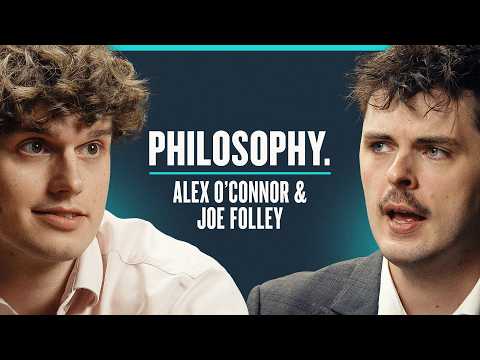
Is Being Smart Worth the Depression? - Alex O’Connor & Joe Folley (4K)
Chris Williamson (host), Alex O’Connor (guest), Joe Folley (guest), Guest (guest), Guest (guest)
In this episode of Modern Wisdom, featuring Chris Williamson and Alex O’Connor, Is Being Smart Worth the Depression? - Alex O’Connor & Joe Folley (4K) explores is Philosophy Practical Or Just Depressing Intellectual Masturbation Today? Alex O’Connor and Joe Folley discuss how ancient philosophy tightly linked metaphysics, ethics, and practical guidance for living, in contrast to much of modern philosophy’s fragmented and sometimes sterile specialization. They explore Stoicism, Aristotelian ethics and friendship, pessimism, nihilism, antinatalism, and how dark philosophies can paradoxically console or even amuse. The conversation then turns to philosophy of mind and panpsychism, using split-brain patients and combination problems to question what consciousness is and how unified it really might be. Finally, they examine emotivism about morality and the ethical responsibilities of being public-facing philosophers whose ideas may influence people wrestling with life-and-death questions.
Is Philosophy Practical Or Just Depressing Intellectual Masturbation Today?
Alex O’Connor and Joe Folley discuss how ancient philosophy tightly linked metaphysics, ethics, and practical guidance for living, in contrast to much of modern philosophy’s fragmented and sometimes sterile specialization. They explore Stoicism, Aristotelian ethics and friendship, pessimism, nihilism, antinatalism, and how dark philosophies can paradoxically console or even amuse. The conversation then turns to philosophy of mind and panpsychism, using split-brain patients and combination problems to question what consciousness is and how unified it really might be. Finally, they examine emotivism about morality and the ethical responsibilities of being public-facing philosophers whose ideas may influence people wrestling with life-and-death questions.
Key Takeaways
Ethics without metaphysics risks becoming shallow lifestyle advice.
Ancient schools like Stoicism and Epicureanism grounded their ethical rules in substantive claims about what the world is (e. ...
Get the full analysis with uListen AI
Aristotle offers a realistic, underused blueprint for flourishing.
Joe argues Aristotle’s Nicomachean Ethics is still the most useful single philosophy text: it rejects the idea that virtue alone guarantees happiness, emphasizes the ‘golden mean’ between vices, and treats deep, duty-laden friendships as central to a good life—resisting today’s narrow focus on romance and individualism.
Get the full analysis with uListen AI
Dark philosophies can lower existential stakes and even be consoling.
Pessimists like Cioran or Schopenhauer, and antinatalists like David Benatar, frame life as dominated by suffering or morally regrettable to begin—yet by expecting little from existence, they can blunt disappointment, sometimes turning extreme misfortune into something darkly comic and strangely liveable.
Get the full analysis with uListen AI
Panpsychism reframes consciousness as fundamental, not emergent.
Facing the hard problem of consciousness and odd phenomena like split-brain patients, Alex sketches panpsychism: instead of mind mysteriously arising from matter, consciousness is the basic “stuff” of the universe, with brains as complex arrangements that let that underlying consciousness do memory, self-awareness, and thought.
Get the full analysis with uListen AI
Our sense of a single, unified self may be an illusion.
Split-brain experiments where each hemisphere acts semi-independently—and one side confabulates reasons for actions it didn’t initiate—suggest we’re more like a parliament of drives and sub-selves than a single inner controller, echoing Nietzsche’s picture of competing internal wills.
Get the full analysis with uListen AI
Emotivism sees moral judgments as expressions of feeling, not facts.
On emotivism, saying “murder is wrong” is more like saying “boo, murder” than stating a truth; most moral ‘debate’ is actually about empirical facts (e. ...
Get the full analysis with uListen AI
Public philosophers have a duty to flag their own fallibility.
Both guests stress that YouTube and podcasts inevitably oversimplify; to avoid misleading especially vulnerable listeners (e. ...
Get the full analysis with uListen AI
Notable Quotes
“It’s like we’re trying to do ethics without the metaphysics.”
— Alex O’Connor
“There is no philosophy that’s going to make you happy on the rack.”
— Joe Folley (paraphrasing Aristotle)
“If you’re not expecting things to go very well, the stakes are kind of lowered.”
— Joe Folley
“The biggest myth for panpsychists is that complexity is required for consciousness.”
— Alex O’Connor
“If you ask why incest is wrong, most people’s honest answer is just: it’s gross. And that’s exactly what an emotivist thinks is going on.”
— Alex O’Connor
Questions Answered in This Episode
If ethics needs metaphysics to be robust, what metaphysical commitments are you personally willing to adopt or reject, and why?
Alex O’Connor and Joe Folley discuss how ancient philosophy tightly linked metaphysics, ethics, and practical guidance for living, in contrast to much of modern philosophy’s fragmented and sometimes sterile specialization. ...
Get the full analysis with uListen AI
How might your own life change if you took Aristotle’s friendship-centered model of flourishing as seriously as most people take romantic relationships?
Get the full analysis with uListen AI
Does panpsychism genuinely solve the hard problem of consciousness, or does it just relocate the mystery to an even more basic level?
Get the full analysis with uListen AI
To what extent do your deepest moral intuitions—on issues like incest, abortion, or antinatalism—reduce to emotional reactions you can’t rationally justify?
Get the full analysis with uListen AI
What responsibilities do thinkers and content-creators have when publicly exploring ideas about suicide, meaninglessness, and pessimism with audiences who may be emotionally fragile?
Get the full analysis with uListen AI
Transcript Preview
Was philosophy always meant to be practically applicable, or is that some modern reinterpretation?
Ah, that's Joe question.
Oh, well, I mean, (laughs) I suppose one of the, uh, differences between, like, very broadly speaking, between something like ancient, uh, ancient Greek philosophy say, and the way that we conceive our philosophy today is that, you know, philosophy today is largely thought of in terms of different fields. You've got your kind of epistemologists who discuss questions like, you know, what is knowledge, and, you know, more importantly, like, how do we, how do we attain knowledge? Um, what are the kinds of systems and processes that produce reliable knowledge? That kind of stuff. And then there are kind of ethicists talking about, you know, what is the good life, you know, uh, vitally important question. Also, you know, what are, what are the right things to do? And then you've got kind of logicians talking about, um, you do, (laughs) do a lot of proofs and try to often model, uh, ordinary things, um, using formal s- mathematical or at least semi-mathematical systems. You've got philosophers of language, philosophers of science. But, um, suddenly, uh, for, uh, in the ancient world, these weren't as differentiated, (laughs) certainly, as they are today. And so, um, uh, you know, Aristotle wrote different treatises on these different topics. But, um, eh, even in his philosophy, everything is so interlinked, and if you go, you know, back before Aristotle, it's very, very hard to separate these. So for example, um, the Stoics, uh, although, you know, you know, in kind of popular discourse around Stoicism today, we talk a lot about Stoic ethics. Um, the Stoics thought that their ethics fell out of their metaphysics-
Mm-hmm.
... and their logic, which was their word for what we would call today things like logic and epistemology. And, um, so I think that's, that's, um, that's one major difference. In terms of practicality, I mean, yeah, the, uh, a lot of ancient philosophy is incredibly practical. You know, these are, especially, you know, the, the, one of the paramount, um, questions that are asked, that's asked by almost every, um, ancient philosopher is, you know, how to live a good life. The, the first, uh, philosopher, um, like, in, like, received wisdom is Thales. Uh, uh, he's a kind of ancient, ancient Greek philosopher. Um, but before that, there, there are lots of kind of, we have scraps of, like, ancient, uh, Egyptian, um, philosophies and things like that, and they're, they're often concerned with, you know, what's the good life? How do we live it? Um, so I, I, I think philosophy, philosophy is eminently practical. I also think, you know, maybe this is just my own bias showing, I, I think, I think that, I think that, um, today philosophy at its best is, is often very practical.
How... Has something gone awry? Is there some sense that modern philosophy, a lot of that is kind of like string theory in physics-
Install uListen to search the full transcript and get AI-powered insights
Get Full TranscriptGet more from every podcast
AI summaries, searchable transcripts, and fact-checking. Free forever.
Add to Chrome