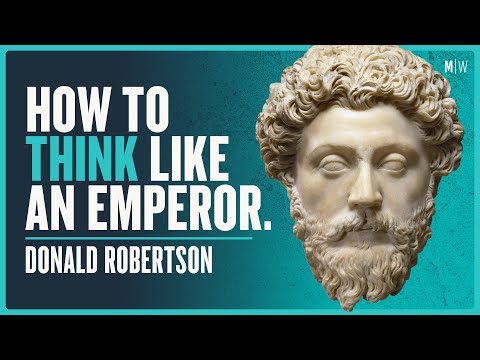
The Stoicism Secrets Of Marcus Aurelius - Donald Robertson
Donald Robertson (guest), Chris Williamson (host)
In this episode of Modern Wisdom, featuring Donald Robertson and Chris Williamson, The Stoicism Secrets Of Marcus Aurelius - Donald Robertson explores marcus Aurelius, Stoicism, And Mastering Anger In The Internet Age Donald Robertson, a Stoicism scholar and psychotherapist, unpacks Marcus Aurelius’ life, influences, and how his Stoic practices connect to modern cognitive therapy and online culture.
Marcus Aurelius, Stoicism, And Mastering Anger In The Internet Age
Donald Robertson, a Stoicism scholar and psychotherapist, unpacks Marcus Aurelius’ life, influences, and how his Stoic practices connect to modern cognitive therapy and online culture.
He explains how Marcus’ upbringing, tutors, and environment shaped his Stoicism, how Meditations was likely composed, and how much of it may condense or echo earlier thinkers like Epictetus and Heraclitus.
Robertson then bridges ancient Stoic techniques with evidence-based methods for handling anger, anxiety, and depression, emphasizing perspective‑broadening, cognitive distancing, and memento mori.
The conversation closes by applying Stoic ideas to fame, cancel culture, narcissism, and “loving your fate,” showing how Marcus’ approach remains relevant to modern social media, status anxiety, and self‑improvement.
Key Takeaways
Your value judgments quietly shape the quality of your entire life.
Robertson stresses a core Stoic idea: it’s not events themselves but your opinions about what’s good, bad, admirable, or shameful that form your character and determine how you experience life.
Get the full analysis with uListen AI
Borrowed wisdom still transforms you—what matters is internalizing and practicing it.
Much of Meditations likely rephrases earlier thinkers like Epictetus and Heraclitus; Marcus’ genius is in personalizing, condensing, and repeatedly paraphrasing their ideas until they become habits of thought.
Get the full analysis with uListen AI
Work on anger first; it’s the most neglected ‘royal road’ to growth.
Ancient Stoic therapy targeted anger as the most urgent problem, while modern self‑help and psychotherapy over-focus on anxiety and depression; people with anger issues rarely self‑refer, so this is a huge blind spot and opportunity.
Get the full analysis with uListen AI
Break anxiety’s loop by widening your time and space perspective.
Exercises like the Stoic “view from above” and repeatedly asking “What would probably happen next? ...
Get the full analysis with uListen AI
Practice cognitive distancing: notice your thoughts instead of becoming them.
Treat anxious or depressive thoughts as mental events (e. ...
Get the full analysis with uListen AI
Meditating on death can deepen gratitude, not hedonism.
By seeing your life as a finite whole—recognizing the presence and inevitable absence of people, health, and possessions—you temper cravings, appreciate what you have, and enjoy pleasures without being ruled by them.
Get the full analysis with uListen AI
Status, fame, and online applause are especially corrosive without criticism.
From Nero’s forced ovations to modern social media, using spectacle and validation to secure power or self‑worth breeds narcissism and fragility; Stoicism instead seeks open critique, reasoned dialogue, and inner standards of success.
Get the full analysis with uListen AI
Notable Quotes
“The quality of your life is shaped fundamentally by certain opinions that you hold, predominantly your value judgments.”
— Donald Robertson (explaining Marcus Aurelius/Epictetus)
“In a philosophical debate, the person who benefits the most is the one who loses the argument.”
— Donald Robertson (paraphrasing Epicurus)
“If people could just get past that blind spot and realize that’s the biggest opportunity for actually transforming our character… working on anger is the biggest opportunity.”
— Donald Robertson
“What if you do the opposite and imagine the absence of things that are currently present? Then rather than desire, you experience gratitude.”
— Donald Robertson (on Marcus Aurelius’ insight)
“We need critics, we need disagreement, in order to knock the rough edges off our thinking.”
— Donald Robertson
Questions Answered in This Episode
How can someone practically audit and change the value judgments that are currently shaping their life and character?
Donald Robertson, a Stoicism scholar and psychotherapist, unpacks Marcus Aurelius’ life, influences, and how his Stoic practices connect to modern cognitive therapy and online culture.
Get the full analysis with uListen AI
What would a structured ‘Stoic anger program’ look like for someone who doesn’t believe they’re angry—but everyone around them does?
He explains how Marcus’ upbringing, tutors, and environment shaped his Stoicism, how Meditations was likely composed, and how much of it may condense or echo earlier thinkers like Epictetus and Heraclitus.
Get the full analysis with uListen AI
How can we bring more of the Stoic marketplace ethos—welcoming criticism and refutation—into today’s social media and online discourse?
Robertson then bridges ancient Stoic techniques with evidence-based methods for handling anger, anxiety, and depression, emphasizing perspective‑broadening, cognitive distancing, and memento mori.
Get the full analysis with uListen AI
In your own life, where are you most vulnerable to status loss and public opinion, and how might a Marcus‑style perspective shift change your behavior?
The conversation closes by applying Stoic ideas to fame, cancel culture, narcissism, and “loving your fate,” showing how Marcus’ approach remains relevant to modern social media, status anxiety, and self‑improvement.
Get the full analysis with uListen AI
If Meditations is partly a tapestry of lost Stoic ideas, how should that influence the way we read and apply it today—more as a workbook than a holy text?
Get the full analysis with uListen AI
Transcript Preview
The quality of your life is shaped fundamentally by certain opinions that you hold, predominantly your value judgments. The things that you value and the things that you despise are gonna shape your character and therefore the quality of your life. (airplane whooshing)
Are you Marcus Aurelius's number one fan, do you think? Or do you think that you're the most-
Definitely.
... most educated on him, or one of the most educated on him that's alive at the moment?
I, yeah, I mean, it doesn't seem like that much of a brag 'cause I've spent so much time having to read his stuff. I'm probab- I must be one of the people in the world that knows the most about Marcus Aurelius now just 'cause I've spent so much time writing stuff about him. And, uh, I kind of thought I learned a lot about him, and then obviously when you write other stuff, like you write, uh, from a different perspective. The graphic novel, I suddenly had to think, "What did this look like and what did that look like?" And so it made me explore his life from a bit of a different perspective. I had to visualize it more. And I thought, "Well, now I know everything I need to know about him." But then when I did the more academic biography, uh, that was to a, a more rigorous standard in a way, and, uh, I thought, "No, I'm now doing research that's even deeper than I did before." So, apparently there's always more to learn.
So-
Uh-
... Marcus Aurelius.
... there can't be that much left.
Emperor of Rome.
Yes.
But followed a Greek-born philosophy. Why?
Yeah. Well, I'll, let, let's get into some obscure stuff then. I th- I've, I can't be 100% sure, but somebody started speculating , Chris, right? I reckon it was to do with his mum, partly. That's one reason. So his mum ... His father passed away when Marcus was, we think, about three or four years old, and so he was brought up to a large extent, although not exclusively, by his mother. Now, his mother was a very wealthy and powerful woman. She was a construction magnate, believe it or not, and we know that 'cause we have hundreds of bricks with her name stamped on them. She owned a, uh, a brick and tile factory and clay fields that were used in construction, so she was very wealthy and powerful woman, not like we might have kind of assumed, you know, in, uh, in Roman times. And she had a kind of ... She seems to have had an intellectual circle that surrounded her, like a salon, um, of intellectuals at their house, and so she was a very well-educated woman. Here's a bit of trivia for you. Marcus Cornelius Fronto, who is Marcus' Latin rhetoric tutor, and was considered the greatest Roman orator since Cicero, which is, you know, quite an accolade. We have a letter from him where he says to Marcus, he's writing to Marcus' mother in Greek, and he says, "Marcus," kinda pathetically, "Could you check my grammar and, like, vocabulary and stuff to make sure that it's okay before your mum reads it?" So Fronto, one of the greatest intellectuals of the era, is kind of intimidated by Marcus' mother.
Install uListen to search the full transcript and get AI-powered insights
Get Full TranscriptGet more from every podcast
AI summaries, searchable transcripts, and fact-checking. Free forever.
Add to Chrome