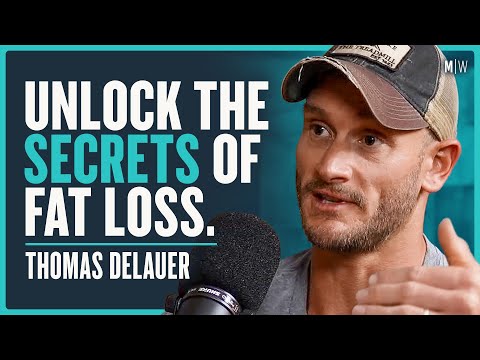
Stop Making These Mistakes When Intermittent Fasting - Thomas DeLauer
Thomas DeLauer (guest), Chris Williamson (host)
In this episode of Modern Wisdom, featuring Thomas DeLauer and Chris Williamson, Stop Making These Mistakes When Intermittent Fasting - Thomas DeLauer explores intermittent Fasting, Fat Loss, And Mastery: Thomas DeLauer Unfiltered Thomas DeLauer shares his unconventional childhood, early OCD and anxiety, and how extreme endurance, overwork, and disordered eating shaped his obsession with control, performance, and later, physique. He explains how a rapid weight gain to nearly 300 pounds, self‑induced type 2 diabetes, and subsequent recovery led him into biochemistry, medical sales, and eventually evidence‑based fitness education online.
Intermittent Fasting, Fat Loss, And Mastery: Thomas DeLauer Unfiltered
Thomas DeLauer shares his unconventional childhood, early OCD and anxiety, and how extreme endurance, overwork, and disordered eating shaped his obsession with control, performance, and later, physique. He explains how a rapid weight gain to nearly 300 pounds, self‑induced type 2 diabetes, and subsequent recovery led him into biochemistry, medical sales, and eventually evidence‑based fitness education online.
DeLauer argues that the real power of intermittent fasting isn’t magic fat loss or autophagy, but the psychological mastery gained by deliberately abstaining from food in a world of constant availability. He emphasizes thermodynamics, proper meal spacing, energy flux (G‑flux), diet breaks, and adequate protein as non‑negotiables of sustainable fat loss and health.
Fatherhood and the death of his father radically shifted his motivations from ego, vanity, and dopamine hits from online validation toward service, nuance, and less dogmatic nutrition advice. The conversation also covers training strategies (HIIT vs EMOM/Tabata), gut health and bloating, cravings management, protein and longevity debates, and the confusion around extreme longevity/plant‑based vs high‑protein approaches.
Key Takeaways
Intermittent fasting’s biggest benefit is psychological mastery, not magic fat loss.
DeLauer argues IF mainly works as an adherence and self‑control tool: voluntarily abstaining from food in a food‑abundant world builds discipline that carries over into other areas, while most of its physiological effects mirror basic caloric restriction and exercise.
Get the full analysis with uListen AI
Fat loss still hinges on thermodynamics, but timing and spacing of meals matter.
He emphasizes calories in vs calories out as foundational, while also recommending meaningful gaps between meals so insulin can fall and lipolysis (fat burning) can occur, instead of constant grazing that keeps fat mobilization suppressed.
Get the full analysis with uListen AI
Use energy flux (G‑flux): move more and eat more to be leaner and healthier.
Maintaining a higher intake and higher output (e. ...
Get the full analysis with uListen AI
Plan diet breaks and avoid chronic under‑eating, especially with fasting.
Many people turn 16:8 fasting into perpetual low calories, driving metabolic rate down; DeLauer suggests structured periods of higher intake paired with higher activity to restore metabolism before re‑entering a deficit.
Get the full analysis with uListen AI
HIIT only works if intervals are truly near‑maximal; EMOM/Tabata are often better for most.
He defines real HIIT as 15–25 seconds of all‑out effort with long enough rest to repeat that intensity, while recommending EMOM and Tabata‑style sessions as more sustainable, accountable ways to combine cardio and resistance for fat loss.
Get the full analysis with uListen AI
Cravings and bloating often have simple physiological drivers you can target.
For sweet cravings, he suggests trying salt/electrolytes first (possible hindbrain NSD neuron link), then small amounts of very dark chocolate; for bloating, he highlights gut dysbiosis and encourages greater dietary diversity in fibers and foods, or formal elimination/reintroduction if severe.
Get the full analysis with uListen AI
High protein and adequate mTOR signaling may be slightly preferable to chronic restriction for longevity.
While acknowledging methionine and protein‑restriction data, he currently leans toward maintaining sufficient protein for muscle and recovery, using modest caloric restriction and AMPK‑activating behaviors (exercise, some fasting) rather than aggressive protein avoidance.
Get the full analysis with uListen AI
Notable Quotes
“The biggest benefit to me with intermittent fasting is not body composition changes, it's the element of mastery that comes with it.”
— Thomas DeLauer
“You cannot argue with me that there is an element of mastery that comes into place with abstaining from something.”
— Thomas DeLauer
“All of this happened in a pursuit of building muscle and a pursuit of making money. These two vanity things could have completely fucked up my life.”
— Thomas DeLauer
“I used to live in this echo chamber of what worked for me. Suddenly I’m like, ‘Holy crap, I’m using my gift for all the wrong shit.’”
— Thomas DeLauer
“People that perform, people that are successful, on average are more miserable. You cannot understand the price that certain people pay to be in a position you think you want.”
— Chris Williamson (paraphrasing Michael Gervais’ perspective)
Questions Answered in This Episode
How can someone distinguish between using intermittent fasting as a healthy tool for mastery versus turning it into another form of disordered control or self‑punishment?
Thomas DeLauer shares his unconventional childhood, early OCD and anxiety, and how extreme endurance, overwork, and disordered eating shaped his obsession with control, performance, and later, physique. ...
Get the full analysis with uListen AI
Given your own history of extreme dieting and metabolic damage, what concrete checks or lab markers would you recommend people monitor when experimenting with fasting and aggressive fat loss?
DeLauer argues that the real power of intermittent fasting isn’t magic fat loss or autophagy, but the psychological mastery gained by deliberately abstaining from food in a world of constant availability. ...
Get the full analysis with uListen AI
How should an average, non‑athlete practically apply the G‑flux concept without overtraining or building an unsustainable lifestyle around constant high activity?
Fatherhood and the death of his father radically shifted his motivations from ego, vanity, and dopamine hits from online validation toward service, nuance, and less dogmatic nutrition advice. ...
Get the full analysis with uListen AI
With so much conflicting information about protein intake and longevity, what would a pragmatic weekly eating pattern look like that balances muscle preservation and potential life‑span benefits?
Get the full analysis with uListen AI
In light of your experience with parental dynamics and anxiety, what specific behaviors are you intentionally repeating or avoiding with your own children to break those generational patterns?
Get the full analysis with uListen AI
Transcript Preview
The biggest benefit to me with intermittent fasting is not body composition changes, it's not cognitive awareness, it's the element of mastery that comes with it, and that's where people miss the boat because you cannot contest that. You can sit here and you could fight every single nook and cranny of intermittent fasting based upon where you stand in your views of nutrition, time-restricted feeding. You cannot argue with me that there is an element of mastery that comes into place with abstaining from something. (wind blowing)
For the people that don't know you, what's your background? What do you do?
Just a guy on the internet, man. I am just this, you know, uh, for, for me, I'm a translator of science. Um, not a biochemist. I don't pretend to be one. I, I take the research, I know how to read a paper very well, and I tend to get really overly excited about stuff like that, and then I translate it, and I try to put it into layman terms and do a decent job at articulating complex subject matter into a way that's digestible for people so that they can have a chance to really review the research and understand and put another brick in the wall for themselves towards being healthier, having more vitality, and just being better humans.
Why did you get interested in that?
I realized not that long ago that I'm not that great at many things. Uh, but I'm decent at a lot of things, and I've realized the one thing that I am really good at is articulating and communicating, and for a long time I tried to fight that. I always wanted to be the strongest guy in the room or the smartest guy in the room. I always wanted to kinda, you know, face adversity a- and I just wanna, I wanna be that guy. And then I realized that, you know what? It's actually really good to be a good, effective communicator, and I started leaning into that. And the moment that I leaned into that, and I fed the stallion and starved the pony, so to speak, I realized that I can take all these things that I'm halfway decent at, but really get people excited about them with my ability to communicate it.
Talk to me about childhood for you. You have a very interesting background. What was that like?
Yeah, my childhood, you know, it, it's interesting. I don't talk about it much, and recently it's been coming up more, probably because people are trying to figure out what makes me tick. Um, I came from what looked like a pretty normal, conventional childhood on the surface. Uh, I had a loving mother, I had, you know, a very loving father. I ran my first, like, 10K when I was, like, five years old, right? So I, I, I was kind of got into running at a very young, young age, and then I ultimately, I'm flashing forward, I ran my first marathon when I was 11. And the reason that I'm starting with that is not to say, "Hey, I'm this amazing person. Look at me." It's because now as an adult and as a father myself, I look back at that, I'm like, "Wow, that's interesting. Like, what, what was my mom thinking?" And I love my mom and I'm close with my mom and, uh, everything, I did everything with my mom, like, I was always along by her side, right? And I realized that she did these things, and I wanted to be like her. I wanted to be with her, and my mom would run marathons, so I would run marathons too, and my mom sort of had this mentality of like, "Hey, well, you know what? If you wanna hang out with me, then you're gonna do the stuff that I'm gonna do," and there was n- no real worry about it. It was just the way that it is. Um-
Install uListen to search the full transcript and get AI-powered insights
Get Full TranscriptGet more from every podcast
AI summaries, searchable transcripts, and fact-checking. Free forever.
Add to Chrome