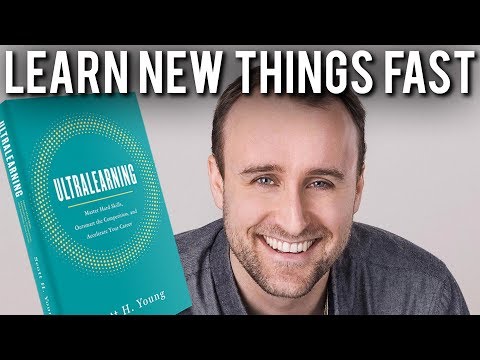
Scott H Young | Ultralearning
Scott H Young (guest), Narrator, Chris Williamson (host), Narrator
In this episode of Modern Wisdom, featuring Scott H Young and Narrator, Scott H Young | Ultralearning explores ultralearning: How Aggressive Self-Education Outperforms Traditional Schooling Constraints Scott H. Young explains his concept of ultralearning—aggressive, self-directed projects designed to master skills far more efficiently than traditional schooling or casual self-study.
Ultralearning: How Aggressive Self-Education Outperforms Traditional Schooling Constraints
Scott H. Young explains his concept of ultralearning—aggressive, self-directed projects designed to master skills far more efficiently than traditional schooling or casual self-study.
He shares flagship experiments like completing the MIT computer science curriculum in one year and learning four languages in twelve months through immersive, no-English rules.
The conversation contrasts school-based learning with real-world skill acquisition, emphasizing direct practice, retrieval, drilling bottlenecks, and continuous meta-learning (learning how to learn).
Young argues that even small, well-designed projects done in limited time can transform confidence, accelerate careers and hobbies, and create a compounding lifelong learning habit.
Key Takeaways
Optimize how you use learning time, not how much you have.
Ultralearning is less about full-time intensity and more about what you do in each minute—10 minutes of direct, effortful practice can outperform hours of passive review or casual exposure.
Get the full analysis with uListen AI
Design projects around real-world use, not abstract study.
Young’s principle of directness says you should practice in conditions that closely resemble your target situation—e. ...
Get the full analysis with uListen AI
Identify and drill the rate-limiting step in any skill.
Progress often bottlenecks on a single component (like vocabulary in languages or algebra fluency in math); isolating and drilling that element can speed up improvement across the entire skill.
Get the full analysis with uListen AI
Use retrieval practice instead of repeated review to actually remember.
Research shows students feel they learn more from re-reading, but testing themselves from memory (free recall, flashcards) produces much better long-term retention, despite feeling harder and less fluent.
Get the full analysis with uListen AI
Start with small, contained projects to build a ‘learning engine.’
Rather than an MIT-scale challenge, Young recommends bite-sized goals (e. ...
Get the full analysis with uListen AI
Invest in meta-learning: learn how the skill is learned.
Spending ~10% of a project’s time on researching best methods, materials, and common pitfalls (meta-learning) prevents wasted effort and helps you adjust intelligently mid-project when something isn’t working.
Get the full analysis with uListen AI
Confidence and capability compound when you complete hard projects.
Finishing ambitious learning challenges reshapes your self-image from ‘I’m not academic’ to ‘I can figure out hard things,’ which fuels a virtuous cycle of taking on and succeeding at ever more complex skills.
Get the full analysis with uListen AI
Notable Quotes
“What I'm trying to focus people on is not so much what is your schedule; it is what are you doing when you are trying to learn.”
— Scott H. Young
“The staying at home, being in that bubble of English speakers, not being in immersion and really trying to learn French was harder than just ripping the Band-Aid off.”
— Scott H. Young
“You'd be surprised not only how much you can do with the time you have, but also how much learning you're already doing that you could make more efficient if you rethink how you're approaching it.”
— Scott H. Young
“Reading the book is just the starting point, because just reading about something does not necessarily make you good at it.”
— Scott H. Young
“If you could do this, what else could you do?”
— Scott H. Young
Questions Answered in This Episode
How could I redesign one current goal in my life as a small ultralearning project with a clear outcome and end date?
Scott H. ...
Get the full analysis with uListen AI
Where am I relying on passive review or ‘feeling fluent’ instead of testing myself through retrieval and real-world practice?
He shares flagship experiments like completing the MIT computer science curriculum in one year and learning four languages in twelve months through immersive, no-English rules.
Get the full analysis with uListen AI
What is the rate-limiting step in the skill I most care about right now, and how could I drill it in isolation for the next month?
The conversation contrasts school-based learning with real-world skill acquisition, emphasizing direct practice, retrieval, drilling bottlenecks, and continuous meta-learning (learning how to learn).
Get the full analysis with uListen AI
If I weren’t constrained by school-like assumptions, how would I learn my next big skill differently—materials, environment, and practice style?
Young argues that even small, well-designed projects done in limited time can transform confidence, accelerate careers and hobbies, and create a compounding lifelong learning habit.
Get the full analysis with uListen AI
What past experience do I have of successfully teaching myself something, and what elements from that could I deliberately reuse in my next ultralearning project?
Get the full analysis with uListen AI
Transcript Preview
What I'm trying to focus people on is not so much, okay, what is your schedule, because that's really just up to you, it is what are you doing when you are trying to learn. And that's where I think the Ultralearning approach differs from a lot of more traditional approaches, both to formal schooling and to self-education, is that, um, a lot of people just the way they're approaching it. So my, my critique is not, you know, yeah, if you only have 10 minutes to work on Spanish a day-
(laughs)
... 10 minutes is enough.
(laughs) .
It's just what are you doing with those 10 minutes? And similarly with programming or with learning Excel or with, you know, enhancing a career skill or what have you, it's all about, um, what are you doing with that time? So that's what we'll talk about in the book. If, if you get it and you read through it and you're worried, you know what, I don't have a lot of time to spend learning, you'd be surprised not only how much you can do with the time you have but also how much learning you're already doing that you could make more efficient if you rethink how you're approaching it. Because we're all trying to learn new things in our jobs and lives. (air whooshing)
I am joined by none other than Scott H. Young. Scott, welcome to the show.
Oh, it's great to be here. Great to be talking to you.
I'm really excited to go through what we are, uh, discussing today, which is Ultralearning.
(laughs) .
None other than-
Ultralearning.
Oh.
We both, we both have copies today. There you go. (laughs)
(laughs)
(laughs)
We both have copies. Have you read it? Have you read it? It's really good. Um, so for the, uh, for the listeners at home who don't know who you are, would you be able to give us a little bit of a background to you, please?
Sure. So I've been, uh, writing about learning and psychology and self-improvement for my, for my website for over a decade now. And for a big chunk of that, I spent my time focusing on learning and how do you learn things, particularly outside of school and including the kinds of skills schools don't teach. And part of this book was just me sort of documenting a little bit of my journey and all the really interesting people I've met who have taken on really interesting, challenging self-education projects. And in the process, really discovering how applicable this is to people who, you know, they don't want to do something really crazy, they just want to get a better job or they want to learn a language for their next trip, or they just want to be good at something that's gonna make them feel confident and enjoy their lives.
Install uListen to search the full transcript and get AI-powered insights
Get Full TranscriptGet more from every podcast
AI summaries, searchable transcripts, and fact-checking. Free forever.
Add to Chrome