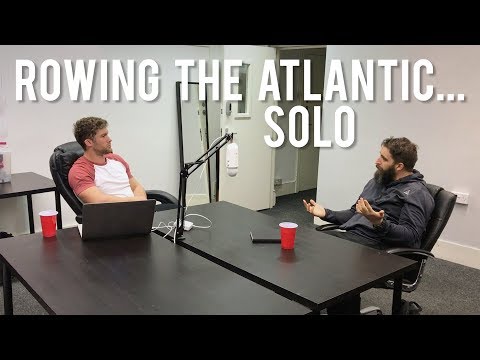
Rowing The Atlantic Solo | Stu Morton
Chris Williamson (host), Stu Morton (guest), Narrator, Narrator, Narrator
In this episode of Modern Wisdom, featuring Chris Williamson and Stu Morton, Rowing The Atlantic Solo | Stu Morton explores ex-Marine Prepares To Row Atlantic Solo In World-First Attempt Former Royal Marine Stuart Morton outlines his plan to row solo in a wooden boat from Portugal to Venezuela, a route that’s never been completed solo from mainland Europe to mainland South America.
Ex-Marine Prepares To Row Atlantic Solo In World-First Attempt
Former Royal Marine Stuart Morton outlines his plan to row solo in a wooden boat from Portugal to Venezuela, a route that’s never been completed solo from mainland Europe to mainland South America.
He explains the logistics, cost, training, risk management, and mental preparation required for roughly 100 days alone at sea and about 1.5 million oar strokes.
Morton contrasts race culture and record-chasing with his own focus on personal challenge and self-discovery, while acknowledging records help secure sponsors.
The row is a fundraising and awareness campaign for Rock2Recovery, a mental health charity supporting veterans with PTSD and brain trauma.
Key Takeaways
Choose challenges that genuinely test unknown limits, not just repeatable goals.
Morton differentiates between completing well-prepared events (like marathons) and entering challenges where you cannot fully simulate the stress in advance, such as a 100-day ocean row.
Get the full analysis with uListen AI
Set a clear date and publicly commit to create accountability.
He emphasizes that picking a launch date and telling people about the row forced him to solve problems, find a route, and keep moving forward instead of indefinitely postponing the project.
Get the full analysis with uListen AI
Train for robustness, not just specificity, in extreme endeavors.
Rather than only sitting on a rowing machine, Morton prioritizes broad functional fitness, strength, and overall durability, arguing that being “ready for anything” translates better to the unpredictable ocean.
Get the full analysis with uListen AI
Deliberate bodyweight manipulation can be a performance tool, not just aesthetic.
He intentionally gained ~27 kg (from 85 to 112 kg) and shifted to a high-fat, keto-style diet so his body can better burn fat during a multi-month energy deficit, treating weight gain as strategic fuel storage.
Get the full analysis with uListen AI
Plan for self-reliance: assume critical systems will fail.
Morton learns to strip and rebuild every component on the boat “upside down and in the dark,” and has layered backups for steering, water making, and ballast so a single failure doesn’t end the expedition.
Get the full analysis with uListen AI
Redefine ‘bad weather’ as an opportunity where safely possible.
He distinguishes between truly dangerous storms and heavy conditions that can be exploited to surf waves and gain “free speed,” highlighting how mindset and skill can turn threats into advantages.
Get the full analysis with uListen AI
Mental health support must be as prioritized as physical injury care for veterans.
Through Rock2Recovery, Morton stresses that PTSD and brain trauma are under-served compared to visible injuries, and fast, proactive intervention for veterans and their families can prevent crisis and suicide.
Get the full analysis with uListen AI
Notable Quotes
“There’s not many things left that no one’s ever done before… it was one of those last things to grab.”
— Stuart Morton
“More people have climbed Everest than have rowed the Atlantic.”
— Stuart Morton
“It’s one thing to say you’re gonna do it, but actions are remembered long after words are forgotten.”
— Stuart Morton
“The true test is the test itself. If it takes me 120 days, I’m not really bothered.”
— Stuart Morton
“At the moment there’s no prosthetics for the mind.”
— Stuart Morton
Questions Answered in This Episode
How do you plan to cope psychologically with prolonged solitude and monotony once the initial excitement wears off?
Former Royal Marine Stuart Morton outlines his plan to row solo in a wooden boat from Portugal to Venezuela, a route that’s never been completed solo from mainland Europe to mainland South America.
Get the full analysis with uListen AI
What specific signs of mental strain or PTSD should veterans’ families look for, and how can they practically support someone they’re worried about?
He explains the logistics, cost, training, risk management, and mental preparation required for roughly 100 days alone at sea and about 1. ...
Get the full analysis with uListen AI
If a critical system fails mid-ocean—like your water maker or auto-helm—what is your exact decision-making process for when to improvise versus when to trigger a rescue?
Morton contrasts race culture and record-chasing with his own focus on personal challenge and self-discovery, while acknowledging records help secure sponsors.
Get the full analysis with uListen AI
After experiencing such an extreme, high-focus challenge, how do you anticipate re-adjusting to everyday life when you return?
The row is a fundraising and awareness campaign for Rock2Recovery, a mental health charity supporting veterans with PTSD and brain trauma.
Get the full analysis with uListen AI
To what extent do you think social media and public documentation add pressure or meaning to a challenge that you primarily view as a personal test?
Get the full analysis with uListen AI
Transcript Preview
(wind blowing) Um, so Mr. Stuart Morton? Welcome.
Yeah. You all right? How you doing?
Very good, thank you. How are you?
Good.
Fantastic.
Yeah.
So we've known each other for nearly a year now-
Mm-hmm.
... um, through Reebok Tyneside and a few other bits and pieces as well.
Yeah.
And since I met you, you've had a- an idea that I think is probably one of the- the maddest things that I've ever heard. It's the sort of- the sort of story that you hear about in the news, but you never actually know anyone who's going to go ahead and do it. So I guess, in short, what- what's your next three months gonna look like? What are you doing?
Um, I'm gonna row a wooden rowing boat from Portugal to Venezuela, um, which has actually never been done before by anybody solo.
Wow.
It's been done by a team of five guys before, um, but never done by someone on their own. So it'll be like a world's first and all that sort of stuff.
So you're rowing across the Atlantic Ocean-
Yeah.
... on your own?
Yeah. From Mainland Europe to Mainland South America, which is important 'cause there's a race that exists where people go from the Canary Islands to the Caribbean, so it takes in sort of 80% of the Atlantic Ocean.
Uh-huh.
Um, and it's- long story short, it's 20 grand to enter, um-
Wow.
... and there's more kudos attached to going from Mainland Europe to Mainland South America.
Right.
'Cause it's about 1,000 miles longer-
Uh-huh.
... than the- the race. Um, so that's the reason for- for choosing that.
Mm-hmm.
And then also the fact that no one's ever done it before, so-
Wow.
... there's not many things left that no one's ever done before-
Yeah, there's not many, uh-
... in this world, stuff, especially in exploration and stuff, and adventures. Um, so it was one of those, like, last things to grab, and it just sort of built, as it, uh, you know, as it evolved, it sort of built into what it is now.
Mm-hmm.
Um, the initial intention was to just row the Atlantic. Um, and-
And is that in- in any way possible?
Say again?
In any way possible?
Yeah.
From whatever bit to whatever bit, so to speak?
Yeah. And being kind of naive to it, I was just like, "Well, I want to row the Atlantic. What's the most common form of doing that? And then I'll- I'll try that."
Mm-hmm.
Um, and then looking into it and peeling back the layers, you sort of figure out what's on offer.
Mm-hmm.
Um, and then through a bit of sort of bucking against the rules and sort of not wanting to conform-
Install uListen to search the full transcript and get AI-powered insights
Get Full TranscriptGet more from every podcast
AI summaries, searchable transcripts, and fact-checking. Free forever.
Add to Chrome