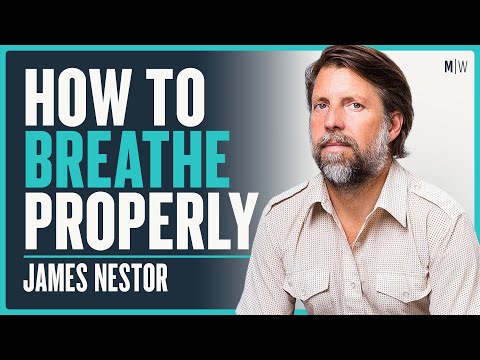
Change Your Breath, Change Your Life - James Nestor | Modern Wisdom Podcast 350
James Nestor (guest), Chris Williamson (host)
In this episode of Modern Wisdom, featuring James Nestor and Chris Williamson, Change Your Breath, Change Your Life - James Nestor | Modern Wisdom Podcast 350 explores master Your Breath: Transform Health, Stress, Sleep, and Performance Naturally James Nestor explains how modern humans breathe in chronically dysfunctional ways, and how simple, science-backed breathing changes can dramatically impact health, stress, sleep, and athletic performance.
Master Your Breath: Transform Health, Stress, Sleep, and Performance Naturally
James Nestor explains how modern humans breathe in chronically dysfunctional ways, and how simple, science-backed breathing changes can dramatically impact health, stress, sleep, and athletic performance.
He distinguishes between automatic and conscious control of the autonomic nervous system, showing how breath is a rare lever we can voluntarily pull to influence heart rate, blood pressure, inflammation, and even metabolism.
The conversation ranges from ancient techniques like Tummo and modern methods like Wim Hof breathing, to everyday issues such as mouth breathing, snoring, sleep apnea, and office “email apnea.”
Nestor emphasizes that breathing is not a miracle cure, but a foundational habit that, when optimized, can help bring many bodily systems back into balance and enhance both longevity and performance.
Key Takeaways
Prioritize nasal breathing over mouth breathing, day and night.
Breathing through the nose slows airflow, pressurizes and filters air, improves gas exchange, and makes over-breathing harder; chronic mouth breathing is linked to snoring, sleep apnea, anxiety, asthma, and other issues.
Get the full analysis with uListen AI
Breathe less but better: slow, low, and in line with metabolic needs.
Over-breathing (especially rapid chest breathing) blows off too much CO₂, constricts blood vessels, and reduces oxygen delivery to tissues; slower nasal breathing improves circulation, oxygen efficiency, and energy with less physiological wear and tear.
Get the full analysis with uListen AI
Use breath to regulate stress instead of relying only on pills and gadgets.
Simple patterns like inhaling for ~3–4 seconds and exhaling for ~6–8 seconds can measurably lower heart rate and blood pressure, counteracting chronic sympathetic arousal from modern “threats” like email and social stress.
Get the full analysis with uListen AI
Tackle sleep-disordered breathing to protect long-term health.
Snoring and sleep apnea are not “normal” quirks; they fragment sleep, raise blood pressure, spike blood sugar and cortisol, and are linked to diabetes, hypertension, and even Alzheimer’s. ...
Get the full analysis with uListen AI
Train CO₂ tolerance to boost endurance and performance.
The urge to breathe is driven primarily by CO₂, not lack of oxygen; building tolerance through slow-breathing or controlled breath-hold drills allows better oxygen delivery, lower heart rates at a given workload, and often improved VO₂ max and recovery.
Get the full analysis with uListen AI
Incorporate nasal breathing into exercise, accepting a temporary performance dip.
Switching from mouth to nasal breathing during training initially feels uncomfortable and may slow you down, but over weeks can lead to more efficient work, lower heart rates, better fat oxidation, and improved overall output.
Get the full analysis with uListen AI
Use physical pursuits or breathwork as deliberate “peace from mind” practices.
Activities like free diving, intense breath sessions, or other high-focus skills force presence by making distraction impossible, offering a non-technological route to states of deep concentration and nervous system reset that our biology seems to crave.
Get the full analysis with uListen AI
Notable Quotes
“We get most of our energy from our breath. If you think that how you’re inhaling and exhaling 20,000 times a day doesn’t matter, you’re crazy.”
— James Nestor
“The autonomic nervous system is called autonomic as in automatic, beyond our control. And yet we can immediately affect it by controlling our breathing.”
— James Nestor
“Breathing is not going to fix all of your problems, but when people have very dysfunctional breathing, breathing more efficiently can allow the body to come back into balance.”
— James Nestor
“How dare you be born a human with this capacity to do these amazing things, and instead sit in front of your computer and watch Netflix all day eating popcorn?”
— James Nestor (paraphrasing the perspective of monks and freedivers)
“We don’t want peace of mind. We want peace from mind.”
— Naval Ravikant (quoted by Chris Williamson
Questions Answered in This Episode
How can an average person design a simple, sustainable daily breathing practice that measurably improves sleep, stress, and focus without feeling like a chore?
James Nestor explains how modern humans breathe in chronically dysfunctional ways, and how simple, science-backed breathing changes can dramatically impact health, stress, sleep, and athletic performance.
Get the full analysis with uListen AI
What objective markers (HRV, CO₂ tolerance tests, pulse oximetry, sleep data) are most useful for tracking improvements from breath training over weeks and months?
He distinguishes between automatic and conscious control of the autonomic nervous system, showing how breath is a rare lever we can voluntarily pull to influence heart rate, blood pressure, inflammation, and even metabolism.
Get the full analysis with uListen AI
Where is the line between beneficial hormetic stress from intense breathing techniques and potentially harmful overuse or dysregulation?
The conversation ranges from ancient techniques like Tummo and modern methods like Wim Hof breathing, to everyday issues such as mouth breathing, snoring, sleep apnea, and office “email apnea.”
Get the full analysis with uListen AI
Given the strong links between sleep-disordered breathing and conditions like diabetes and Alzheimer’s, should routine screening for snoring and apnea be a standard part of primary care?
Nestor emphasizes that breathing is not a miracle cure, but a foundational habit that, when optimized, can help bring many bodily systems back into balance and enhance both longevity and performance.
Get the full analysis with uListen AI
How might modern architecture, work culture, and technology be redesigned to reduce chronic low-grade stress and dysfunctional breathing patterns in everyday life?
Get the full analysis with uListen AI
Transcript Preview
I want to be very clear, breathing is not going to fix all of your problems, right? But what I have found is that when people have very dysfunctional breathing, when you start controlling your breathing and you breathe in a more efficient way, the body can come back into balance. (wind blowing sound)
James, welcome to the show. How crazy has the last year been for you after your book came out? Because it feels like breathwork is everywhere at the moment.
Well, I think it was a crazy year for everybody for so many different reasons. I mean, you put a pandemic onto a virtual book tour, onto me finally coming out of my closet, uh, after so many years of research and writing to be on the other side of the mic, and it's been, uh, complete and utter chaos to- to put it mildly, but in all- almost all good ways. So, I'm very grateful for the attention, and I'm very grateful that people have discovered breathing as a way to help improve their health.
Yeah. And you talk about how these insights of breathing have been around for a very, very long time, you know, thousands and thousands of years, but aren't still now super widely known. Isn't it crazy in the 21st century that we can still have gated information, that there's stuff that monks in monasteries somewhere know, but that the internet doesn't?
Hmm. Well, I think that if you look at medicine, and if you look at so much of science, uh, this is exactly the pattern it takes, is, in one culture a group will discover something to be true, and then a- another culture where that group had no association with the previous group, they discovered the same exact thing. This is true with nutrition, it's true with exercise, and it's certainly true with breathing. So, it wasn't that surprising to see that we've had this huge blind spot, because we've had huge blind spots in regards to so many other things, so many other very basic things that have to do with human health.
Yeah, we saw that with Matthew Walker's book, right? The- why we sleep. W- wh- why should a book about something that everybody does for a third of their life be so revolutionary?
(laughs) I was just talking with Matthew Walker a couple of weeks ago. I was lucky enough to interview him, uh, at a conference, our first conference, uh, since the pandemic has somewhat lightened up here in the US, and I was cracking up because when I first heard of that book, I said, "You have to be kidding me. Oh, now some guy wants to teach me how to sleep. I sleep just fine." And then, we realized that breathing and sleeping, uh, both people expect them to be a default reaction, something that we don't need to think about. But then, you look at populations, across populations of- of people who are sleeping and people who are breathing dysfunctionally, and there is an epidemic going on- on- on both of those fronts. And there's a lot of crossover that- that Venn diagram between disordered sleeping and disordered breathing. And so, uh, you know, these simple things, I think, get so ignored because they're so simple, and yet just adopting the most basic, simple human habits can really enrich your- your life and i- on so many levels, and the science is very clear about that.
Install uListen to search the full transcript and get AI-powered insights
Get Full TranscriptGet more from every podcast
AI summaries, searchable transcripts, and fact-checking. Free forever.
Add to Chrome