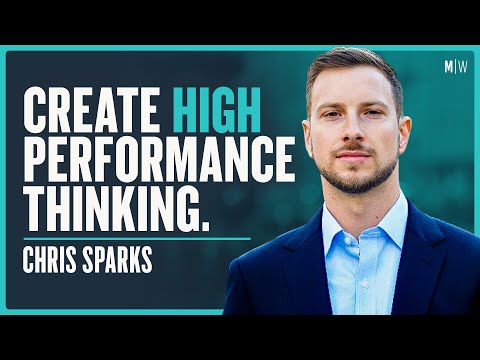
The Mindset Rules Of A Poker Professional - Chris Sparks
Chris Sparks (guest), Chris Williamson (host)
In this episode of Modern Wisdom, featuring Chris Sparks and Chris Williamson, The Mindset Rules Of A Poker Professional - Chris Sparks explores poker Pro Reveals Mindset Blueprint: Goals, Enoughness, And Intuition Mastery Chris Sparks, a high-stakes poker pro and performance coach, unpacks how poker, investing, and life all hinge on separating identity from outcomes while still aiming aggressively at ambitious goals. He describes preparing obsessively for a massive Bitcoin-denominated tournament, losing in an 80/20 spot, and choosing to interpret it as “this is what 20% feels like” rather than a personal failure. The conversation then explores the balance between systems and goals, choosing a single North Star, avoiding “productive” distractions, and overcoming scarcity mindset by operating from an inner sense of “I’ve already won.” Sparks also details how to lean on intuition built from experience, manage emotions as data rather than enemies, and design a daily routine that front-loads high‑leverage work and reduces “opportunity anxiety.”
Poker Pro Reveals Mindset Blueprint: Goals, Enoughness, And Intuition Mastery
Chris Sparks, a high-stakes poker pro and performance coach, unpacks how poker, investing, and life all hinge on separating identity from outcomes while still aiming aggressively at ambitious goals. He describes preparing obsessively for a massive Bitcoin-denominated tournament, losing in an 80/20 spot, and choosing to interpret it as “this is what 20% feels like” rather than a personal failure. The conversation then explores the balance between systems and goals, choosing a single North Star, avoiding “productive” distractions, and overcoming scarcity mindset by operating from an inner sense of “I’ve already won.” Sparks also details how to lean on intuition built from experience, manage emotions as data rather than enemies, and design a daily routine that front-loads high‑leverage work and reduces “opportunity anxiety.”
Key Takeaways
Anchor identity to effort and process, not to outcomes.
Sparks emphasizes that in poker, investing, and life, you can do everything right and still lose; long-term sustainability requires seeing yourself as successful for showing up, improving, and “being in the arena,” not for any single win or loss.
Get the full analysis with uListen AI
You need clear goals to grow; systems exist to serve those goals.
He argues that a pure “systems only” mindset (inspired by Atomic Habits) is incomplete: without explicit targets and tracking, you risk working hard on the wrong things and mistaking motion for progress.
Get the full analysis with uListen AI
Choose one North Star and treat everything else as a distraction.
Because results follow a power law, one project or one hour typically dwarfs all others in impact; committing to a single primary goal for a defined period (e. ...
Get the full analysis with uListen AI
Continuously align actions with your top values to avoid quiet self-betrayal.
By forcing yourself to rank values (e. ...
Get the full analysis with uListen AI
Operate from ‘I’ve already won’ to escape scarcity and moving goalposts.
Sparks critiques the endless “when I have X, then I’ll be happy” loop; adopting an inner stance of enoughness reduces anxiety, makes you less outcome-attached, and lets you pursue ambitious goals with a lighter touch.
Get the full analysis with uListen AI
Trust intuition built from reps, then analyze critically after the fact.
He defines intuition as internalized experience: in the moment you act quickly and confidently on your gut, and only afterward switch into analytical mode to review mistakes—this speeds learning and avoids overthinking live decisions.
Get the full analysis with uListen AI
Front-load key habits and work to minimize ‘opportunity anxiety.’
Leaving important tasks or routines (meditation, deep work, workouts) unfinished creates a constant mental tax of thinking about them; doing them early frees attention, reduces background stress, and improves the felt quality of the entire day.
Get the full analysis with uListen AI
Notable Quotes
“This is what 20% feels like. Twenty percent of the time I’m going to lose, and this is one of those times.”
— Chris Sparks
“I’ve already won. I don’t need to do anything else. I have nothing else to prove.”
— Chris Sparks
“There is no growth without goals.”
— Chris Sparks
“Your best hour today, what you do in that hour is going to be worth more than the rest of the day combined.”
— Chris Sparks
“The most dangerous distractions are the ones that feel productive to you because it’s you working on goal number three, four, and five to procrastinate on goal number one.”
— Chris Sparks
Questions Answered in This Episode
How can someone practically transition from a scarcity-driven mindset to genuinely feeling like they’ve ‘already won’ without losing ambition?
Chris Sparks, a high-stakes poker pro and performance coach, unpacks how poker, investing, and life all hinge on separating identity from outcomes while still aiming aggressively at ambitious goals. ...
Get the full analysis with uListen AI
What criteria should you use to choose a single North Star goal when you truly care about several competing priorities?
Get the full analysis with uListen AI
How do you distinguish between healthy intuition and uncalibrated impulse, especially early in a new domain where you lack experience?
Get the full analysis with uListen AI
What are some concrete signs that you’re stuck in ‘shadow projects’ or a ‘shadow career’ instead of doing the real work you’re meant to do?
Get the full analysis with uListen AI
In everyday life outside of poker or investing, how can people implement Sparks’ plan–execute–reflect ‘improvement loop’ to ensure continuous improvement?
Get the full analysis with uListen AI
Transcript Preview
... your best hour today, what you do in that hour is going to be worth more than the rest of the day combined. That long to-do list you have, that ten things that you say you're going to do today, one of the things on your list, if you did that, it would be worth more than doing everything else on the list combined.
(wind blowing) Christoph, welcome to the show.
Honored to be here, Chris. Good to see you.
Good to see you too, man. So the last time that we spoke was in the carpark of Cosmic Coffee, uh, across the street from where I was staying in Austin, and you were gearing up for a very big poker tournament-
That's right.
... that was happening quite soon. Tell me, uh, tell everybody what that was, and let me know how you got on.
Sure. So I went on a bit of a poker sabbatical, uh, in June of last year, and I wanted to take some time to travel and focus on, on some other things, maybe have a normal schedule for a while, and I got alerted to a private tournament that was happening, and the tournament was denominated in Bitcoin, so it was attracting a lot of people who were, let's say, whales in the, uh, the crypto ecosystem. Not necessarily poker whales, but people who are, like, generally good to play with. And I was obviously intrigued. Uh, I don't consider myself a tournament player, but this was a possibility of playing in a very large buy-in tournament with people who I think I would have, uh, a pretty big advantage on. So I took myself out of semi-retirement for (laughs) , you know, the fifth or sixth time, and, uh, went on a, uh, training program, both in tournaments, but also, you know, physically, mentally, to develop the, the discipline, the stamina, the presence that I thought would allow me to maximize this opportunity.
And you got out there and talked me through that.
(laughs) Oh, I'm gonna get in trouble. I wish, I wish I knew this was coming. Uh, I think I played very well. Uh, as in many things in life, uh, the cards fall where they may. Uh, I mean, there's many times in poker... You know, really, success in poker is you have lots of these 55-45 spots where you, you're 55% to win, and you just get enough of these, and eventually, you're stacking all the money in the world, right? It's like, when I play cash games, I get enough hands that all these small edges compound and multiply. And the best possible situation that you can get into in Texas hold 'em is that you are an 80-20 favorite, meaning that you are going to win 80% of the time. And in this case, I got all in pre-flop with pocket kings against pocket 10s. It was a scenario that I had been setting up all day, and it went exactly how I'd written it up, and if I win this hand, which I'm going to win 80% of the time, I'm the chip leader in the tournament, and based on who was left and the situation, so this was approaching the money bubble. Uh, those of you guys who don't play tournaments, the bubble is right before the payouts begin. So usually people really tighten up. They start put, being a lot more risk-averse, playing less hands, because no one wants to walk away empty-handed. So if you are in no danger of losing, as I would've been, having the most of the chips, you can really ramp up the aggression and put a lot of pressure on players and chip up very quickly. So I, I believe that I, had I won this hand, there were five players remaining at the time, uh, I was a, I was a heavy favorite to win the tournament. Alas, a 10 comes on the river, uh, and I am out of the tournament. And it's always important, especially when you are playing a single hand for, uh, well over six figures in expectation, and you're mentally counting the chips, and all of a sudden you are standing up and everyone's kind of feeling a little bit bad for you, but also internally very grateful that the best player left is no longer in the tournament. You just kinda have to tell yourself as, uh, "This is what 20% feels like. Uh, 20% of the time, I'm going to lose, and this is one of those times, and I did everything that was in my control." So-
Install uListen to search the full transcript and get AI-powered insights
Get Full TranscriptGet more from every podcast
AI summaries, searchable transcripts, and fact-checking. Free forever.
Add to Chrome