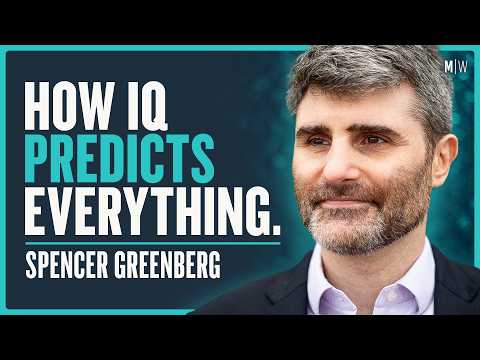
IQ Is Misunderstood - Spencer Greenberg
Chris Williamson (host), Spencer Greenberg (guest), Narrator
In this episode of Modern Wisdom, featuring Chris Williamson and Spencer Greenberg, IQ Is Misunderstood - Spencer Greenberg explores iQ, Personality, And Imposter Syndrome: Rethinking What Really Matters Spencer Greenberg discusses his large-scale research on intelligence, challenging extreme views of IQ as either meaningless or destiny. His team replicated many classic findings, showing that a general intelligence factor (g) explains about 40% of variance in lab-based cognitive tasks, while the remaining 60% reflects specific aptitudes and skills. He argues that personality traits often predict life outcomes (income, education, GPA) better than IQ, and that IQ is surprisingly uncorrelated with happiness or life satisfaction. The conversation expands to imposter syndrome, Dunning–Kruger, and personality disorders like narcissism and sociopathy, emphasizing how misunderstood traits can quietly shape relationships, careers, and well‑being.
IQ, Personality, And Imposter Syndrome: Rethinking What Really Matters
Spencer Greenberg discusses his large-scale research on intelligence, challenging extreme views of IQ as either meaningless or destiny. His team replicated many classic findings, showing that a general intelligence factor (g) explains about 40% of variance in lab-based cognitive tasks, while the remaining 60% reflects specific aptitudes and skills. He argues that personality traits often predict life outcomes (income, education, GPA) better than IQ, and that IQ is surprisingly uncorrelated with happiness or life satisfaction. The conversation expands to imposter syndrome, Dunning–Kruger, and personality disorders like narcissism and sociopathy, emphasizing how misunderstood traits can quietly shape relationships, careers, and well‑being.
Key Takeaways
IQ captures only part of cognitive ability; skills and aptitudes matter enormously.
Greenberg’s 62-task battery showed that IQ (g) explains about 40% of performance differences, leaving 60% to task-specific aptitudes and noise. ...
Get the full analysis with uListen AI
IQ predicts many objective outcomes but does not predict happiness or life satisfaction.
Higher IQ is associated with better socioeconomic outcomes (income, education, lower incarceration), yet Greenberg’s data and others’ show essentially zero correlation with life satisfaction or perceived goal attainment, suggesting some offsetting downside in how high-IQ people structure or experience their lives.
Get the full analysis with uListen AI
Personality traits often outpredict IQ for real-world success metrics.
When Big Five personality traits were pitted against IQ for predicting GPA, income, and education, personality either matched or beat IQ on almost every outcome. ...
Get the full analysis with uListen AI
Self-assessments of intelligence are weakly accurate; people systematically misjudge themselves.
In Greenberg’s study, estimated IQ and measured IQ correlated only about 0. ...
Get the full analysis with uListen AI
Imposter syndrome is common and tightly linked to perfectionism and harsh self-talk.
Key impostor beliefs include fear of being “found out” and worrying you can’t meet others’ expectations again. ...
Get the full analysis with uListen AI
Classic Dunning–Kruger plots can arise without any special stupidity effect.
Greenberg’s simulations show that noisy tests plus rational Bayesian updating can reproduce the same “low performers overestimate, high performers underestimate” pattern. ...
Get the full analysis with uListen AI
Narcissism and sociopathy are over-labeled yet under-recognized where they matter most.
Many difficult people are not disordered, while true narcissistic and antisocial personality disorders are relatively rare but disproportionately harmful in close, high-stakes relationships. ...
Get the full analysis with uListen AI
Notable Quotes
“IQ captured about 40% of the variation in people’s ability at our 62 intelligence tasks, which means 60% is not being explained by IQ.”
— Spencer Greenberg
“Nobody’s really figured out a good way to raise your IQ… but you can get good at anything you want.”
— Spencer Greenberg
“The shocking thing to me was that personality won on almost every one of the predictions, or it tied IQ. I don’t think it lost on a single one.”
— Spencer Greenberg
“It’s not correlated with life satisfaction or happiness. And this is our finding, it’s also a finding of others. I view it as this incredible mystery I hope someone figures out.”
— Spencer Greenberg
“I want to fail at more things than most people try at their entire life.”
— Spencer Greenberg
Questions Answered in This Episode
If IQ doesn’t increase happiness, what should parents and policymakers prioritize when thinking about education or embryo selection?
Spencer Greenberg discusses his large-scale research on intelligence, challenging extreme views of IQ as either meaningless or destiny. ...
Get the full analysis with uListen AI
How can an individual practically lean into their idiosyncratic aptitudes while also building high-value skills, regardless of their IQ score?
Get the full analysis with uListen AI
What are concrete signals that distinguish a truly disordered narcissist or sociopath from someone who’s just self-centered or abrasive?
Get the full analysis with uListen AI
Could widespread use of embryo selection for traits like IQ or mental health risk meaningfully change societal structures—or mainly shift status competitions?
Get the full analysis with uListen AI
How might someone with strong impostor feelings redesign their internal dialogue and work habits without sacrificing their drive to achieve?
Get the full analysis with uListen AI
Transcript Preview
What was this study you did on intelligence?
Yeah. So some people say that IQ is a pseudoscientific swindle and other people think it fully captures everything about your intelligence and says who you are as a person fundamentally. And y- as you probably know, there was a big replication crisis in social science where many studies failed to replicate and so we thought, "Hey, we can do our part by trying to replicate a lot of claims about IQ and intelligence." So we recruited over 3,000 people. We implemented 62 distinct intelligence tasks, which includes everything from, like, memorization, puzzle solving, math problems, spelling, reaction time, sort of everything you could possibly think about that you could do online automatically. And then, uh, we tested about 40 different claims that are made about intelligence and we checked if they held up.
Right. Yeah, the, it is... Intelligence is kind of like the barbell chalk and cheese. It's the, uh, how would you say? It's like the cognitive Rorschach test.
(laughs)
It's like what do you... What... How you see it kind of tells me probably quite a lot about your priors coming into it. You're right. It's either the fundamental underpinning that explains all of the outcomes that you're going to get in life or it is a Nazi-ish policy that n- n- never had any basis in science and should be totally disbanded.
Yeah. It's, it's pretty wild. And so the question is like, yeah, what's really true about it? To what extent does academia write about it? To what extent do the lay public write about it? And so we explored a bunch of those questions.
Why do you think... Even before we get into that, why do you think it's so contentious?
Yeah. I think it's a few things. One, it does have a horrendous history. It was used, for example... Like, the idea of IQ or measuring intelligence was used for forced sterilization, so that's pretty horrible. I mean, the Nazis got into really s- some evil stuff around, you know, thinking about how intelligent people are and, and murdering people on that basis. Um, so I think that's part of it. I think another thing is, you know, everyone kind of thinks... It's like, yeah, it's good to be organized, but if someone says you're disorganized, it doesn't feel like it cuts to the bone, like, of who you are as a human or it doesn't make you subhuman, but I think some people feel this about intelligence. If you're told you're unintelligent, then it sort of, like, says you're bad in a kind of a fundamental way or you're lesser-
You're less of a person. Yeah.
Exactly. And I think that's... You know. And I think, um... So I think it, it feels different.
That's interesting. Intelligence is very close to our sense of self in a way that the cleanliness of our cupboards, uh, or, like, our obsessiveness or something isn't quite so much.
Install uListen to search the full transcript and get AI-powered insights
Get Full TranscriptGet more from every podcast
AI summaries, searchable transcripts, and fact-checking. Free forever.
Add to Chrome