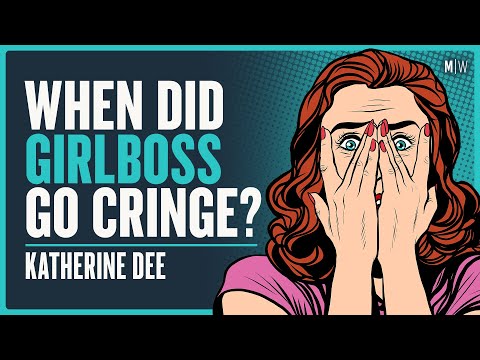
The Rise And Fall Of The Girlboss Meme - Katherine Dee
Katherine Dee (guest), Chris Williamson (host)
In this episode of Modern Wisdom, featuring Katherine Dee and Chris Williamson, The Rise And Fall Of The Girlboss Meme - Katherine Dee explores from Girlboss Burnout To Sex Negativity: Mapping Modern Dating Culture Chris Williamson and writer Katherine Dee unpack the rise and fall of the ‘girlboss’ archetype, the shift from sex positivity to sex skepticism, and how internet subcultures shape modern dating expectations for both men and women.
From Girlboss Burnout To Sex Negativity: Mapping Modern Dating Culture
Chris Williamson and writer Katherine Dee unpack the rise and fall of the ‘girlboss’ archetype, the shift from sex positivity to sex skepticism, and how internet subcultures shape modern dating expectations for both men and women.
Dee explains how legacy media, Tumblr, and now TikTok amplified fringe ideas into mainstream discourse, fueling trends around identity, sexuality, and feminism that are now entering a more self-critical, moderate phase.
They explore how chronically online life distorts perceptions of romance, increases “ambient rejection,” and encourages pathological dating strategies on both sides, from incel culture to girlboss oversharing and manifestation fantasies.
The conversation closes with Dee’s blunt dating heuristics, emphasizing boundaries, predictability, shared values, and the dangers of high body counts, limerence, and trying to manipulate relationships via sex or convoluted “hacks.”
Key Takeaways
The girlboss archetype burned out as its promises clashed with loneliness and aging.
What began as an empowering ideal—women ‘having it all’ in career and casual sex—devolved into a “train-wreck girlboss” trope of oversharing, manic spending, and emotional denial, which many women abandoned as it stopped serving them in their 30s.
Get the full analysis with uListen AI
Sex positivity has hit its limit, prompting a swing toward sex skepticism and restraint.
After years of pushing every taboo—from Teen Vogue kink pieces to extreme TikTok content—the only way to be transgressive became ideological, and many young people and mainstream feminists are now re-evaluating hookup culture, MeToo excesses, and casual sex norms.
Get the full analysis with uListen AI
Online life massively increases low-level rejection, which compounds into deeper hurt.
Dee’s “rejection sensitivity” idea highlights that dating apps, social media, and ghosting create thousands of micro-rejections, so when a big rejection hits, it lands on top of a huge unseen pile, making people feel far more fragile and jaded than they realize.
Get the full analysis with uListen AI
Most ‘new’ TikTok pathologies are old internet patterns with bigger reach.
Trends like self-diagnosed multiple personality disorder appeared on Usenet and personal sites long before TikTok; what’s changed is user volume and journalists amplifying niche behaviors for clicks, turning micro-subcultures into perceived generational crises.
Get the full analysis with uListen AI
Dating works best with clear boundaries, moderate availability, and predictability.
Dee’s advice stresses not being constantly available, avoiding “relationship purgatory,” valuing people who are emotionally predictable, and recognizing that convoluted dating hacks and love-bombing narratives often mask simple truths: interest, or lack of it.
Get the full analysis with uListen AI
High partner counts and constant ‘failing forward’ in love can spiritually exhaust people.
Beyond moral or religious arguments, both sexes risk becoming jaded: people start to see partners as interchangeable, sex loses meaning, and it becomes harder to invest sincerely in long-term relationships after too many similar experiences.
Get the full analysis with uListen AI
Shared values and background are strong predictors of durable relationships.
Couples from similar cultural, geographic, and value frameworks avoid endless conflict over basics like where to live or how to raise children; many breakups Dee and Williamson see stem from deep value clashes, not superficial compatibility issues.
Get the full analysis with uListen AI
Notable Quotes
“You can't really be a girlboss if you're completely alone, quarantined in your apartment.”
— Katherine Dee
“When all the taboos have become mainstream, there is nothing left to transgress other than ideological transgression.”
— Chris Williamson (paraphrasing Ben Shapiro)
“We're sort of swimming in this soup of rejection, and it has to have an impact on the way we feel.”
— Katherine Dee
“If he doesn’t want to date you, he doesn’t want to date you. Doing this is a good way to get used for your body.”
— Katherine Dee
“We weren’t designed to be exposed to this many people this frequently.”
— Chris Williamson
Questions Answered in This Episode
How can individuals consciously step out of ‘chronically online’ dating narratives and recalibrate their expectations using real-world experience?
Chris Williamson and writer Katherine Dee unpack the rise and fall of the ‘girlboss’ archetype, the shift from sex positivity to sex skepticism, and how internet subcultures shape modern dating expectations for both men and women.
Get the full analysis with uListen AI
What practical steps can women take if they recognize themselves in the ‘train-wreck girlboss’ or Call Her Daddy-style empowerment scripts and feel they’ve been harmed by them?
Dee explains how legacy media, Tumblr, and now TikTok amplified fringe ideas into mainstream discourse, fueling trends around identity, sexuality, and feminism that are now entering a more self-critical, moderate phase.
Get the full analysis with uListen AI
How should we distinguish between legitimate MeToo cases and overzealous public shaming, and who should set those boundaries in a click-driven media ecosystem?
They explore how chronically online life distorts perceptions of romance, increases “ambient rejection,” and encourages pathological dating strategies on both sides, from incel culture to girlboss oversharing and manifestation fantasies.
Get the full analysis with uListen AI
In a world of ambient rejection, what habits can people adopt to build resilience without becoming cynical or avoidant about relationships?
The conversation closes with Dee’s blunt dating heuristics, emphasizing boundaries, predictability, shared values, and the dangers of high body counts, limerence, and trying to manipulate relationships via sex or convoluted “hacks.”
Get the full analysis with uListen AI
If high body count and limerence are spiritually exhausting, what does a healthier path into dating and sexuality look like for people starting in their late teens and 20s today?
Get the full analysis with uListen AI
Transcript Preview
She fails at dating, but who cares? She's doing great at her career. She doesn't need a man, but she's gonna sleep around like a man anyway. She's, like, not afraid to admit she, like, farts. You know, you know, this is like a very specific sort of girl that was, like, really sort of popular in the 2010s. They had a manic episode and spent $18,000, but who cares because, you know, they're a product manager at Facebook. (laughs)
Do you think that you're a pickup artist?
(laughs) No. (laughs)
You recently released a podcast where you considered that you might have been a pickup artist all along. And definitely some of the insights that I've seen you write are unusually incisive, I think, about the dating world. Where have they come from? Why have you taken such an interest in attraction and mating?
Um, well, so I have sort of a weird romantic history. I, uh, I got married very young and then I got divorced, and so my first real time on the dating market, I was already in my late 20s. Um, and, like, I've, it was like a crash course. And I be- it was the first, um, I don't know if relationship's even the right word, but my first sort of foray into dating was so humiliating, I became, like, autistically sort of obsessed with preventing that pain. (laughs) Um, and I was like, "I, I can't ever feel like this again." Um, because I really felt like I was, like, 14, um, but I was 27, and it was just, it was, like, the worst.
Does that-
And I think that's what motivates me.
Yeah, does that suggest that there's a, some time and attention that everyone needs to spend kind of breaking up, and making up, and learning those lessons, and that it doesn't come really as a byproduct of maturity or age, it comes as a byproduct of the amount of times that you've done it?
Um, I mean, I think you just have to have the, you know, requisite emotional intelligence. I don't think that (laughs) um, practicing on people al- like, that's also not, I wouldn't recommend that either, um, because, you know, you become jaded, right? And that's (laughs) that's the, that's the flip side. There's such a thing as too much experience.
That's definitely true. Two years ago, you predicted a coming wave of sex negativity. I think that you were absolutely on the money with that, although it's maybe moving a little bit more slowly than you might have thought. But I think that you're absolutely spot on. Why did you think that that was going to happen?
I started noticing, um... So the way I do my predictions is I look at where journalists are paying attention, um, because I really do, I still believe in legacy media and institutions. I feel like they guide the conversation. And a lot of my predictions are about media conversations as opposed to, like, on the ground behaviors. Um, and so one of the places that journalists scrape stories from, um, at least when I wrote that, I don't know how true that is now, is Twitter, right? And it was very trendy to be, um, sex skeptical. Um, sex negative might have been the wrong term, um, but I was, I mean, it's a very slipshod blog post. I was like Cassandra having visions when I wrote it. (laughs) Um, it, it was, a lot of young people are very sex skeptical. Um, and you know, it was also, we've kind of run out of gas on sex positivity, so you want to generate clicks. So it's like, how is the media conversation going to move and where is the zeitgeist gonna move? Um, so it kind of just made sense for the pendulum to, to swing. Like, you know, when we're at the point where Teen Vogue is, like, the right way to, you know, introduce your cannibalism fetish in the bedroom, right? There's, like, so many things wrong with that sentence. (laughs) It's like, you can only go bad, you can't, there's no, you can't go further than that. (laughs)
Install uListen to search the full transcript and get AI-powered insights
Get Full TranscriptGet more from every podcast
AI summaries, searchable transcripts, and fact-checking. Free forever.
Add to Chrome