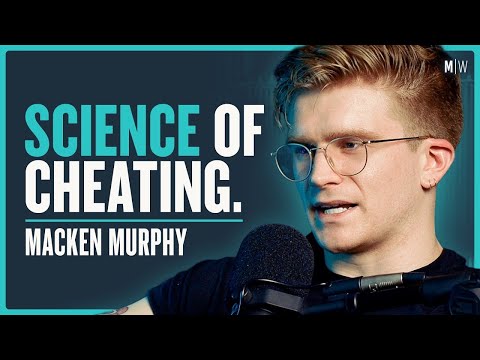
What Psychology Says About Women Who Cheat - Macken Murphy
Chris Williamson (host), Macken Murphy (guest), Narrator
In this episode of Modern Wisdom, featuring Chris Williamson and Macken Murphy, What Psychology Says About Women Who Cheat - Macken Murphy explores new Study Revives Controversial Theory On Why Women Cheat The conversation explores competing evolutionary psychology theories about female infidelity: the traditional Dual Mating hypothesis versus the newer Mate Switching hypothesis. Macken Murphy describes a preregistered study of 254 men and women who actually cheated, directly pitting the two theories’ predictions against each other. Results show affair partners are rated as more physically attractive but worse as parents than primary partners, strongly supporting Dual Mating and undermining Mate Switching in this dataset. The discussion also covers motives for cheating, sex differences in jealousy, predictors of infidelity, and broader implications for how ‘natural’ monogamy and cheating are in humans.
New Study Revives Controversial Theory On Why Women Cheat
The conversation explores competing evolutionary psychology theories about female infidelity: the traditional Dual Mating hypothesis versus the newer Mate Switching hypothesis. Macken Murphy describes a preregistered study of 254 men and women who actually cheated, directly pitting the two theories’ predictions against each other. Results show affair partners are rated as more physically attractive but worse as parents than primary partners, strongly supporting Dual Mating and undermining Mate Switching in this dataset. The discussion also covers motives for cheating, sex differences in jealousy, predictors of infidelity, and broader implications for how ‘natural’ monogamy and cheating are in humans.
Key Takeaways
New empirical data strongly supports the Dual Mating hypothesis over Mate Switching.
In Murphy’s preregistered study, affair partners were rated about two points higher in physical attractiveness, while primary partners were about three points higher in parental attractiveness—exactly the crossover pattern Dual Mating predicts (good genes from the affair partner, good parenting from the primary partner), and not what Mate Switching (trading up overall) would expect.
Get the full analysis with uListen AI
Women’s infidelity is multi-motivated, not explained by a single strategy.
Women most often cited relationship dissatisfaction, followed by an uninvested primary partner and revenge (often for a partner’s affair), and only a small fraction explicitly mentioned physical attractiveness—even though quantitative ratings show they clearly did ‘cheat up’ in looks.
Get the full analysis with uListen AI
Men show a similar cheating pattern: up in looks, down in parenting.
Contrary to the idea that men simply ‘cheat down’ for easy access and variety, male cheaters also tended to rate affair partners as more physically attractive but worse in parental qualities, suggesting a broader human pattern of seeking conceptive benefits in affairs and parental benefits in primary relationships.
Get the full analysis with uListen AI
Stated reasons for cheating often diverge from actual patterns of behavior.
Only about 5% of women said they cheated because the affair partner was attractive, yet 77% were more likely to prefer the affair partner’s looks in forced-choice ratings—highlighting limited self-insight and social desirability bias in people’s narratives about their own behavior.
Get the full analysis with uListen AI
Attachment, jealousy, and investment concerns map onto evolved risks for each sex.
Men are relatively more distressed by sexual infidelity (risk of cuckoldry) and women by emotional infidelity (risk of losing partner investment), aligning with paternity uncertainty for men and investment uncertainty for women, and fitting better with Dual Mating than pure Mate Switching.
Get the full analysis with uListen AI
Past behavior and sociosexuality are robust predictors of future cheating.
People who cheated in a previous relationship were about three times more likely to cheat in the next; high promiscuity, narcissism, and strong extra-pair interest (e. ...
Get the full analysis with uListen AI
Infidelity is “natural” in a socially monogamous species—but not universal.
Humans resemble other socially monogamous mammals that show regular extra-pair sex and some extra-pair paternity; most women don’t execute a dual-mating strategy, but evolved psychology likely includes biases that make affairs selectively advantageous in some contexts.
Get the full analysis with uListen AI
Notable Quotes
“Our study ended up being the best case scenario for dual mating, and the worst case scenario for mate switching.”
— Macken Murphy
“Women were 77% more likely to prefer their affair partner’s physical attractiveness than their primary partner’s. What a coincidence if that’s not a motivating factor.”
— Macken Murphy
“It’s incredibly patronizing how everyone’s happy when you talk about men’s evolved psychology, but as soon as you talk about women’s, it’s almost as if the whole story is about men.”
— Macken Murphy
“If you label everything as ‘the patriarchy’, then you’re basically saying that men are the only ones with their hands on the wheel.”
— Macken Murphy
“The consistent themes that you find throughout your life—if they continue to come up—have to have something to do with you.”
— Chris Williamson
Questions Answered in This Episode
If Dual Mating is supported, what does that practically mean for how couples should think about and manage risk around infidelity?
The conversation explores competing evolutionary psychology theories about female infidelity: the traditional Dual Mating hypothesis versus the newer Mate Switching hypothesis. ...
Get the full analysis with uListen AI
How might including purely emotional affairs (without sex) change the balance of evidence between Dual Mating and Mate Switching?
Get the full analysis with uListen AI
To what extent can people consciously override these evolved biases, or are some individuals effectively ‘wired’ to be more likely to cheat?
Get the full analysis with uListen AI
How should we interpret personal responsibility and moral blame if significant portions of cheating behavior are heritable and evolutionarily shaped?
Get the full analysis with uListen AI
Could different cultural or economic environments (e.g., resource scarcity vs. abundance) shift which infidelity functions—genes, resources, revenge, information—are most common?
Get the full analysis with uListen AI
Transcript Preview
You have caused some drama in the world of evolutionary psychology.
A little bit of drama. I- I try not to get in trouble, but certainly this, uh, last publication, uh, might be a little controversial within the field, sure.
What have you done? What's the current state of the leading infidelity hypothesis?
Well, I- I- I mean, (sighs) I guess we've got time to get into it, but it is a bit of a long story. So I would say that- that the background to know for someone who's just completely entry level here and has not heard about the evo infidelity debate is that there's been a long running debate as to the evolutionary drivers of women's infidelity, female infidelity in humans. And, you know, during the late '90s and the early 2000s and to an extent, uh, the- the 2010s as well, I would say that most evolutionary psychologists would have said that the primary driver of women's infidelity, from an evolutionary perspective, is the powerful benefit of being able to obtain better genes, right, better in a fitness sense, not... (laughs) obviously, not in a moral sense. And we might end up saying, you know, the phrase "good genes" quite a bit, uh, on this show, and- and every time it's always in, it's always good in a fitness sense. But in any case, the mainstream idea was that infidelity is a conditional strategy that women sometimes employ in order to obtain better genes for their offspring, right, so to pair the genetic benefits of one male with the parental investment benefits of another male. So everyone, when we're looking for mates, there are two things that they can give our offspring. They can give our offspring genes, obviously, uh, or they can give our offspring investment. And normally women get genes and investment from the same person, but the idea was is that women's infidelity allows them to get genes from one person and parenting from another. Let's say if they're with a mate who is very high investment, right? They're- they- they love them, they've got lots of resources, but they don't necessarily have, you know, the heretable traits that a woman might want to pass on. So that was the mainstream idea for a very, for a very long time, uh, a- almost 20 years. And then in the late 2010s there was a bit of a reckoning, right, which stemmed from the fact that during the- the 2010s, the original suite of experiments that were used to evidence this idea, which from here on we'll call the dual mating hypothesis... In this case, um, I mean, there's a few ways to use that term. I'm using it to describe that specific strategy. There was a bit of a reckoning because the original support for the dual mating hypothesis was based on these ovulatory shift experiments. So the idea was, and it was a very clever hypothesis, uh, originally put forward by Steve Gangestad and- and Randy Thornell, which is that if it's true that women's infidelity functions to pair, quote-unquote, "good genes with good parenting," well, women can only get pregnant during a brief window in their monthly cycle. And so it would only really make sense for them to have affairs during that time, right? Because the risks of infidelity are evenly distributed, right? Infidelity is a very risky behavior. You could lose your relationship, you could be subject to retaliatory violence or- or social penalties, and- a- and so- it would make sense for women to engage in the, you know, genetic strategy during their peri-ovulatory phase and the parental investment strategy during the rest of their cycle. And so that was their hypothesis. And the first tests which were with, and this isn't their fault, but small samples and relatively primitive methods, those looked quite positive. Then as methods got better, th- th- these effects either shrank or disappeared depending on who you ask, right? It seemed to be-
Install uListen to search the full transcript and get AI-powered insights
Get Full TranscriptGet more from every podcast
AI summaries, searchable transcripts, and fact-checking. Free forever.
Add to Chrome