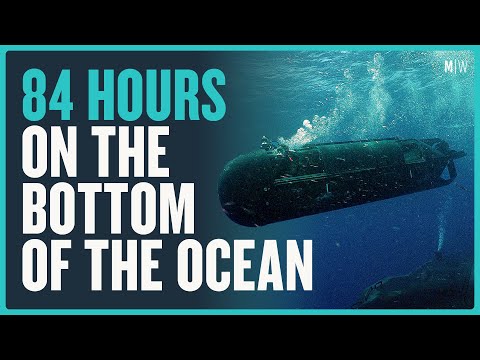
Stephen McGinty - The World's Deepest Submarine Rescue | Modern Wisdom Podcast 351
Stephen McGinty (guest), Chris Williamson (host)
In this episode of Modern Wisdom, featuring Stephen McGinty and Chris Williamson, Stephen McGinty - The World's Deepest Submarine Rescue | Modern Wisdom Podcast 351 explores analog-age heroism: Inside history’s deepest, near-fatal submarine rescue The episode recounts the 1973 sinking of the Pisces III mini‑submersible to 1,650 feet and the unprecedented three‑day international effort to rescue pilots Roger Chapman and Roger Mallinson. The sub, working on a new transatlantic telephone cable, accidently flooded and plunged to the seabed with minimal food, no water, and rapidly dwindling life-support. Above them, British, Canadian, and American teams scrambled ships, aircraft, divers, manned subs, and a U.S. Navy robot vehicle, improvising hardware and procedures in real time as multiple rescue attempts failed. McGinty highlights both the psychological ordeal of the trapped men and the ‘brotherhood of the sea’ that ultimately succeeded when almost all oxygen was gone.
Analog-age heroism: Inside history’s deepest, near-fatal submarine rescue
The episode recounts the 1973 sinking of the Pisces III mini‑submersible to 1,650 feet and the unprecedented three‑day international effort to rescue pilots Roger Chapman and Roger Mallinson. The sub, working on a new transatlantic telephone cable, accidently flooded and plunged to the seabed with minimal food, no water, and rapidly dwindling life-support. Above them, British, Canadian, and American teams scrambled ships, aircraft, divers, manned subs, and a U.S. Navy robot vehicle, improvising hardware and procedures in real time as multiple rescue attempts failed. McGinty highlights both the psychological ordeal of the trapped men and the ‘brotherhood of the sea’ that ultimately succeeded when almost all oxygen was gone.
The story also shows how this near‑disaster helped shape modern submarine rescue systems and preserves the memory of largely forgotten engineers, pilots, and divers whose ingenuity and refusal to give up made survival possible.
Key Takeaways
Extreme crises demand both redundancy and improvisation.
Multiple rescue systems (two Pisces subs, the U. ...
Get the full analysis with uListen AI
CO₂ management is often a more immediate threat than oxygen shortage.
Chapman and Mallinson survived by stretching CO₂ scrubber chemicals and battery life, spacing out scrub cycles, and minimizing movement and speech—showing that controlling exhaled gases is as critical as having oxygen to inhale.
Get the full analysis with uListen AI
Psychological discipline can materially extend survival time.
The pair reorganized the cramped interior so they barely needed to move, consciously lowered heart and respiration rates, and maintained a calm, almost stoic demeanor, effectively turning composure into a life-support resource.
Get the full analysis with uListen AI
Clear communication and shared standards are crucial in multinational operations.
Misunderstandings over units (feet vs. ...
Get the full analysis with uListen AI
Rapid, low-tech engineering can rival high-tech solutions in emergencies.
The key rescue component—the toggle that actually held the sub—was designed with pencils and T-squares and fabricated in hours, while sophisticated systems like the U. ...
Get the full analysis with uListen AI
Leadership choices and decisive logistics make or break time-critical rescues.
Decisions to launch without key personnel, commandeer aircraft and helicopters, send in ‘fresh’ teams, and insist on immediate fabrication work shaved hours off the timeline, which likely translated into minutes of survivable oxygen.
Get the full analysis with uListen AI
Near-disasters can drive lasting safety innovation.
Chapman later built a successful business specializing in submarine rescue systems, and the Pisces III ordeal influenced best practices and technology that have since been called upon in other submarine emergencies.
Get the full analysis with uListen AI
Notable Quotes
“Try and imagine that you're in a phone box next to the Empire State Building, and then the Atlantic Ocean sweeps in, then all the lights go out, then you start bleeding oxygen.”
— Stephen McGinty
“They know roughly where they are, i.e. they know there's a haystack, they just don't know where the needle is.”
— Stephen McGinty
“If it was easy, everyone would do it.”
— Stephen McGinty, quoting Al Trice
“Literally everything that could have gone wrong with the rescue did go wrong, but they still managed to get them up.”
— Stephen McGinty
“The worst part of it… was coming back up.”
— Stephen McGinty, recounting Roger Chapman and Roger Mallinson
Questions Answered in This Episode
What specific procedural or design changes in modern submersibles and rescue systems can be traced directly back to the Pisces III incident?
The episode recounts the 1973 sinking of the Pisces III mini‑submersible to 1,650 feet and the unprecedented three‑day international effort to rescue pilots Roger Chapman and Roger Mallinson. ...
Get the full analysis with uListen AI
How would today’s digital technology—ROVs, real-time positioning, and comms—alter the timeline and tactics of a similar deep-sea rescue?
The story also shows how this near‑disaster helped shape modern submarine rescue systems and preserves the memory of largely forgotten engineers, pilots, and divers whose ingenuity and refusal to give up made survival possible.
Get the full analysis with uListen AI
Psychologically, what distinguishes people like Chapman and Mallinson, who stay functional under such extreme confinement and near-certainty of death?
Get the full analysis with uListen AI
In multinational emergencies, how can teams better pre‑align on standards, communication protocols, and roles to avoid the frictions seen in this rescue?
Get the full analysis with uListen AI
Is there a point in a rescue where continuing efforts become unjustifiable risk for rescuers, and how should leaders weigh that against the moral imperative to ‘never give up’?
Get the full analysis with uListen AI
Transcript Preview
Try and imagine that you're in a phone box next to the Empire State Building, and then the Atlantic Ocean sweeps in, then all the lights go out, then you start bleeding oxygen. Then you know that rescue is at least two days away. And what you've got to do is preserve your oxygen as long as you can. (wind blowing)
Steven McGinty, welcome to the show.
Thanks for having me.
We are talking about the world's deepest submarine rescue today.
Yes, indeed. Yes, indeed. It's the subject of my new book, The Dive: Which Is the- the Untold Story of the World's Deepest Submarine Rescue. And yeah, it's an- it's an incredible story from a kind of- from the analog age of 1973. Um, it's- yeah, the- I mean, the- the- the background to it, um, is effectively that, um, just to- to get people kind of, uh, in- in the mood, it's- it's really from the time when, uh, in 1973, when, um, new phone lines were laid down and there was what's known as the CanSat, um, cable was laid between Canada and the United Kingdom. And this was- this was high technology. You know, this was a cable that allowed 1,750 phone calls to be made from the entirety of America and Canada to the UK at any one time. So this was the days when it would be like three pounds 50 a minute to make a phone call transatlantic. Um, but this was the cable that- in fact, uh, this new cable was three times what previous cables had done. Um, and- and what- what was happening at the time was that the cable had been laid, um, but these miniature submarines, this Pisces III, um, was being sent down to do a- a simple but very important job, which was, um, to find the cable and to dig a little ditch so that the cable would then settle into the ditch and then be covered over by sand and silt. The idea being that while it was on the surface, I mean this was, um, 150 miles off the coast of Cork, so it was- it was in the- the Atlantic Ocean. Um, but it was still in an area where people were fishing and the- the fear was that, um, nets would be- would go down or- or trawlers and effectively the cable could be hauled back up. And as I said in the book, you know, Murphy's Law does apply, um, within 150 miles of Ireland and the fear was that they could- they obviously needed to- to tackle that. So- so on the day, back in August 1973, um, there was two men in this- this small Pisces III, uh, mini submersible. There was, um, Roger Chapman and there was Roger Mallinson. Uh, Roger Chapman was ex, uh, Royal Navy. He was an ex, uh, nuclear submariner, um, who had been- who'd effectively had to leave the services because his- his eyesight wasn't as good as it should have been, and he moved into the- into the private sector. And at the time, um, what was interesting about it was, it was the company that ran the submarines was- was Vickers Oceanics. Um, now Vickers, uh, is anyone from Barra or Furness or anyone who knows about the great kind of, um, nautical history of Britain will know, Vickers was the- the- the titan of s- ship builders and particularly, um, you know, military and sort of, um, naval ships, um, from the- the First World War, Second World War, and into the Cold War. Um, so what they did was that they were obviously making these massive ships but they decided that, um, it was 1973, there had been the boom in the North Sea oil industry, and they decided miniature submarines were going to be a- a- an effective gadget, effectively, that the industry would have been needed. Uh, and this little miniature submarine, um, had been invented by these- these incredible Canadians. Uh, there was a guy called Alf Trice, uh, and Alf Trice, back in the 19s- early 1960s was from Vancouver and he was one of the pioneers of- of, he was a great salvage diver. Those were the days where you wore hard hats, you went down with kind of heavy steel boots, and he pioneered some of the deepest dives. I mean, they were doing bounce dives in those days, so that basically meant that you would- you would go down as many- as- as- as deep as maybe 350 feet, but you could be down there for literally two or three minutes, and then you would take these long slow ascends to the surface to avoid the bends. Alf Trice said, "Look, this isn't... there has to be a practical device. There has to be... Let's- let's develop a submarine that- that's small, that's commercial." Um, the- the French had developed the bathyscaphe, which has gone down right down to the Canomero Trench effectively, um, but he wanted to- to develop a- a effectively a- a commercial submarine. And these guys who could go into the story later on, effectively what they did was they developed, they spent the money, they- they- they pioneered and created the Pisces, um, craft. And what was interesting about Pisces, um, miniature submarine was that they tested it in Vancouver on a day that the US Navy were testing anti-submarine missiles (laughs) . And what I find fascinating about Pisces- the Pisces craft was that- that, um, they managed- they managed on its test dive, it managed to evade a missile that- that had been sent out with- with its principal job was effectively to track down, um, submar- submarines. And there's something about it that- that says that this thing was- was- was maybe indestructible, but also lucky. Um...
Install uListen to search the full transcript and get AI-powered insights
Get Full TranscriptGet more from every podcast
AI summaries, searchable transcripts, and fact-checking. Free forever.
Add to Chrome