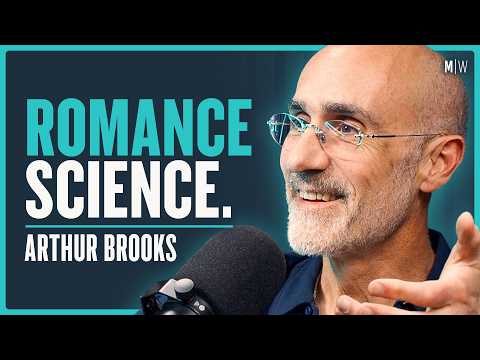
You Can’t “Solve” Your Relationship - Arthur Brooks
Chris Williamson (host), Arthur Brooks (guest), Narrator, Narrator, Narrator
In this episode of Modern Wisdom, featuring Chris Williamson and Arthur Brooks, You Can’t “Solve” Your Relationship - Arthur Brooks explores arthur Brooks: Why Love Can’t Be Solved, Only Courageously Lived Arthur Brooks joins Chris Williamson to explain why relationships are inherently complex systems that cannot be ‘solved’ with formulas or apps, only lived through experience, failure, and growth. He breaks down the neurochemical “cascade” of falling in love into four stages, showing how attraction, obsession, jealousy, and eventual bonding are rooted in biology yet must be managed by our prefrontal cortex and values.
Arthur Brooks: Why Love Can’t Be Solved, Only Courageously Lived
Arthur Brooks joins Chris Williamson to explain why relationships are inherently complex systems that cannot be ‘solved’ with formulas or apps, only lived through experience, failure, and growth. He breaks down the neurochemical “cascade” of falling in love into four stages, showing how attraction, obsession, jealousy, and eventual bonding are rooted in biology yet must be managed by our prefrontal cortex and values.
They explore how modern dynamics—dating apps, pornography, long-distance relationships, workaholism, and self-help ‘wisdom porn’—often short‑circuit our capacity to form deep pair bonds and stay in love. Brooks offers practical guidance on maintaining relationships through touch, eye contact, eliminating contempt, respecting biology, and deliberately designing your life like a lab of experiments rather than a passive experience.
Beyond romance, they discuss anxiety, success addiction, aging, personality change, and the fear of irrelevance, arguing that true happiness requires accepting suffering, facing our ‘death fears,’ and transitioning from being special and individually brilliant to being wise, useful, and deeply connected to others.
Key Takeaways
You can’t ‘solve’ a relationship; you must live a complex system.
Brooks distinguishes complicated problems (like engineering) from complex ones (like marriage). ...
Get the full analysis with uListen AI
Understand and respect the four stages of falling in love.
Attraction starts with sex hormones, then dopamine and norepinephrine create euphoria and anticipation, low serotonin triggers rumination and jealousy, and finally oxytocin/vasopressin form deep pair bonds. ...
Get the full analysis with uListen AI
Stop trying to eliminate suffering; it’s a pathway to happiness and meaning.
Brooks argues that attempts to remove all unhappiness sabotage real happiness. ...
Get the full analysis with uListen AI
Use your prefrontal cortex to manage obsessive love, anxiety, and overthinking.
He recommends metacognitive tools like journaling, structured fear analysis (turning anxiety into specific fears, probabilities, and plans), prayer or meditation, and simply labeling what’s happening (“I’m in the serotonin/rumination stage”) to shift emotions from the limbic system into conscious control.
Get the full analysis with uListen AI
Protect and grow your pair bond with simple, disciplined habits.
For long-term couples, Brooks prescribes two basic rules: every time you’re together, be touching; every time you talk, make direct eye contact. ...
Get the full analysis with uListen AI
Eliminate contempt: it’s the single most toxic pattern in relationships.
Drawing on Gottman’s work, Brooks explains that eye-rolling, sarcasm, and “Really? ...
Get the full analysis with uListen AI
Treat your life as a lab: learn, experiment, and then teach.
Rather than binging endless ‘wisdom content,’ Brooks urges people to pick one idea (gratitude practice, anxiety journaling, couples’ touch rules), run a personal experiment, track what happens, and then share what works. ...
Get the full analysis with uListen AI
Notable Quotes
“Complex problems can’t be solved; they can only be experienced. Your marriage is a football game, not a math problem.”
— Arthur Brooks
“The process of getting happier means accepting, embracing, being grateful for the unhappiness that comes along the way of being fully alive.”
— Arthur Brooks
“You want to fall in love and stay in love? Your goal is best friendship. You want to spend every night with your best friend.”
— Arthur Brooks
“Avoiding temptation is way easier than resisting it.”
— Arthur Brooks
“Your weaknesses are your strengths and your strengths are your weaknesses. If you eliminate your weaknesses, you’ll probably eliminate your success.”
— Arthur Brooks
Questions Answered in This Episode
How can someone practically distinguish between a relationship problem that needs to be ‘worked on’ and one that reflects fundamental incompatibility or an unhealthy pattern like the dark triad?
Arthur Brooks joins Chris Williamson to explain why relationships are inherently complex systems that cannot be ‘solved’ with formulas or apps, only lived through experience, failure, and growth. ...
Get the full analysis with uListen AI
In what specific ways can people who grew up in non-intact or high-conflict homes become ‘circuit breakers’ and intentionally build very different relationship models for their own families?
They explore how modern dynamics—dating apps, pornography, long-distance relationships, workaholism, and self-help ‘wisdom porn’—often short‑circuit our capacity to form deep pair bonds and stay in love. ...
Get the full analysis with uListen AI
Given the biological power of the love cascade and workplace bonding, what concrete boundaries should organizations and individuals adopt to prevent unintended emotional entanglements?
Beyond romance, they discuss anxiety, success addiction, aging, personality change, and the fear of irrelevance, arguing that true happiness requires accepting suffering, facing our ‘death fears,’ and transitioning from being special and individually brilliant to being wise, useful, and deeply connected to others.
Get the full analysis with uListen AI
How should someone addicted to achievement recalibrate their life so they stop sacrificing their relationship to their career without feeling like they’re abandoning their ambition?
Get the full analysis with uListen AI
If so many modern tools (dating apps, porn, remote work) undermine pair bonding, what does a realistic, healthy, tech-aware dating and relationship strategy look like in practice today?
Get the full analysis with uListen AI
Transcript Preview
I think if I, if I was to give myself the three traits that I've managed to hold onto: I pay a lot of attention to detail, I have a unusual capacity for suffering, uh, or doing, d- delaying gratification might be an easier way to put it, uh, and I'm just consistent. And those three things seem to be, like, pretty potent fuel, no matter what industry you try and get into.
Yeah, but then of course there's the natural level of curiosity, high level of cognitive ability, right? I mean, tha- those are table stakes, though. That's your point, right?
Mm-hmm. Mm-hmm.
For s-
You've got to have that to play the game.
Yeah, yeah. Because otherwise, you have that to play the game, but then when things are slow at the very beginning, that's when you stop your podcast.
Correct.
And you didn't...
A lot of, a lot of questions come through from people who say stuff like, um, "Hey man, in the beginning, when you didn't have any plays or anything, like, you know, what motivated you to keep going?" But, t- to be honest, man, my motivation waned way more in sort of year three and four and five.
'Cause you were getting bored.
Yeah, it's like, well I've, I've been there. There's, there's n- you're trying to inject novelty-
Yeah.
... into what you do, and you're trying t- uh, uh, e- even less than that, you're just trying to not let it get stale. And, um, you know, how many books deep are you now?
F- f- uh, f- 15.
(laughs)
(laughs) 14 and 15 are coming out in the next year.
Uh, w- there's a new one about meaning?
The one that's coming out about meaning is coming out one year from the 14th.
Unreal.
April 14th 2026.
I'm so fired up for that. I've been thinking about m- I remember I read this, Roy Baumeister-
Yeah.
... uh, uh-
Buddy of mine.
... essay, article, a journal post from like 2011, uh-
Compressing Meaning and Happiness. That one. And-
Fucking legend, dude.
Yeah, yeah, totally, and my whole concept of happiness rolls meaning into happiness.
Right.
Thus incorporating unhappiness into the process of getting happier, which of course is the standard experience of being fully alive.
Mm-hmm.
You want to be happy? You better be unhappy. Let's see how unhappy you can be before you can be happy.
Mm-hmm.
And the people who try to avoid their unhappiness paradoxically avoid their happiness, which is the problem.
Yeah, it does... How do you sort of square the circle of the fact that there seems to be some data that comes out around the more that people focus on trying to be happy, the less happy they become? Is that true?
Install uListen to search the full transcript and get AI-powered insights
Get Full TranscriptGet more from every podcast
AI summaries, searchable transcripts, and fact-checking. Free forever.
Add to Chrome