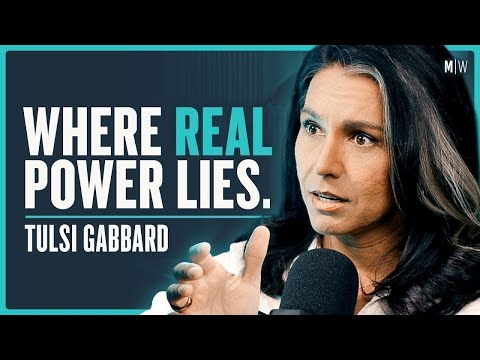
The Psychology of Power & Control - Tulsi Gabbard
Chris Williamson (host), Tulsi Gabbard (guest), Narrator
In this episode of Modern Wisdom, featuring Chris Williamson and Tulsi Gabbard, The Psychology of Power & Control - Tulsi Gabbard explores tulsi Gabbard Dissects Hidden Power, Endless War, And Democratic Decay Tulsi Gabbard argues that U.S. presidents—especially Biden and potentially Harris—are largely figureheads for an entrenched, bipartisan establishment of party elites, security bureaucrats, and the military‑industrial complex. She contrasts this with Donald Trump, whom she portrays as uniquely non‑beholden to these interests, particularly on foreign policy and war. The conversation ranges from elite warmongering and media manipulation to civil-liberties threats like the TikTok bill and the broader erosion of constitutional norms, free speech, religion, and the family. Gabbard also reflects on her break from the Democratic Party, the disillusionment of younger voters, and her belief that citizen engagement and principled, service‑oriented leaders are still capable of course‑correcting the system.
Tulsi Gabbard Dissects Hidden Power, Endless War, And Democratic Decay
Tulsi Gabbard argues that U.S. presidents—especially Biden and potentially Harris—are largely figureheads for an entrenched, bipartisan establishment of party elites, security bureaucrats, and the military‑industrial complex. She contrasts this with Donald Trump, whom she portrays as uniquely non‑beholden to these interests, particularly on foreign policy and war. The conversation ranges from elite warmongering and media manipulation to civil-liberties threats like the TikTok bill and the broader erosion of constitutional norms, free speech, religion, and the family. Gabbard also reflects on her break from the Democratic Party, the disillusionment of younger voters, and her belief that citizen engagement and principled, service‑oriented leaders are still capable of course‑correcting the system.
Key Takeaways
Unelected elites exert outsized control over U.S. policy, especially under weak figureheads.
Gabbard claims Biden—and potentially Harris—are not true decision‑makers, but fronts for a network of Democratic elites, national‑security bureaucrats, and corporate interests who benefit from crisis, war, and expanded state power.
Get the full analysis with uListen AI
Incentives around war strongly distort U.S. foreign policy decisions.
She argues many politicians are beholden to defense contractors and donors, making military action a reflexive response instead of a last resort, despite the human and economic costs and public fatigue with endless wars.
Get the full analysis with uListen AI
Trump is targeted because he resists establishment control, not because he’s policy‑perfect.
While not endorsing all of his behavior, Gabbard maintains that Trump’s unpredictability and refusal to ‘bend the knee’ to the Washington establishment—especially his skepticism of regime‑change wars—make him uniquely threatening to entrenched interests.
Get the full analysis with uListen AI
Recent legislation like the TikTok bill risks normalizing broad censorship powers.
She warns that giving the president unilateral authority to label companies ‘agents of foreign adversaries’ and effectively shut platforms down is a major civil‑liberties threat that can easily extend beyond TikTok to any disfavored outlet.
Get the full analysis with uListen AI
Democratic Party leadership has drifted away from traditional liberal values.
Gabbard says today’s Democrats are hostile to free speech, religious expression, and parental choice in education, and enforce ideological conformity on issues like gender and Title IX, punishing dissent even within their own ranks.
Get the full analysis with uListen AI
Media framing and selective narratives deepen public distrust and apathy.
Examples like coverage of the Trump assassination attempt, Biden’s cognitive decline, and AI‑manipulated clips reinforce for many viewers that legacy outlets spin or suppress facts, pushing people either toward skepticism or total disengagement.
Get the full analysis with uListen AI
Political renewal depends on citizen engagement and service‑driven leaders, not credentials.
Gabbard argues that ordinary people rooted in principle—rather than Ivy‑League résumés or party loyalty—are what’s needed in office, and that voting and local involvement remain the most realistic levers for systemic change.
Get the full analysis with uListen AI
Notable Quotes
“You take one horse out, you put another horse in, you’ve got the same people who are running the show.”
— Tulsi Gabbard
“The answer to speech in situations that you don’t like is always more speech.”
— Tulsi Gabbard
“Even if you don’t care about anybody else in the world, at least care enough about yourself to get informed and be a part of the solution.”
— Tulsi Gabbard
“They don’t even care enough to make that effort. They’re not even trying to understand the second and third order consequences.”
— Tulsi Gabbard
“This is the sort of choice that requires a fucking walk.”
— Chris Williamson (quoting Rory Sutherland on voting)
Questions Answered in This Episode
How can citizens realistically counter the influence of unelected elites and the military‑industrial complex without simply swapping one figurehead for another?
Tulsi Gabbard argues that U. ...
Get the full analysis with uListen AI
Where should the line be drawn between combating foreign influence (e.g., TikTok) and preserving free speech and open information flows?
Get the full analysis with uListen AI
If both major parties are deeply compromised, what would a viable third‑party or independent strategy actually need—money, media, structure—to succeed?
Get the full analysis with uListen AI
How can voters distinguish between genuine anti‑war, pro‑freedom candidates and those who merely adopt that rhetoric while remaining beholden to the establishment?
Get the full analysis with uListen AI
What concrete steps could rebuild trust among disillusioned Gen Z voters who feel that no political issue or party genuinely represents them?
Get the full analysis with uListen AI
Transcript Preview
Who actually runs the government, in your experience?
(laughs) Not who you think it is (laughs) . It's, um... And in- and- and- in many cases, especially recently, uh, the- the troubling part about all this is it's not even people who we vote for. When you look at, uh, what happened when President Biden had that infamous debate with President Trump, uh, it- it exposed the reality that many of us have known for a long time, which is that President Biden has not been the guy calling the shots. He's not been the guy making the decisions, nor has it been Kamala Harris for that matter, nor will it be if she is elected president. It is this cabal of, you know, the Democrat elite, the- the woke warmongers, uh, made up of the likes of Hillary Clinton and, uh, Barack Obama, and, you know, Tony Blinken and Jake Sullivan and, you know, people who are in the military industrial complex, people who profit from us being in a constant state of war. It is, um, those in the administrative state and the national security state who derive more authorities and ability to take away, uh, our liberty when we are in a heightened state of crisis or war. It is the- the- their friends and billionaires and people in media who all derive their power from being able to have a figurehead that essentially they can control. And the most troubling part about oth- There's so many things wrong with this, of course, but really at- at the most fundamental level, you look at, um, you know, our country is the oldest democracy in the world, but the reality of a truly functioning and thriving democracy that has brought to life the vision that our founders had for us, that we really have a government of, by, and for the people, and that we have the ability and responsibility for that matter, to ensure that, um, the government we have only exists with the consent of the governed, that becomes very hard to do, to hold people accountable when the person that you voted for is- is certainly not the one making the decisions.
How long has that been the case? Was it ever the case that the president ran the country? Wh- When was the inflection point?
Y- I don't- I don't know that there's one specific. I mean, there ha- You know, as personalities come in and shift here and there, uh, I would say the answer to that has probably changed. But i- i- in the election that we are facing here very shortly in the United States, um, it's our opportunity to hit the reset button, and, you know, however people feel about the choices and the options that we have, and they've changed a little bit recently, but really it's only the faces that have changed. The stakes have not changed, and- and the choices between the Democrat elite, and I've been saying this for months, like, "Hey guys, don't..." Because it's like, "Oh, is Biden gonna stay or is he gonna go? And who's e- they gonna replace him? Is it Gavin? Is it Ka-" All of these different theories, they make for good chatter, I guess, on cable news, but I've been telling people all along, "Don't be distracted." You know, you take one horse out, you put another horse in, you've got the same people who are running the show, and it is- it is between the Democrat elite, will be Kamala Harris on the ballot, and, uh, a- and the- uh, those calling the shots behind the scenes continuing to remain in power versus, uh, Donald Trump, who has a record of... I mean, the reason why they're doing all they can to destroy him is because he won't bend the knee to this Washington establishment, which is- which is made up of people in both political parties, by the way.
Install uListen to search the full transcript and get AI-powered insights
Get Full TranscriptGet more from every podcast
AI summaries, searchable transcripts, and fact-checking. Free forever.
Add to Chrome