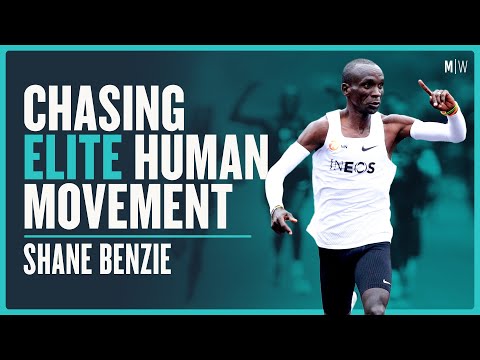
Creating The Perfect Running Form - Shane Benzie
Shane Benzie (guest), Chris Williamson (host), Narrator
In this episode of Modern Wisdom, featuring Shane Benzie and Chris Williamson, Creating The Perfect Running Form - Shane Benzie explores unlocking Efficient Running: Foot Mechanics, Posture, and Natural Movement Shane Benzie, a movement and running coach, explains that modern humans have lost much of their natural movement efficiency due to sedentary lifestyles, technology, and misconceptions about biomechanics. He argues that elite performance comes from exploiting our evolutionary design—an elastic, tensegrity-based body and a highly sophisticated foot—rather than from gear, gyms, or clever shoes. Drawing lessons from East African runners, Sherpas, surfers, and indigenous tribes, he shows how posture, tripod foot landings, arm mechanics, cadence, and group dynamics transform running economy. Benzie maintains that improving form can boost running economy by up to 30%, often eclipsing gains from VO2 max or lactate threshold training.
Unlocking Efficient Running: Foot Mechanics, Posture, and Natural Movement
Shane Benzie, a movement and running coach, explains that modern humans have lost much of their natural movement efficiency due to sedentary lifestyles, technology, and misconceptions about biomechanics. He argues that elite performance comes from exploiting our evolutionary design—an elastic, tensegrity-based body and a highly sophisticated foot—rather than from gear, gyms, or clever shoes. Drawing lessons from East African runners, Sherpas, surfers, and indigenous tribes, he shows how posture, tripod foot landings, arm mechanics, cadence, and group dynamics transform running economy. Benzie maintains that improving form can boost running economy by up to 30%, often eclipsing gains from VO2 max or lactate threshold training.
Key Takeaways
Prioritize foot function over shoe technology.
The human foot is a highly evolved interface with the ground, providing stability, elasticity, impact dispersion, and proprioception. ...
Get the full analysis with uListen AI
Use a tripod landing to unlock stability and elastic recoil.
Landing with three contact points—under the big toe, little toe, and heel—activates the arch and plantar fascia like an architectural dome, spreading load and storing elastic energy. ...
Get the full analysis with uListen AI
Run tall and elastic, not low and shuffling.
Humans’ evolutionary advantage is upright, elastic movement powered by a continuous fascial ‘sea of tension. ...
Get the full analysis with uListen AI
Let your arms drive your legs, not the other way around.
Arms are neurologically dominant over legs: relaxed shoulders with elbows driving backward (not punching forward) cue the legs to land under the body and extend behind. ...
Get the full analysis with uListen AI
Target a natural elastic cadence, not a forced turnover fix.
A cadence around 175–185 steps per minute aligns with the body’s elastic frequency—creation, storage, and release of elastic energy at each footstrike. ...
Get the full analysis with uListen AI
Build strength through the task itself, not just the gym.
Sherpas and elite runners develop extraordinary strength and resilience by repeatedly doing their specific task, remodeling bone, muscle, and fascia for that movement. ...
Get the full analysis with uListen AI
Change form gradually and cognitively with ‘little and often’ practice.
Movement change is software reprogramming, not ‘muscle memory’, and bone remodeling alone takes ~17 weeks. ...
Get the full analysis with uListen AI
Notable Quotes
“You could spend $10,000 on a pair of trainers. It’s not gonna make you land with a tripod landing.”
— Shane Benzie
“Movement is becoming a lost art because we’re no longer the animal that we were, so we’re no longer moving in that way.”
— Shane Benzie
“Kipchoge didn’t run a sub-two marathon because he ran like a hunter‑gatherer. He ran a sub-two marathon because he harnessed all the gifts Mother Nature gave him and turned them into human performance.”
— Shane Benzie
“If you start in control, I think that’s the best you can do.”
— Shane Benzie
“It’s good to build a big engine, but if you can build a big engine and take the toll of what that engine’s got to do down by using elastic energy and gravity, we don’t need such a massive engine.”
— Shane Benzie
Questions Answered in This Episode
How can an everyday recreational runner practically transition from heel striking to a stable tripod landing without getting injured?
Shane Benzie, a movement and running coach, explains that modern humans have lost much of their natural movement efficiency due to sedentary lifestyles, technology, and misconceptions about biomechanics. ...
Get the full analysis with uListen AI
If modern strength and conditioning is often too general, what would an ideal, movement-driven weekly plan look like for someone training for a marathon?
Get the full analysis with uListen AI
Given that group mimicry is so powerful, how can runners who train alone recreate some of the benefits East African athletes get from their group sessions?
Get the full analysis with uListen AI
Where is the threshold between useful cognitive focus on form and overthinking that interferes with relaxed, efficient running?
Get the full analysis with uListen AI
How might these principles of elastic, tensegrity-based movement apply to other sports or to general daily movement for people who don’t run at all?
Get the full analysis with uListen AI
Transcript Preview
You could spend $10,000 on a pair of trainers. It's not gonna make you land with a tripod landing. It's not gonna make you leave the f- the ground correctly. We can't buy our way out of trouble. It's- I think it's easier to order something and for it turn up on the doorstep, and we put them on, and it's a magic pair of trainers, and now all our troubles are solved. We'd rather do that than spend 12 weeks learning to move differently. (wind blows)
Shane Betsy, welcome to the show.
Thank you for the invite.
You were just in Portugal. Tell me what you were doing.
I was just in Portugal. So, I was in, uh, a place called Nazare, and Nazare, uh, has the biggest waves in the world. So, it's on the Atlantic Coast, and, uh, it has huge waves. And, uh, I'm predominantly a running coach, but actually, more and more, I'm becoming a movement coach with different sports. And I'm actually working on a project out there studying and coaching some of the big wave surfers. So, these guys are surfing waves up to sort of 70, 80 feet. So, I'm really get excited about, you know, their foot contact on the board, how are they balancing on that board, you know, what are they doing? What's their perception of their movement? Their mental approach to something that's pretty dangerous, and that you can't just go out every day and practice because of course these big waves only come sometimes. So, I use very clever sensors to put in their boots to kind of have a look at how they're interacting with the board and all sorts of stuff. And that does, believe it or not, feed back into running.
What is the similarity between surfing and running?
So, for me, if I'm coaching running, one of the big things I get excited about with running is the- the foot. The- the- you know, the human foot is a very, very clever thing, and I like to think of the foot as the interface between us and the ground. Yeah. If the foot lands well, and if the foot leaves the ground well when we run, it creates stability, it creates elasticity, it creates amazing proprioception from the quarter of a million nerves on the bottom of it, it spreads impact, it does loads of amazing things. So, if I can understand how the foot interacts with lots of other surfaces, uh, and in other sports, then I can learn some very interesting things about maybe how we should land the foot and leave the ground when we run.
What are some of the things that you've learned since working with these psychopathic surfers?
(laughs) Well, uh, one of the other big things about sport as well is- is the mental approach. You know, that- that's- that's extremely important. So, we're learning all the time about the foot. The- I- when I'm looking at, uh, foot contact in whatever sport it is, I'm always looking where possible for what I would call a tripod contact with, uh, the board or with the ground or whatever it is you're working with. So, I'm learning from them about how they create stability in what is a very kind of dynamic situation and how that foot changes based on their interaction with the board. And maybe then I can understand how better we should change and interact our foot as we move- move over maybe uneven surfaces or uphills or downhills because of course they're- they are on, uh, you know, they're up going at some pretty crazy angles. So yeah, lots to learn and- and lots of information to swap. I did a- a similar, well, say similar, I had a- I have a collaboration with British Diving, um, so worked with British Diving in the- in the lead-up to the Olympics. Uh, and, uh, just looking at how the divers have their- their- their movement on the board, not the twirly stuff, that's all really exciting and impressive, but I just work with them on their three steps on the board and then how they leave the board. So, looking at things in minute detail, but then maybe bringing it back into running is something we might do tens of thousands of times in a single run.
Install uListen to search the full transcript and get AI-powered insights
Get Full TranscriptGet more from every podcast
AI summaries, searchable transcripts, and fact-checking. Free forever.
Add to Chrome