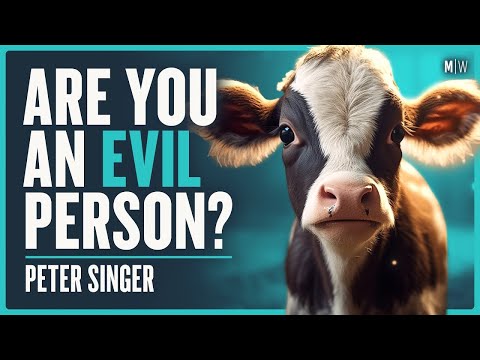
Are You An Evil Person For Eating Meat? - Peter Singer
Peter Singer (guest), Chris Williamson (host), Narrator
In this episode of Modern Wisdom, featuring Peter Singer and Chris Williamson, Are You An Evil Person For Eating Meat? - Peter Singer explores peter Singer Challenges Meat-Eaters: Is Animal Suffering Ever Justified? Peter Singer revisits his seminal work *Animal Liberation* nearly 50 years on, arguing that industrial animal agriculture is a vast ethical wrong comparable in structure to racism and sexism, because it discounts the interests of non-human beings. He outlines both progress (more vegans, some legal reforms) and regression (explosive growth of factory farming, especially in China) in global animal welfare. Singer defends a utilitarian focus on reducing suffering for all sentient creatures, discusses gradations of sentience across species, and explores whether any forms of animal farming can be ethically defensible. The conversation broadens into tactics of the vegan movement, practical compromises, wild-animal and AI ethics, and the challenges of motivating moral dietary change in a resistant culture.
Peter Singer Challenges Meat-Eaters: Is Animal Suffering Ever Justified?
Peter Singer revisits his seminal work *Animal Liberation* nearly 50 years on, arguing that industrial animal agriculture is a vast ethical wrong comparable in structure to racism and sexism, because it discounts the interests of non-human beings. He outlines both progress (more vegans, some legal reforms) and regression (explosive growth of factory farming, especially in China) in global animal welfare. Singer defends a utilitarian focus on reducing suffering for all sentient creatures, discusses gradations of sentience across species, and explores whether any forms of animal farming can be ethically defensible. The conversation broadens into tactics of the vegan movement, practical compromises, wild-animal and AI ethics, and the challenges of motivating moral dietary change in a resistant culture.
Key Takeaways
Animal ethics is about justice and suffering, not affection for animals.
Singer’s argument does not rely on loving animals but on the claim that ignoring the interests of sentient non-humans is a serious moral wrong, structurally analogous to racism and sexism: a dominant group exploiting a vulnerable one because it can.
Get the full analysis with uListen AI
Industrial animal agriculture has worsened overall despite some welfare reforms.
While battery cages and gestation crates have been restricted in some regions and veganism has grown, global demand—especially rising meat consumption in newly prosperous countries like China—means more animals suffer in factories now than in 1975.
Get the full analysis with uListen AI
The scale and intensity of factory farming inflict massive, routine suffering.
Singer details how billions of fish, chickens, and pigs live in crowded, painful conditions (e. ...
Get the full analysis with uListen AI
Eating animals is an inefficient and environmentally damaging way to feed humans.
Feeding grains and fish to livestock wastes most caloric value (often 60–90%), exacerbates climate and resource pressures, and undermines food security—contrary to claims that factory farming is necessary to feed a growing population.
Get the full analysis with uListen AI
Some forms of animal use may be ethically defensible, but they are rare and costly.
Singer leaves room for genuinely high-welfare systems—truly free-range hens, rare dairies that keep calves with cows, sperm-selection to avoid male calves—but notes these products are niche, expensive, and far from the norm, and even then remain ethically debatable.
Get the full analysis with uListen AI
Pragmatic, consequence-focused ethics allows for limited compromise and partial change.
As a utilitarian, Singer is willing to endorse imperfect but better choices (e. ...
Get the full analysis with uListen AI
Future ethical challenges include wild animal suffering and potential sentient AI.
Singer argues we should reduce harm to wild animals when feasible (e. ...
Get the full analysis with uListen AI
Notable Quotes
“My argument is not based on the idea that we should love animals or have warm feelings to them. It's based on the idea that this is a major ethical issue, a major ethical wrong that we are doing to those who are not members of our species.”
— Peter Singer
“Animals legally are property, everywhere in the world... they are means to our ends, and we don't give their interests consideration.”
— Peter Singer
“We're talking about hundreds of billions of animals that humans cause suffering to by the conditions in which they raise them each year.”
— Peter Singer
“If you really start worrying about every calorie, you're gonna go crazy and you're not gonna be very effective in doing anything else.”
— Peter Singer
“You’ve got to decide which wars you can fight. You can't win all the wars at the same time.”
— Peter Singer
Questions Answered in This Episode
If we accept Singer’s analogy between speciesism and racism/sexism, what changes in law and culture would be required to treat animals as non-property while still allowing some limited use?
Peter Singer revisits his seminal work *Animal Liberation* nearly 50 years on, arguing that industrial animal agriculture is a vast ethical wrong comparable in structure to racism and sexism, because it discounts the interests of non-human beings. ...
Get the full analysis with uListen AI
How should individuals balance striving for moral dietary ideals (e.g., full veganism) against psychological, social, or health constraints that make partial change more realistic?
Get the full analysis with uListen AI
In practice, what criteria could we use to reliably distinguish genuinely high-welfare, ethical animal products from mere marketing claims?
Get the full analysis with uListen AI
To what extent should we prioritize reducing animal suffering over other ethical goods like cultural traditions, personal freedom, or economic livelihoods tied to animal agriculture?
Get the full analysis with uListen AI
If AI systems one day plausibly claim consciousness and suffering, what kind of evidential standard should we demand before granting them moral status similar to animals or humans?
Get the full analysis with uListen AI
Transcript Preview
My argument is not based on the idea that we should love animals or have warm feelings to them. It's based on the idea that this is a major ethical issue, a major ethical wrong that we are doing to those who are not members of our species. (wind blows)
It's nearly 50 years since you first published Animal Liberation. Why re-release the book now?
Well, partly because it is, uh, nearly 50 years. And although I did revise it in 1990, that's still 33 years. And the book isn't just, you know, timeless philosophy. It, it has some of what I hope is timeless philosophy in it, but it, it's applied to the real world. And the real world includes, um, industrial animal production, uh, which is a vast industry that is terrible for animals, the planet, climate, uh, health, everything. Um, but it's changed, of course, that industry has changed over the last, uh, 50 or 33 years. Um, I also talk about the use of animals in laboratories, um, and I described experiments that were done the last time I revised the book, so experiments from the 1980s, not very relevant if you want to know what's going on with animals in labs today. So those are two main reasons. Um, lots of people ask me about, "Well, you know, has... have we made progress for animals over the time since you wrote Animal Liberation?" Um, I wanted to answer that question. Uh, and I did want to talk about climate change and its relevance to our choice of what we eat, because that obviously wasn't in the 1975 edition. I had no knowledge of climate change, and it was barely in the 1990 edition either.
What ways do you think we've made progress with regards to animal welfare, and in which ways have we gone backward?
We've made progress in restrictions on some of the worst forms of close confinement of animals in industrial animal production that I focused on in the earlier, uh, book. Um, so for example, laying hens, egg-laying hens were in very small wire cages, uh, where they couldn't even stretch their wings. Even if there'd only been one hen per cage, they couldn't have stretched their wings fully, um, but there might be four or five hens in those cages. They have been prohibited in some places. So they've been prohibited in the European Union. The United Kingdom has maintained those prohibitions after leaving the, uh, European Union. Uh, some states of the United States where citizens can bring initiatives to the ballot and have a vote on them, uh, California is the largest of those states, uh, have, uh, also restricted those cages, and as well, individual stalls for, uh, veal calves and sows, uh, where again, they, they couldn't turn around. The stalls were so tight they could hardly walk a step. Um, so there are some places where those things have been banned. Um, another big form of progress is that there are many more vegetarians and vegans. There were virtually no vegans when, in 1975, when the book was published. Uh, there are now, uh, I think, supposed to be 1.3 million vegans in the United Kingdom, and varying figures for the United States that, uh, some, some surveys go much higher than that in the US. So, you know, uh, there's greater awareness of animals and the idea that animals might have rights is no longer a matter for ridicule, as it was when the book first came out. So there's lots of, um, ways in which we've gone ahead. The big way in which we've gone backwards is that there are more animals in industrial animal production now than ever before. Uh, and that's, uh, at least partly because of the rise of China, uh, the fact that China has become a lot more prosperous, which is great. We don't want people to be in extreme poverty. But, um, so hundreds of millions of Chinese now use their extra income that they have to buy more meat. Um, and China has been building these enormous factory farms, like 26-story buildings just full of thousands and thousands of pigs, obviously never getting to go outside, just living their entire lives, uh, on the concrete floors of these buildings. Uh, and because of that, uh, and, you know, expansion of other... chicken production, uh, uh, fish factory farming, aquaculture as it's, uh, called, too nice a word for what it really is. Um, you know, so there are far more animals suffering now from human abuse than there were in 1975.
Install uListen to search the full transcript and get AI-powered insights
Get Full TranscriptGet more from every podcast
AI summaries, searchable transcripts, and fact-checking. Free forever.
Add to Chrome