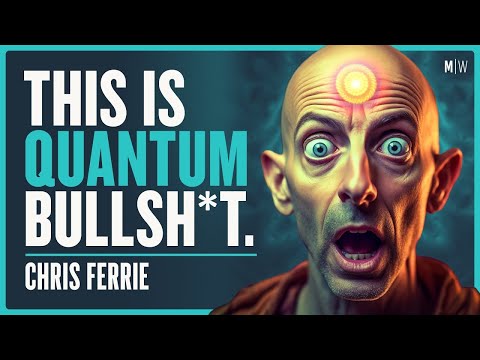
7 Ways To Ruin Your Life With Lies From Quantum Physics - Chris Ferrie
Chris Ferrie (guest), Chris Williamson (host), Narrator
In this episode of Modern Wisdom, featuring Chris Ferrie and Chris Williamson, 7 Ways To Ruin Your Life With Lies From Quantum Physics - Chris Ferrie explores physicist Exposes How Quantum Myths Fuel Pseudoscience, Woo, And Harm Chris Ferrie, a quantum physicist and author, explains how core ideas from quantum physics—energy, vibration, entanglement, uncertainty, and many-worlds—are routinely distorted to sell spirituality, healing, and self-help products.
Physicist Exposes How Quantum Myths Fuel Pseudoscience, Woo, And Harm
Chris Ferrie, a quantum physicist and author, explains how core ideas from quantum physics—energy, vibration, entanglement, uncertainty, and many-worlds—are routinely distorted to sell spirituality, healing, and self-help products.
He distinguishes between legitimate scientific concepts and their pseudoscientific counterparts, emphasizing that claims become unscientific once they stop being measurable, testable, or predictive, even if they feel comforting or meaningful.
Ferrie and host Chris Williamson unpack why quantum physics, due to its difficulty, mystique, and genuine weirdness, is uniquely attractive to charlatans, and how cognitive biases and the placebo/expectation effect help bad ideas stick.
They also touch on the real promise and limits of quantum technology—like quantum computing and simulations—while rejecting popular misuses such as quantum healing, quantum love, and many-worlds as a life strategy.
Key Takeaways
Be suspicious whenever ‘quantum’ is used to explain everyday life problems.
Ferrie argues that terms like quantum energy, quantum healing, or quantum love almost never use the real technical meanings; they’re marketing labels slapped onto ordinary psychology, placebo, or wishful thinking.
Get the full analysis with uListen AI
Testability and measurability are the basic filters for scientific claims.
In science, a claim only counts as knowledge if others can measure it using a reproducible procedure. ...
Get the full analysis with uListen AI
Don’t confuse metaphorical language (energy, vibration, resonance) with physical reality.
Words like ‘energy’, ‘frequency’, and ‘resonance’ have precise physical definitions; using them to describe emotions or relationships is fine as metaphor, but it becomes pseudoscience when treated as literal mechanisms of healing or cosmic attraction.
Get the full analysis with uListen AI
Quantum entanglement does not enable faster‑than‑light communication or mystical bonds.
Entangled particles exhibit correlations, but no information or influence travels faster than light; extrapolating this to human ‘soul connections’ or instant communication is a misuse of the concept.
Get the full analysis with uListen AI
Placebo and expectation effects are real, but the stories told to justify them matter.
Belief and expectation can change outcomes, yet attributing those improvements to imaginary ‘quantum fields’ trains people to trust bad explanations, making them more vulnerable to harmful decisions like abandoning effective medical treatment.
Get the full analysis with uListen AI
Our brains prefer simple, coherent stories over messy, uncertain reality.
Ferrie points out that people stick to intuitive narratives—whether conspiracies, flat‑Earth, or quantum woo—and resist abandoning them, whereas scientific progress requires constant willingness to revise or discard cherished models.
Get the full analysis with uListen AI
Quantum technology will be transformative but gradual and mostly invisible to users.
Quantum computers and simulations may revolutionize areas like materials science and cryptography, but they will be slowly integrated behind the scenes; everyday interfaces and experiences will look familiar, not like a sci‑fi quantum leap.
Get the full analysis with uListen AI
Notable Quotes
“Quantum physics isn’t well understood. It has a reputation.”
— Chris Ferrie
“There’s no mystical source of energy. If you can’t measure it and repeat it, it’s not science.”
— Chris Ferrie
“It’s like woo, but it’s people with PhDs.”
— Chris Ferrie
“What do you mean, ‘I believe in quantum physics’? For the love of God, what the fuck do you mean?”
— Chris Williamson
“Some ideas aren’t just wrong—they’re not even wrong. They’re untestable mental masturbation.”
— Chris Ferrie
Questions Answered in This Episode
How can a non‑expert practically distinguish between legitimate quantum science and quantum-flavored marketing or spiritual claims?
Chris Ferrie, a quantum physicist and author, explains how core ideas from quantum physics—energy, vibration, entanglement, uncertainty, and many-worlds—are routinely distorted to sell spirituality, healing, and self-help products.
Get the full analysis with uListen AI
Is it ever ethically acceptable to knowingly use a false explanation (like ‘quantum energy’) to harness placebo or expectation effects for someone’s benefit?
He distinguishes between legitimate scientific concepts and their pseudoscientific counterparts, emphasizing that claims become unscientific once they stop being measurable, testable, or predictive, even if they feel comforting or meaningful.
Get the full analysis with uListen AI
What responsibilities do high‑profile science communicators have in preventing their work from being co‑opted by pseudoscience and self‑help industries?
Ferrie and host Chris Williamson unpack why quantum physics, due to its difficulty, mystique, and genuine weirdness, is uniquely attractive to charlatans, and how cognitive biases and the placebo/expectation effect help bad ideas stick.
Get the full analysis with uListen AI
If many popular quantum interpretations are untestable, how should scientists and laypeople decide which, if any, are worth taking seriously?
They also touch on the real promise and limits of quantum technology—like quantum computing and simulations—while rejecting popular misuses such as quantum healing, quantum love, and many-worlds as a life strategy.
Get the full analysis with uListen AI
Given how powerful cognitive biases and simple stories are, what communication strategies best help people let go of appealing but false quantum narratives?
Get the full analysis with uListen AI
Transcript Preview
Quantum physics isn't well understood. It has a reputation. Even scientists get out in front of the public and say that it's counterintuitive and mystical. So when someone repeats that, you're inclined to believe it, especially if you have a problem where you went to a doctor and the doctor didn't help you. Now you're inclined to distrust science. And so when someone comes along, the rogue scientist that real doctors don't want you to know about, you feel compelled to believe them and have the backing of this miraculous, super mysterious, and complex theory. It's way better. People buy into it.
(wind blowing) I'm very much looking forward to this episode. I have been for quite a while since I heard about your book. I feel like the world of quantum physics is one which is used by all manner of different people to explain things that they absolutely shouldn't be, but why should we listen to you as some sort of jujitsu assassin of quantum physics? What are your credentials? Who are you?
Well, I'm, uh, an associate professor of quantum physics at the University of Technology Sydney, um, in Australia, one of the, one of the big places to do quantum technology research and development. And I've been studying quantum physics for 20 odd years now.
You've also written 60 books on science-
(laughs)
... in one form or another.
Yeah, I have quite a few. Most of them are children's books, so the latest one, probably shouldn't read to children.
(laughs)
And be- be- because of the place I had to sit in my house for the people watching anyway. (laughs)
Yeah. That's-
Yeah.
... a lot of alcohol.
Yeah, not for children. (laughs)
Yeah. Uh, okay.
You need it to study quantum physics. (laughs)
So what are the different types of quantum bullshit? Talking about quantum physics, there are ways in which people misuse and abuse and misappropriate it. What are the broad buckets of quantum bullshit?
Mm-hmm. Yeah, so in, in the book I go through the major concepts in quantum physics, so like buzzwords that you might have heard, super position, entanglement, energy, and I ... They each have their own brand of bullshit attached to them. The- there's sort of the good, the bad, and the ugly. The, the, the ugly is when it comes to quantum energy, which is associated with things like quantum healing which suggests that people do things that are unscientific and not medically sound in lieu of, of actual medical attention and medical advice, so that's very bad. Uh, and then there's like mundane things when people misinterpret, say, entanglement as some spiritual connection between things that are separated, uh, which, you know, if, if you're not waste- if you're not stealing people's money and you're not harming people, no big deal. So there's a whole kind of range from, from, yeah, harmful to just annoying and head-scratching if you're a- (laughs) an expert.
Install uListen to search the full transcript and get AI-powered insights
Get Full TranscriptGet more from every podcast
AI summaries, searchable transcripts, and fact-checking. Free forever.
Add to Chrome