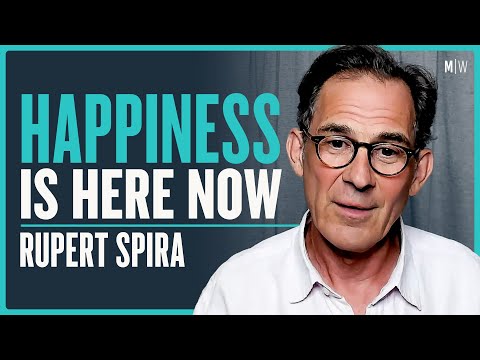
Rupert Spira - Enlightenment, Happiness & Non-Duality | Modern Wisdom Podcast 349
Rupert Spira (guest), Chris Williamson (host)
In this episode of Modern Wisdom, featuring Rupert Spira and Chris Williamson, Rupert Spira - Enlightenment, Happiness & Non-Duality | Modern Wisdom Podcast 349 explores rupert Spira Explains Non-Dual Enlightenment As Ever-Present Peace Within Rupert Spira and Chris Williamson explore enlightenment as the simple recognition of our essential, unchanging self—awareness itself—rather than an exotic mystical state.
Rupert Spira Explains Non-Dual Enlightenment As Ever-Present Peace Within
Rupert Spira and Chris Williamson explore enlightenment as the simple recognition of our essential, unchanging self—awareness itself—rather than an exotic mystical state.
Spira argues that peace and happiness are the inherent nature of this aware presence, and that suffering comes from seeking them in changing external conditions, objects, and achievements.
They extend this into non-duality: the idea that all apparent multiplicity—selves, objects, world—are expressions of one underlying reality or consciousness, illustrated through dream and screen analogies.
Practically, Spira suggests turning inward during moments of suffering to investigate the ‘I’ that is aware, distinguishing desires arising from lack from those arising from love, care, or joy.
Key Takeaways
Enlightenment is recognizing your essential self, not gaining something new.
Spira frames enlightenment as the clear seeing of what remains when all non-essential layers—thoughts, feelings, roles, memories—are mentally ‘removed’: the bare, aware presence we call ‘I’.
Get the full analysis with uListen AI
Peace and happiness are the nature of awareness, not products of circumstances.
By examining awareness itself, Spira leads Chris to see it is free of agitation and lack; the common names for these absences are peace and happiness, which are prior to and independent of life’s ‘weather’.
Get the full analysis with uListen AI
The main obstacle to lasting happiness is seeking it in objects and outcomes.
Culturally we are taught that better health, money, status, or relationships will complete us; Spira says this belief guarantees disappointment, because any relief from lack is brief and demands ever-stronger doses.
Get the full analysis with uListen AI
Not all desires are problematic; only those driven by inner lack.
He distinguishes desires arising from fear and insufficiency (to fill a hole) from desires arising from care, responsibility, joy, or love of truth, which are compatible with inner peace.
Get the full analysis with uListen AI
Non-duality means we share one being with everyone and everything.
Using the movie-screen and dream metaphors, Spira describes all apparent individuals and objects as expressions of a single reality or consciousness, like characters and scenery on one screen.
Get the full analysis with uListen AI
Inner inquiry during suffering can reveal the peaceful ‘I’ behind experience.
Instead of reaching for distractions (fridge, bottle, phone), Spira suggests pausing, closing the eyes, and asking ‘Who is suffering? ...
Get the full analysis with uListen AI
Realization deepens empathy: less personal suffering, more sensitivity to others.
As identification with a separate, lacking self loosens, one’s own suffering diminishes and sensitivity to others’ pain increases; seen from awareness itself, however, this isn’t experienced as overwhelming.
Get the full analysis with uListen AI
Notable Quotes
“Everything that you are aware of is constantly changing, but that which is aware of it remains consistently present throughout all changing experience.”
— Rupert Spira
“The recognition of the nature of one's essential being is what is referred to in the religious and spiritual traditions as enlightenment or awakening.”
— Rupert Spira
“Peace and happiness are the very nature of yourself. They are prior to and independent of the content of experience.”
— Rupert Spira
“The sky doesn't feel that it needs something from the weather… Awareness is like that.”
— Rupert Spira
“The world owes its reality to infinite consciousness, but its appearance to the finite mind.”
— Rupert Spira
Questions Answered in This Episode
If happiness is inherent to awareness, how can someone practically distinguish it from fleeting positive emotions in the midst of real-life hardship?
Rupert Spira and Chris Williamson explore enlightenment as the simple recognition of our essential, unchanging self—awareness itself—rather than an exotic mystical state.
Get the full analysis with uListen AI
Where is the line between responsibly improving life circumstances and subtly using self-improvement as a way to avoid facing inner lack?
Spira argues that peace and happiness are the inherent nature of this aware presence, and that suffering comes from seeking them in changing external conditions, objects, and achievements.
Get the full analysis with uListen AI
How can someone with no prior exposure to non-dual ideas begin recognizing awareness experientially rather than just intellectually?
They extend this into non-duality: the idea that all apparent multiplicity—selves, objects, world—are expressions of one underlying reality or consciousness, illustrated through dream and screen analogies.
Get the full analysis with uListen AI
If all beings share one underlying reality, how should this insight influence our approach to conflict, injustice, or harmful behavior?
Practically, Spira suggests turning inward during moments of suffering to investigate the ‘I’ that is aware, distinguishing desires arising from lack from those arising from love, care, or joy.
Get the full analysis with uListen AI
Is there a risk that the idea ‘my happiness doesn’t depend on circumstances’ leads some people to neglect necessary action or systemic change?
Get the full analysis with uListen AI
Transcript Preview
Everything that you are aware of is constantly changing, but that which is aware of it remains consistently present throughout all changing experience. In fact, that aware presence that we refer to when we say I is the only element of experience that never changes. (wind blows)
I actually want to start at the end, to perhaps give us an idea of where we're heading. How do you define enlightenment?
I would suggest that enlightenment is, um, a rather exotic term that has, um, acquired all sorts of, um, uh, e- e- exotic and superfluous meanings for people. But that it really refers to something very simple, and well within everybody's grasp. And, and it is, uh, simply this. The recognition of the nature of one's essential being, or self.
So it's innately linked to some sort of truth.
It, y- you, we could say it is, it is the truth about what we essentially are. Now, when I say, "What we essentially are," I mean, that aspect of ourselves that i- i- never disappears, cannot be taken away from us, is, is inherent or integral to us. So for instance, uh, the current conversation that you and I are having is not inherent in us. It, it started a few minutes ago, and it will come to an end. It's not part of our essential being. And, and indeed, no thought that we have ever had is essential to us. All thoughts appear, they exist briefly, and they vanish. Likewise, our feelings how ever, uh, however intimate or deep a feeling may be, it is still something that is added to us, it lasts a while, and then it vanishes. The same is true of any relationship or activity. So if one were to imagine removing everything from our self that is not essential to us, what would remain would be what I refer to as our essential irreducible self or being. The recognition of its nature is what is referred to in the religious and spiritual traditions as enlightenment or awakening.
So it feels a lot like that is casting off rather than learning more. It feels-
Absolutely.
... it feels like we need to get rid as opposed to acquire.
Well, it's actually not even necessary to get rid of anything. It, it, it is simply necessary to see clearly that all those elements of our experience, uh, namely thoughts, feelings, activities, relationships, sensations and perceptions are not essential to us. We don't actually have to get rid of them, or change them, or discipline them. We just have to realize they're not essential to us. The, the, um, analogy that I sometimes use to illustrate this is the analogy of the, the screen and the image. That no image, no movie is essential to the screen. If you closed down all your programs, your emails, your iPhotos, your notes, your YouTube clips, your Word documents, you closed down all the programs that you have running through the day, w- what, what remains? What, what can't you close down? You even remove your screensaver, which is not essential. It seems to be there always, but actually, it's not essential to the, uh, to the screen. What, what remains? Just the transparent empty screen. So yes, it's a similar process. It, it's a process of, um, removing from one self rather than adding to oneself.
Install uListen to search the full transcript and get AI-powered insights
Get Full TranscriptGet more from every podcast
AI summaries, searchable transcripts, and fact-checking. Free forever.
Add to Chrome