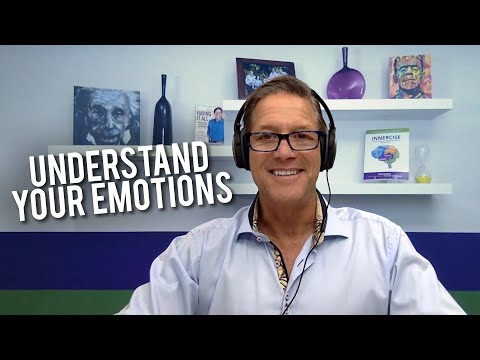
JOHN ASSARAF | Understand Your Emotions & Take Control Of Your Life | Modern Wisdom Podcast 143
John Assaraf (guest), Chris Williamson (host), Narrator
In this episode of Modern Wisdom, featuring John Assaraf and Chris Williamson, JOHN ASSARAF | Understand Your Emotions & Take Control Of Your Life | Modern Wisdom Podcast 143 explores reprogram Your Brain: Turn Fear Into Fuel And Design Success John Assaraf explains that modern underperformance is rarely about lacking information, but about unmanaged inner blocks like fear, limiting beliefs, self-image, and doubt. Drawing on neuroscience and psychology, he frames fear as a useful brain signal, not an enemy, and shows how awareness allows us to respond instead of react.
Reprogram Your Brain: Turn Fear Into Fuel And Design Success
John Assaraf explains that modern underperformance is rarely about lacking information, but about unmanaged inner blocks like fear, limiting beliefs, self-image, and doubt. Drawing on neuroscience and psychology, he frames fear as a useful brain signal, not an enemy, and shows how awareness allows us to respond instead of react.
He outlines four primary internal obstacles and offers practical tools—such as specific breathing and awareness exercises (Innercises)—to interrupt automatic patterns and regain control of thoughts, emotions, and behaviors.
Assaraf also contrasts the popularized "law of attraction" with his "law of GOYA" (Get Off Your Ass), emphasizing that aligned action in the right order, plus mental and emotional alignment, is what actually produces results.
Throughout, he stresses that no one is born with fixed beliefs or habits; by consciously rewriting our internal "script," building empowering habits, and using the brain more skillfully, we can deliberately create a different life.
Key Takeaways
Treat fear as a signal, not a stop sign.
Fear is a survival mechanism that flags potential danger, real or imagined. ...
Get the full analysis with uListen AI
Identify and challenge limiting beliefs that shape your behavior.
Thoughts like "I’m too old" or "I’m not smart enough" form a lens that dictates what you attempt. ...
Get the full analysis with uListen AI
Use simple state-change tools to regain control under stress.
Assaraf’s Innercise ‘Take 6, Calm the Circuits’—six slow nasal inhales with long straw-like exhales—shifts you from fight-or-flight (sympathetic) into a calmer, thinking state (parasympathetic). ...
Get the full analysis with uListen AI
Rewrite your personal “script” instead of replaying your old story.
Rather than staying trapped in a narrative of failure or limitation, you can write a new story beginning with “I’m so happy and grateful for the fact that…”, describing the income, body, relationships, and lifestyle you want, then rehearse and act it out until it becomes your new identity.
Get the full analysis with uListen AI
Focus on empowering vs. disempowering habits instead of ‘good’ vs. ‘bad’.
Labeling thoughts or behaviors as ‘good’ or ‘bad’ adds shame and resistance. ...
Get the full analysis with uListen AI
The law of attraction only works when combined with the law of GOYA.
Thinking, visualizing, and believing are insufficient on their own; you must Get Off Your Ass and take the right actions in the right order, guided by proven blueprints that already exist for almost any goal you have.
Get the full analysis with uListen AI
Deliberate planning multiplies the return on your time and effort.
Whether building a business or planning a holiday, intentionally deciding what to do, when, and how yields far better outcomes than unstructured “just doing,” ensuring your actions align with your desired results.
Get the full analysis with uListen AI
Notable Quotes
“Today's problem isn't that the how-to doesn't exist. It's all of the internal bullshit that people are dealing with that holds them back.”
— John Assaraf
“The problem is not fear. The problem is that most people don't understand that fear is just a signal.”
— John Assaraf
“You are not a victim of your circumstance or your conditions. The only way you're a victim is if you take that role on as part of your identity.”
— John Assaraf
“If I understand that I am not my thoughts, I'm not my emotions, I'm not my behaviors, I'm not my results…I have those, then the question is, can I choose ones that are better for me?”
— John Assaraf
“The law of attraction should be renamed to the law of resonance…Get your head, your heart, your gut, and your behaviors aligned, and then you will be in resonance.”
— John Assaraf
Questions Answered in This Episode
Which of the four internal blockers—fear, limiting beliefs, self-image, or lack of skills—seems to be driving most of my current inaction?
John Assaraf explains that modern underperformance is rarely about lacking information, but about unmanaged inner blocks like fear, limiting beliefs, self-image, and doubt. ...
Get the full analysis with uListen AI
If I rewrote my life script starting with “I’m so happy and grateful for the fact that…”, what would I dare to include that I currently dismiss as unrealistic?
He outlines four primary internal obstacles and offers practical tools—such as specific breathing and awareness exercises (Innercises)—to interrupt automatic patterns and regain control of thoughts, emotions, and behaviors.
Get the full analysis with uListen AI
How might my day-to-day decisions change if I consistently paused to use ‘Take 6, Calm the Circuits’ and AIA before reacting?
Assaraf also contrasts the popularized "law of attraction" with his "law of GOYA" (Get Off Your Ass), emphasizing that aligned action in the right order, plus mental and emotional alignment, is what actually produces results.
Get the full analysis with uListen AI
What disempowering habits am I labeling as ‘just who I am’, and how would reframing them as changeable patterns alter my sense of agency?
Throughout, he stresses that no one is born with fixed beliefs or habits; by consciously rewriting our internal "script," building empowering habits, and using the brain more skillfully, we can deliberately create a different life.
Get the full analysis with uListen AI
In the goals I care about most, am I truly following the right actions in the right order, or am I staying busy with comfortable but low-impact tasks?
Get the full analysis with uListen AI
Transcript Preview
There are 50 different types of fears that hold most people back, but there's a common seven or so. So fear of failure, fear of succeeding and failing, fear of trying my best and disappointing myself or others, fear of being embarrassed, ashamed, ridiculed, or judged. All of these fears have to do with our self-image, self-esteem, and self-worth, and what will I think of me or what will others think of me if I don't succeed or if I do and fail? So fears are naturally occurring phenomenons in our subconscious mind as a safety and protective mechanism to keep us away from any danger or real or imagined pain or suffering. And so, it's just an automatic trigger in the subconscious mind. Now, the problem is not fear. The problem is that most people don't understand that fear, it's just a signal. It's a highly sensitive signal and mechanism in the brain, but the ramifications of not understanding what fear does is the problem.
(wave crashes) John Assaraf in the building. How are you, man?
In the building, here I am-
(laughs)
... doing great. We're- we're- we're par- we're separated by sea, but we're all connected, right?
That's- that's absolutely true. Uh, I'm super, super excited to speak to you today. So-
Thank you.
... people might have seen you on The Secret or know you as bestselling author or, you know, endlessly successful entrepreneur with multiple projects and stuff like that. Do you think that you were naturally gifted to be successful in this many domains? Is this kind of what you thought you were going to end up doing when you were younger?
(laughs) No. I- I was voted most likely to fail in life, uh, by my grade 11 students and my, uh, my basketball team that I- I excelled in basketball when I was a kid, ever thought I was gonna be a, you know, a jock, uh, you know, uh, an athlete of some sort. They- they used to say, you know, "He- he- he's brilliant on the basketball court, but he's dumber than a doorknob in the classroom."
(laughs)
And so (laughs) I- I, um, I- I never thought I would be doing what I do today. I never believed that I could. I thought I was way too dumb. Uh, I was- I was hungry, but I was- I just felt like I wasn't as smart as the other kids. Um, me and my, uh, I- I grew up in a family with, you know, hardworking parents who wanted to put food on the table for their kids. We lived in moderate, moderate, moderate, um, you know, means. Um, you know, it's, I had a bedroom with my brother. My sister had a bedroom. Um, we had an apartment. Uh, there was always arguments and fights around the lack of money. My father was a gambler and an, uh, alcoholic, uh, I believe. Uh, he hasn't drank in probably 50 years, but, uh, so a lot of struggles. And, um, and then, um, I- I- we- I didn't have the environment that really fostered me even thinking about achieving success until I had one chance encounter with one man when I was 19 years old, who asked me one question, and the answer to that question changed my life. Uh, but up until the age of 19, I thought I was, you know, gonna work in a factory, making minimum wage, living in an average place. I was struggling for money, uh, struggling to make a great life for myself. The only great life that I ever had in my imagination was from watching television.
Install uListen to search the full transcript and get AI-powered insights
Get Full TranscriptGet more from every podcast
AI summaries, searchable transcripts, and fact-checking. Free forever.
Add to Chrome