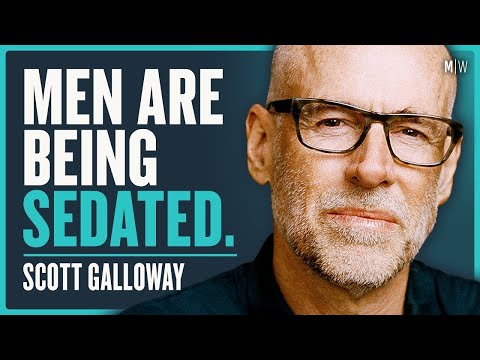
Why Millennials Are Doing Worse Than Their Parents - Scott Galloway
Scott Galloway (guest), Chris Williamson (host)
In this episode of Modern Wisdom, featuring Scott Galloway and Chris Williamson, Why Millennials Are Doing Worse Than Their Parents - Scott Galloway explores scott Galloway Dissects Millennial Decline, TikTok, Masculinity, and Media Scott Galloway explains why, for the first time in U.S. history, young adults are doing worse economically than their parents, arguing this is the result of deliberate policy choices that transfer wealth from younger to older generations. He criticizes regressive tax structures, housing and education policy, and pandemic relief that favored already-wealthy Boomers, turning America from the best place to get rich into the best place to stay rich.
Scott Galloway Dissects Millennial Decline, TikTok, Masculinity, and Media
Scott Galloway explains why, for the first time in U.S. history, young adults are doing worse economically than their parents, arguing this is the result of deliberate policy choices that transfer wealth from younger to older generations. He criticizes regressive tax structures, housing and education policy, and pandemic relief that favored already-wealthy Boomers, turning America from the best place to get rich into the best place to stay rich.
Galloway and Chris Williamson then examine TikTok as an extraordinarily successful but geopolitically dangerous product, potentially serving as a subtle propaganda and polarization tool for the Chinese state while feeding American youth a diet of divisive, anti‑institutional narratives. In contrast, China’s domestic version, Douyin, promotes aspirational, apolitical content and tightly regulates youth screen time.
A major focus is the crisis facing young men—falling educational attainment, economic stagnation, loneliness, and a distorted mating market—that leaves many men broke, alone, and vulnerable to misogynistic or extremist content. Galloway calls this an existential societal risk and argues for reclaiming and redefining masculinity, expanding male role models, and rebuilding in‑person community.
They close by critiquing partisan media economics, the attention economy’s “race to the bottom of the brainstem,” and offering pragmatic life advice for people in their 20s and 30s: build physical and mental grit, move to big cities, take social and professional risks, and be intentional about choosing a long‑term partner.
Key Takeaways
Intergenerational inequality is a policy choice, not an inevitability.
Tax codes that favor mortgage interest and capital gains, massive Social Security transfers to already-wealthy retirees, and education and housing policy have systematically tilted capital toward Boomers and away from younger workers; because we chose these rules, they can be rewritten.
Get the full analysis with uListen AI
America has shifted from high mobility to entrenched wealth protection.
Galloway argues the U. ...
Get the full analysis with uListen AI
TikTok is both a brilliant product and a strategic vulnerability.
Its ultra-personalized, choice‑less feed maximizes engagement but also makes it easy for a foreign owner to subtly up-rank anti‑American, anti‑institutional narratives, turning millions of domestic creators into unwitting amplifiers while China’s own Douyin feeds its youth aspirational, censored content.
Get the full analysis with uListen AI
Young men are in deep trouble across multiple dimensions.
Boys and men lag in education, dominate grim statistics (suicide, overdoses, incarceration, mass shootings), are increasingly shut out of the mating market, and are oversupplied with digital substitutes (porn, games, social media) that sedate rather than develop them, creating a cohort of “young, broke, and alone” men.
Get the full analysis with uListen AI
Reclaiming masculinity is crucial for both men and women.
Galloway distinguishes masculinity from toxicity, framing healthy masculinity as protection, responsibility, and service to others; he urges the political left to champion constructive male role models and opportunities instead of ceding the space to grifters peddling misogyny.
Get the full analysis with uListen AI
Loneliness is an emerging epidemic with serious social costs.
Declines in close friendships, community participation, and in‑person male role models—especially in single‑parent and disadvantaged neighborhoods—fuel isolation, mental health crises, and susceptibility to destructive ideologies; rebuilding local institutions and mentoring structures can mitigate this.
Get the full analysis with uListen AI
For individuals, grit, proximity, and risk-taking are powerful levers.
Galloway’s personal advice: in your 20s and 30s, push yourself physically and mentally, live in big cities to “play up,” seek constant exposure to strangers and opportunities, learn to tolerate rejection, and be deliberate about choosing a partner—since that decision shapes life outcomes more than career or location.
Get the full analysis with uListen AI
Notable Quotes
“This isn’t forces greater than us. These are deliberate decisions… we’ve deliberately taken money from young people and transferred it to old people.”
— Scott Galloway
“America has morphed from the best place to get rich into the best place to stay rich.”
— Scott Galloway
“The most dangerous person on the planet is a young, broke, and alone man.”
— Scott Galloway
“Nothing wonderful will happen to you unless you take an uncomfortable risk.”
— Scott Galloway
“We’re eating each other in the US internally… the fastest way to defeat an enemy is to atomize them.”
— Scott Galloway
Questions Answered in This Episode
If intergenerational wealth transfers are policy-driven, what specific reforms could realistically rebalance resources toward younger generations without provoking political backlash from older voters?
Scott Galloway explains why, for the first time in U. ...
Get the full analysis with uListen AI
How should liberal democracies regulate foreign-owned attention platforms like TikTok without undermining free expression or sleepwalking into digital protectionism?
Galloway and Chris Williamson then examine TikTok as an extraordinarily successful but geopolitically dangerous product, potentially serving as a subtle propaganda and polarization tool for the Chinese state while feeding American youth a diet of divisive, anti‑institutional narratives. ...
Get the full analysis with uListen AI
What concrete programs or institutions could be scaled to provide the kind of male mentorship and community Galloway describes (e.g., fraternities, sports, ex‑prisoner mentorship) outside of college environments?
A major focus is the crisis facing young men—falling educational attainment, economic stagnation, loneliness, and a distorted mating market—that leaves many men broke, alone, and vulnerable to misogynistic or extremist content. ...
Get the full analysis with uListen AI
How can we encourage healthier forms of masculinity in culture and education while avoiding the trap of equating any advocacy for men with being anti‑woman?
They close by critiquing partisan media economics, the attention economy’s “race to the bottom of the brainstem,” and offering pragmatic life advice for people in their 20s and 30s: build physical and mental grit, move to big cities, take social and professional risks, and be intentional about choosing a long‑term partner.
Get the full analysis with uListen AI
Given the economic incentives that drive partisan media, is it actually feasible to rebuild broad‑trust, non‑partisan news at scale, and what funding or governance model would make that sustainable?
Get the full analysis with uListen AI
Transcript Preview
We're eating each other in the US internally. A third of Republicans and Democrats see members of the other party as their mortal enemy. 25% of America is comfortable with an autocrat, as long as the autocrat represents his or her ideals. 54% of Democrats are worried that their kid is gonna marry a Republican. And so, the fastest way to defeat an enemy is to atomize them. (airplane flying)
In the 1950s, a young person had a 90% chance of out-earning their parents. Now, it's a 50% chance. Only half of Millennials are earning more than its parents. Since 1989, people under the age of 40 have seen their share of the nation's wealth plummet from 19% to 9%, and for the first time in US history, young people are no longer better off economically than their parents were at the same age. Nice, positive headlines to get us started today. What- where did you learn that?
(clears throat) Well, look, um, first of all, it's great to be with you, but the ... Where you mentioned that for the first time in our nation's history, a 30-year-old man or woman isn't doing as well as his or her parents, that's kind of a gr- breakdown in what is the fundamental compact between a society and its populous. And that is if you play by the rules, and you're a good person, and you work hard, your kids will do better than you. That's kind of what you want. Anyone who has kids knows you're only as least happy as your least happy kid, and if your kids, on average, aren't doing as well as you, it means to have kids in a nation, means your life is gonna go, is gonna, eh, quality of life is gonna degrade, emotionally and psychologically, which means society no longer works for you. And it- and we gotta hope it's temporary. But that's the bad news. The good news is, depending on how you look at it, this is a problem of our own making. You mentioned that the wealth of people under the age of 40 as registered by their percentage of GDP has been cut in half, and there's this illusion of complexity that the incumbents will try and foment among media and the populous to explain why these very intractable problems are intractable. And they're not. When we, the two biggest tax deductions in America that we have passed, and we have decided make sense are mortgage interest and capital gains. Who owns home and owns stocks? People my age and older. Who rents and makes their money working? People your age and younger. So we've effectively decided that the two biggest tax cuts that further enrich the wealthiest generation in history, and that is US baby boomers. If we look at the biggest transfer of wealth that's recurring in the world, it's a transfer of wealth of one and a half trillion dollars from people of working age in the United States to people of retirement age in the form of Social Security. And again, that cohort receiving a trillion and a half dollar transfer payment from young people are the wealthiest cohort in the history of the planet. So education is skyrocketing, uh, regressive tax ra- I mean, you can just go on and on and on. This isn't an accident. This isn't forces greater than us. These are deliberate decisions, mostly because old people vote, mostly because presidential politics start in Iowa and Maine, the two oldest, Whitest states in the nation, and what do you know? We have a society that tilts capital away from your generation to mine. And it is, uh, i- it's, it's dumb, it's short-sighted, and it's also morally corrupt. Uh, and there's, it just goes on and on and on. Education. When I applied to school in the '80s, to college, the admissions rate was 76%, the tuition was $1200 a year. That same school, the admissions rate is 6% and the tuition is closer to $30,000 a year. So e- everything we've done has sort of stacked the deck. It's sort of Baby Boomers have decided heads I win, tails you lose.
Install uListen to search the full transcript and get AI-powered insights
Get Full TranscriptGet more from every podcast
AI summaries, searchable transcripts, and fact-checking. Free forever.
Add to Chrome