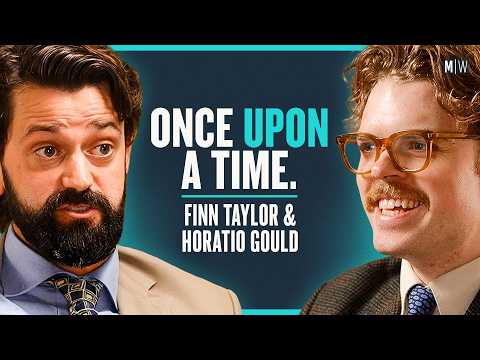
The Good Ol’ Days Were Way Worse - Fin Taylor & Horatio Gould
Chris Williamson (host), Fin Taylor (guest), Horatio Gould (guest), Guest (Fin Taylor or Horatio Gould) (guest), Horatio Gould (guest), Fin Taylor (guest), Horatio Gould (guest), Chris Williamson (host)
In this episode of Modern Wisdom, featuring Chris Williamson and Fin Taylor, The Good Ol’ Days Were Way Worse - Fin Taylor & Horatio Gould explores comedians Deconstruct History, Eugenics, Hitler Memes And Modern Madness Chris Williamson hosts comedians Fin Taylor and Horatio Gould to riff on history, politics, and internet culture through the lens of their show *Fin vs. History*.
Comedians Deconstruct History, Eugenics, Hitler Memes And Modern Madness
Chris Williamson hosts comedians Fin Taylor and Horatio Gould to riff on history, politics, and internet culture through the lens of their show *Fin vs. History*.
They argue that despite current pessimism, the past was generally far worse, using postwar Britain, World War II, Japan, and the Aztecs as darkly comic case studies.
The trio explore how Darwinian ideas fed scientific racism and eugenics, how Hitler has become both moral shorthand and new meme fuel online, and how modern biohacking and embryo selection echo old eugenic impulses.
Threaded through is a critique of online insincerity, the power of British accents and suits to manufacture authority, and a surprisingly earnest discussion of parenting, control, and what it means to live in a hyper-ironic age.
Key Takeaways
Historical perspective can reduce modern anxiety.
Studying periods like 1970s Britain—blackouts, three-day weeks, economic collapse—shows many current problems are milder versions of past crises, which can make today’s chaos feel less apocalyptic.
Get the full analysis with uListen AI
Cultural isolation produces distinct, sometimes extreme norms.
Japan’s 300-year semi-closure, honor culture, and syncretic religion helped normalize seppuku and later kamikaze, where individual life was genuinely subordinate to honor and group duty.
Get the full analysis with uListen AI
Scientific ideas are easily weaponized by ideology.
Darwin’s theory of evolution was taken by thinkers like Francis Galton and extended into racial hierarchies, phrenology, and forced sterilization policies in the US and Germany—illustrating how ‘neutral’ science can justify brutality.
Get the full analysis with uListen AI
World War II still structures our moral imagination.
Hitler, the Holocaust, and Nazi aesthetics underpin how we define ‘evil,’ design villains in pop culture, and argue online, which is why the rise of ironic and genuine pro‑Hitler content is both predictable and dangerous.
Get the full analysis with uListen AI
The line between performance and authenticity online is collapsing.
Creators, ‘experts,’ and even politicians often play heightened personas; audiences both know it’s performative and still treat it as real, making irony, grift, and sincere belief hard to disentangle.
Get the full analysis with uListen AI
Biohacking and embryo selection resurrect eugenic dilemmas.
While selecting embryos to avoid severe disease seems benign, ranking potential children by polygenic scores for IQ or traits could create buyer’s remorse and transactional attitudes toward kids, eroding the unconditional nature of parenthood.
Get the full analysis with uListen AI
Presence may matter more than optimization in parenting.
They argue that a father simply being consistently around, rather than perfectly engineered or career-maximized, is strongly linked to better child mental health—suggesting that relinquishing control can be psychologically healthier for both parent and child.
Get the full analysis with uListen AI
Notable Quotes
“History for me has always been quite a soothing thing. It’s been a lot worse.”
— Fin Taylor
“Britain is bankrupt and yet not completely destroyed, and we spend all the money the Americans give us on getting a nuclear bomb.”
— Horatio Gould
“In the 19th century, the smartest people were the most racist. He was a scholar and a racist.”
— Horatio Gould
“World War II is kind of ASMR for white guys in their 30s.”
— Fin Taylor
“The whole thing about parenthood is that you don’t choose the card you’re dealt. If you go into it thinking you have control, that’s the worst place to be.”
— Fin Taylor
Questions Answered in This Episode
How far should we go with embryo selection—where is the ethical line between preventing suffering and engineering preferred traits?
Chris Williamson hosts comedians Fin Taylor and Horatio Gould to riff on history, politics, and internet culture through the lens of their show *Fin vs. ...
Get the full analysis with uListen AI
Does using dark comedy to talk about topics like genocide, eugenics, and Hitler clarify history for people or risk trivializing it?
They argue that despite current pessimism, the past was generally far worse, using postwar Britain, World War II, Japan, and the Aztecs as darkly comic case studies.
Get the full analysis with uListen AI
Given how Darwin’s ideas were misused, how should we communicate new genetic and AI research so it isn’t co‑opted by extremists?
The trio explore how Darwinian ideas fed scientific racism and eugenics, how Hitler has become both moral shorthand and new meme fuel online, and how modern biohacking and embryo selection echo old eugenic impulses.
Get the full analysis with uListen AI
Is the internet’s default irony eroding our ability to be sincere, or is it a necessary defense against fake authenticity and grift?
Threaded through is a critique of online insincerity, the power of British accents and suits to manufacture authority, and a surprisingly earnest discussion of parenting, control, and what it means to live in a hyper-ironic age.
Get the full analysis with uListen AI
If ‘these are the best times in history,’ why does it feel to so many people as if everything is getting worse?
Get the full analysis with uListen AI
Transcript Preview
You are historians now.
Yes, very much so.
Congratulations.
Big pivot.
Uh-huh. Yeah, hard pivot.
Yeah, yeah. Into academia.
I mean, this is what the manosphere's come to.
Yeah.
If you're speaking to historians, you'll, you'll get us on to talk. It doesn't matter, because we can-
Well, it's the lot-
We can say what we want-
It's the logical end point of-
... and there'll be people who'll be like, "What? Really?"
... podcasts that need academic guests.
Yeah.
Is they use all of them.
This is how low the barrel is that I'm scraping.
This is how your business model works. Is once you've had-
Yeah.
... whatever, what's his name? Graham?
Graham Hancock. (laughs)
Because you've had him on four times.
Graham Hand Job. Yeah.
(laughs) You have to get, you have to get a new guy on.
Yeah.
The legitimacy has declined so much-
Who will deny even more genocide. (laughs)
... that it's got to you guys. Yeah, I agree.
Yeah, it's not clicky enough.
Yeah.
Graham Hancock is just not, it's not-
Yeah, people are used to it. They need to get these guys on.
Yeah, exactly. (laughs) They need someone who's really pushing the boundaries. Yeah.
Have you been any more capable of predicting the future now with all of your illustrious studying of the past? Has it given you any insights about what's going on in the modern world?
It's made me calmer about it.
Yeah.
It's just always fucked.
That's true. That's a gen-
Yeah.
Uh, uh, history for me has always been quite, like, a soothing thing.
Yeah.
It's been a lot worse.
(laughs)
And it, it's gonna carry on being like this, and, uh-
It's like ASMR.
Because people keep saying, like, you know, "Back in the day." Back in... What do you mean back in the day?
Yeah.
It was awful. It was always awful for s-
It's been awful for s- This is, this is the best it's ever been.
The '90s were slightly better.
A bit... Yeah. There was four years.
It's b- Human's gone like this, it's gone like this-
Yeah.
... and now it's like that.
No, I reckon it went like that, and then it was, like, in between Diana and 9/11, and then it's just been like that.
Yeah, exactly. It's been going down, but people is... It is still, like... Step back. It's, it's unreal. People-
Coffee, coffee's good.
I mean, we've got New Tonic now.
All that stuff. That stuff.
Agreed. Thank you f-
You've got... Look at... You don't have this in the Middle Ages. That is true.
Install uListen to search the full transcript and get AI-powered insights
Get Full TranscriptGet more from every podcast
AI summaries, searchable transcripts, and fact-checking. Free forever.
Add to Chrome