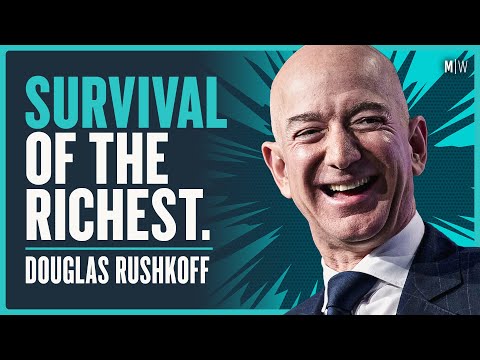
How Billionaires Are Preparing For Doomsday - Douglas Rushkoff
Douglas Rushkoff (guest), Chris Williamson (host), Narrator
In this episode of Modern Wisdom, featuring Douglas Rushkoff and Chris Williamson, How Billionaires Are Preparing For Doomsday - Douglas Rushkoff explores billionaire Bunkers, Tech Hubris, And Why Real Preppers Build Community Douglas Rushkoff explains how many tech billionaires are preparing for “the event” with luxury bunkers, private militias, and escape plans to places like New Zealand and seasteads, revealing the brittle logic and sci‑fi fantasies behind these strategies.
Billionaire Bunkers, Tech Hubris, And Why Real Preppers Build Community
Douglas Rushkoff explains how many tech billionaires are preparing for “the event” with luxury bunkers, private militias, and escape plans to places like New Zealand and seasteads, revealing the brittle logic and sci‑fi fantasies behind these strategies.
He argues that the same mindset driving planned doomsday escapes also underpins extractive capitalism, techno-solutionism, and an apex‑predator attitude that treats environmental and social damage as acceptable externalities.
Rushkoff links billionaire escapism to a backlash against totalizing ideologies and online extremism, showing how digital media accelerates hubris and polarisation on both left and right.
As an alternative, he advocates for local, community-based resilience, smaller-scale ambitions, and a redefinition of comfort and progress away from endless growth and toward embedded, mutual support.
Key Takeaways
Billionaire bunkers are structurally and socially fragile.
Rushkoff highlights basic oversights in elite prep plans—like food systems, spare parts, germs, and the loyalty of hired security—that make isolated underground compounds and remote farms highly brittle compared with community-rooted resilience.
Get the full analysis with uListen AI
Real preppers prepare with their communities, not against them.
Experienced preppers he’s met focus on teaching neighbors foraging, farming, and self-defense because survival is more likely in a cooperative network than as a lone, fortified household.
Get the full analysis with uListen AI
Tech and business incentives push leaders toward escape fantasies.
From Epson’s planned-obsolete printers to social-media execs who won’t let their own kids use their products, Rushkoff argues many fortunes are built by acting as though the world is already disposable—then justifying this behavior with apocalyptic narratives and dreams of exit.
Get the full analysis with uListen AI
Digital media turns every ideology into an extreme, brittle form.
Because online ideas spread at high speed without real-world friction, both “woke” and anti-woke responses become over-amplified, leaving little room for nuance, learning, or repair and making hubristic, all-or-nothing schemes more attractive.
Get the full analysis with uListen AI
Personal sovereignty taken too far becomes atomized, anti-social withdrawal.
While individual agency is valuable, Rushkoff and Williamson note how wealthy people often evolve from productive independence into a “me and mine, screw everyone else” mentality that erodes civic ties and can morph into prepping to abandon society entirely.
Get the full analysis with uListen AI
Scaling everything is part of the problem, not the solution.
Rushkoff suggests that the drive to go from millions to billions—of dollars, users, or followers—forces products and platforms to pivot toward extraction and manipulation, and that accepting “enough” at a smaller scale could avoid a lot of downstream harm.
Get the full analysis with uListen AI
Local engagement is both psychologically protective and politically powerful.
He recommends spending less energy on every global controversy and more on tangible local actions—supporting community agriculture, helping neighbors, building mutual aid—because distributed, grounded resilience weakens the hold of brittle top-down systems and billionaire savior narratives.
Get the full analysis with uListen AI
Notable Quotes
“The lone prepper does not survive. The only way to be prepared is to be prepared together, not prepared alone.”
— Douglas Rushkoff
“These guys are trying to recreate the womb… this technological bubble where they can sit and have algorithms and robots bring to them what they want before they even know they want it.”
— Douglas Rushkoff (via Timothy Leary’s critique of the MIT Media Lab)
“Technology gives us more choice, but we haven’t yet developed the capacity to make wise choices.”
— Douglas Rushkoff
“Science is basically a rape fantasy: take nature by the forelock, hold her down, and submit her to our will.”
— Douglas Rushkoff, paraphrasing Francis Bacon’s vision of science
“If we can laugh at these guys, then the whole thing starts to feel less scary and urgent in that brittle way. Don’t try to be Musk. Let Musk be Musk and you can be you.”
— Douglas Rushkoff
Questions Answered in This Episode
If elite bunker strategies are so brittle, what forms of community-based preparedness would genuinely increase resilience for ordinary people?
Douglas Rushkoff explains how many tech billionaires are preparing for “the event” with luxury bunkers, private militias, and escape plans to places like New Zealand and seasteads, revealing the brittle logic and sci‑fi fantasies behind these strategies.
Get the full analysis with uListen AI
How can societies encourage technological innovation without reinforcing the extractive, externality-ignoring mindset Rushkoff critiques?
He argues that the same mindset driving planned doomsday escapes also underpins extractive capitalism, techno-solutionism, and an apex‑predator attitude that treats environmental and social damage as acceptable externalities.
Get the full analysis with uListen AI
Where is the line between healthy personal sovereignty and the kind of atomized, apex-predator attitude that makes people comfortable abandoning everyone else?
Rushkoff links billionaire escapism to a backlash against totalizing ideologies and online extremism, showing how digital media accelerates hubris and polarisation on both left and right.
Get the full analysis with uListen AI
In a media environment that amplifies extremes, what practical steps can individuals and platforms take to reintroduce friction, nuance, and slower thinking?
As an alternative, he advocates for local, community-based resilience, smaller-scale ambitions, and a redefinition of comfort and progress away from endless growth and toward embedded, mutual support.
Get the full analysis with uListen AI
What would a realistic, desirable future look like that combines some technology with the permaculture-style, lower-energy living Rushkoff admires?
Get the full analysis with uListen AI
Transcript Preview
... any of them that are land-based, we can go take them over. There's more of us. I think these are very penetrable. (laughs) The ones that are totally locked away, their agriculture systems are totally self-contained. Have you ever seen somebody doing vertical farming at home? You get a bad batch, just take it out and go build another one. You can't do that when you're locked away. What do you do? You go out with a crew with a couple of guys with machine guns to run and find some more sterile topsoil? But of course you got the nuclear fallout and the zombies and the killer bees and whatever it is (laughs) out there that you're supposed to be hiding from.
It seems to me kind of an inevitability, I've had a lot of conversations on the show about existential risk, talking about the work of people like Toby Ord and Nick Bostrom. Are we gonna get turned into gray goo or a big bunch of paper clips? You know, this small background risk of a gamma burst destroying us all, or is the polar, the polar, uh, end's gonna flip and then all of the technology's gonna fall out? It seems unsurprising to me that the people that have the absolute most resources on the planet, who are exposed to this kind of thinking, who are probably technologists in one form or another, techno-utopians, would take that, run with it, and think, "I essentially have an unlimited number of resources. How can I try and insulate myself from this problem?" That, to me, doesn't seem very surprising at all.
No, but I wonder what the order of events really is. Is it, "Oh, I've got all these resources so I have a lot of stuff that's at risk and I wanna spend a lot of my energy protecting myself," or is it, "I've achieved my great wealth and all my technological monopolies and stuff by treating other people and places as if the world is already ending, so I really like to have some evidence that s- the world is ending so I can justify having (laughs) essentially used a bomb shelter mentality all along."
How would you say millionaires have treated the world as if it was already ending or billionaires have treated the world as if it was already ending w- from before now?
Well, I mean, there's so many examples. Like, one I just heard was on, um, (smacks lips) a, a piece that Cory Doctorow, a friend of mine, wrote about, uh, Epson printers. And apparently, they make... A certain Epson printer is pre-programmed to brick itself after a certain number of pages. And he interviewed the company to find out why, and they justified that there's a tiny little sponge somewhere in this printer that absorbs the loose dust, and after however many, 5,000 or 10,000 pages, they believe that that little sponge might be filled up and some of the dust might sprinkle out onto the filing cabinet or, or the piece of paper under which you've, you, uh, where you put the printer. And to prevent that disaster from happening, and because you can't replace that two-cent sponge, I mean, my God, that would be i- an impossible feat of, of administration, they will save us all by breaking the com- com- uh, the printer and forcing you to throw it into a, a waste pile somewhere, you know, a big toxic waste pile that some Brazilian children pick at to find the renewable, you know, rare earth metals in it, and then send some other children to get the rare earth metals out of a mine to build a new printer for you. Now, the guy at Epson who makes that decision is not stupid. He knows, "I am contributing to climate change, I'm contributing to the end of the world by doing this, but I'm gonna make enough margin selling an extra few printers that I'm gonna be able to distance myself from the reality I'm creating by earning money in this way." So, this series of decisions that are made, or the guy, the guy I spoke to at one of those, uh, uh, foo camps who, uh, was one of the guys who put the algorithms in the social media feeds that addict teenagers to, uh, uh, you know, clicking and whatever and worrying about themselves, doesn't let his kids touch the stuff. He's got a private, you know, uh, uh, organic farm with a goat share. His kid goes to a Rudolf Steiner school and is not allowed to touch anything. So, he's already got a kind of organic farm bunker in the middle of nowhere and behaving as if everyone else's kids are the ones who are being left behind. So, if you've got an apocalypse coming, you can kind of say, "Okay, that's why I'm doing it this way."
Install uListen to search the full transcript and get AI-powered insights
Get Full TranscriptGet more from every podcast
AI summaries, searchable transcripts, and fact-checking. Free forever.
Add to Chrome