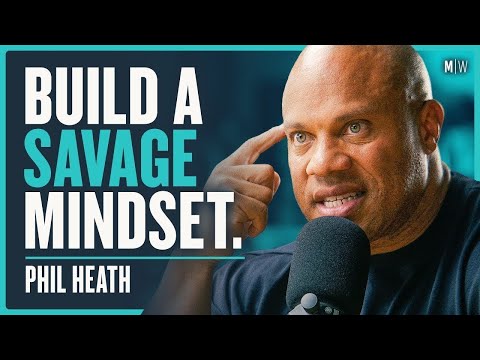
How To Fortify Your Mind And Body - 7X Bodybuilding World Champion Phil Heath (4K)
Chris Williamson (host), Phil Heath (guest), Narrator, Narrator
In this episode of Modern Wisdom, featuring Chris Williamson and Phil Heath, How To Fortify Your Mind And Body - 7X Bodybuilding World Champion Phil Heath (4K) explores phil Heath Reveals Mental Fortitude Behind Seven Mr. Olympia Titles Phil Heath discusses the origins and deeper meaning of his nickname "The Gift," reframing it as a responsibility to develop and give his talents to others rather than a boast about genetics.
Phil Heath Reveals Mental Fortitude Behind Seven Mr. Olympia Titles
Phil Heath discusses the origins and deeper meaning of his nickname "The Gift," reframing it as a responsibility to develop and give his talents to others rather than a boast about genetics.
He walks through formative moments of self-doubt and early competition anxiety, showing how world‑class performance can coexist with insecurity, and how self-belief is built through testing, adversity, and deliberate mental reframing.
The conversation explores battling your inner critic, giving yourself permission to be great, handling pain, grief, and public scrutiny, and the standards required to sustain dominance at the very top of bodybuilding.
He also breaks down rivalry dynamics with Kai Greene, his relatively conservative PED philosophy, distinctive high-volume training methods, and his broader philosophy on legacy, risk, and living up to one’s potential.
Key Takeaways
Reframe your "gift" as something to develop and give away.
Heath rejected the idea that his nickname meant arrogance; instead, he decided his gift was his ability to work, overcome adversity, and then share lessons so others can reach their own "champion podium."
Get the full analysis with uListen AI
Self-belief often lags behind your preparation—act on the work, not the fear.
Before his first show, Heath was riddled with anxiety and focused on others’ physiques until a woman in the crowd yelled, "Smile, you're beautiful," snapping him back into owning the effort he had already put in.
Get the full analysis with uListen AI
Your greatest enemy and ally is yourself; expose your inner lies.
Heath and Williamson stress that the harshest, most sabotaging voice is often your own, carrying inherited stories from family and past; progress requires identifying and challenging those internal lies.
Get the full analysis with uListen AI
Give yourself explicit permission each day to pursue excellence.
Heath advocates consciously "declaring" daily intentions—whether doing hated cardio, eating well, or treating people better—as a way to change behavioral patterns and answer the "call" to your own greatness instead of letting it pass to someone else.
Get the full analysis with uListen AI
Use pain and adversity as badges of honor, not excuses.
From learning of his father’s death before a meet-and-greet to navigating divorce and business collapse mid‑career, Heath chose to "go to work" and later process emotions, using hardship as proof he was truly battle-tested.
Get the full analysis with uListen AI
Stamina and standards, not peak moments, define lasting success.
He distinguishes between brief peak performance and the stamina to hold a high level over years, arguing that sustaining excellence—and "solidifying the win" repeatedly—is what separates champions from momentary standouts.
Get the full analysis with uListen AI
Rely on intelligent training and health monitoring, not escalating drugs.
Heath details comparatively moderate PED use, constant bloodwork, and a focus on time in the gym, recovery modalities, and technique, criticizing younger lifters’ obsession with aggressive compounds like tren and insulin at the expense of longevity.
Get the full analysis with uListen AI
Notable Quotes
“A gift is something I can give to you, so then you have happiness, you have joy, you have peace.”
— Phil Heath
“You have to give yourself extreme permission to just learn and be curious and ask questions.”
— Phil Heath
“Only the best can handle the scrutiny. You're going to be the greatest because now they're looking at you with a harsher lens.”
— Phil Heath
“The better that you get, the better that you realize that you can become—and in that way, the more that you work, the more painfully you become aware of your deficiencies.”
— Chris Williamson
“It would be really shitty at the end of your life to look at the version of yourself you should’ve been and hear him say, ‘Phil, you could’ve done all this.’”
— Phil Heath
Questions Answered in This Episode
How can someone who doesn't feel naturally "gifted" start identifying and developing their own unique strengths?
Phil Heath discusses the origins and deeper meaning of his nickname "The Gift," reframing it as a responsibility to develop and give his talents to others rather than a boast about genetics.
Get the full analysis with uListen AI
What practical steps can you take to expose and rewrite the negative stories you’ve inherited about yourself from family or past experiences?
He walks through formative moments of self-doubt and early competition anxiety, showing how world‑class performance can coexist with insecurity, and how self-belief is built through testing, adversity, and deliberate mental reframing.
Get the full analysis with uListen AI
Where in your life are you waiting for external permission or validation, instead of declaring your own standards and acting on them?
The conversation explores battling your inner critic, giving yourself permission to be great, handling pain, grief, and public scrutiny, and the standards required to sustain dominance at the very top of bodybuilding.
Get the full analysis with uListen AI
How do you personally balance the pursuit of high performance with long-term health and risk management in training, work, or lifestyle?
He also breaks down rivalry dynamics with Kai Greene, his relatively conservative PED philosophy, distinctive high-volume training methods, and his broader philosophy on legacy, risk, and living up to one’s potential.
Get the full analysis with uListen AI
If you met the version of yourself who fully realized their potential, what would they say you’re currently avoiding or compromising on?
Get the full analysis with uListen AI
Transcript Preview
Phil Heath, welcome to the show.
What's happening? (laughs)
Good to see you, man. You look great.
Yeah, you too. Thank you. Thank you, I appreciate it. Thanks for having me on.
Where did the name The Gift come from?
Uh, well, it wasn't me, okay? It was an old roommate that I had, um, I was already getting into the sport of bodybuilding, and he was like, "Bro, I have the perfect nickname for you." I was like, "What is it?" He was like, "The Gift." I was like, "Seriously? You couldn't have picked a better name than this?" Like, everybody's gonna be like, "This guy is conceited, he's arrogant, he's cocky," this, that, and the other. He was like, "No, no, no, no. Think deeper. You're a former Division I athlete, you're intelligent, you're college educated, you have a great physique, and you know how to speak to those audiences. No one's ever seen this." And I was like, "Yeah, man, but I'm not even pro yet." He goes, "It doesn't matter." He's like, "I've been around..." 'Cause he had competed before, and he s- he's actually from Cyprus. So I, I feel like him being European and seeing more bodybuilders over there and just in that area because of, uh, bodybuilding being a much bigger sport overseas than it is here in the States, um, he just saw talent. And he was like, "This is you, and your gift is to give." And then I was like, "Ah, that's what I'm gonna use it as." Allow people to form their own opinion initially, but that's based on their own stuff. Even like me, I was like, "Oh, yeah, I think it's this," when really it's not. It's about what I can give to you. A gift is something I can give to you, so then you do what? You have happiness, you have joy, you have peace. Um, and I use that, you know, I use the gifts that I have, and obviously in bodybuilding, you know, I did some incredible things. But it was about how I got there, so then I can help other people get to their, you know, champion podium, to go through their levels of adversity, to create better moments of triumph. And I love the nickname, because I feel like we all have a gift. You have one, I have one, everyone has one, but we have to face those fears as well, and understand that we're only as good as the tests. Are we truly battle-tested? So it's like, what makes a person so smart? What makes a person, um, you know, we always see like, oh, well, Shaquille O'Neal hit a lot of free throws by himself, but when the lights were on, maybe not as much, right? Um, so you can't say like, "Oh, yeah, um, this guy, he's so badass." It's like, no, man, that gift is only as good as it's been tested, and it's been forged and fortified over and over and over again. So, for me it's just, it takes on a greater meaning than just like, "Oh, yeah, he thinks he's God's gift to this." It's like, well, no, I can be if I pour into myself and be willing to pour into others.
Install uListen to search the full transcript and get AI-powered insights
Get Full TranscriptGet more from every podcast
AI summaries, searchable transcripts, and fact-checking. Free forever.
Add to Chrome