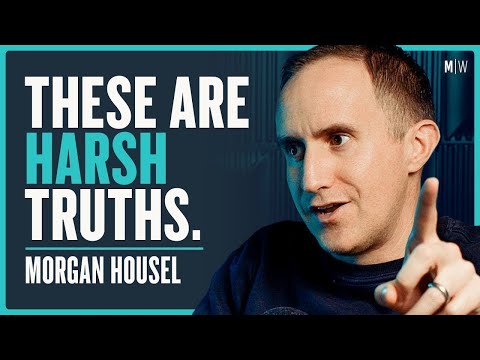
Deconstructing Success Down To The Psychological Level - Morgan Housel
Chris Williamson (host), Morgan Housel (guest)
In this episode of Modern Wisdom, featuring Chris Williamson and Morgan Housel, Deconstructing Success Down To The Psychological Level - Morgan Housel explores morgan Housel Explains Why Stress, Scarcity And Time Create Real Success Morgan Housel and Chris Williamson deconstruct success, risk, and progress through psychology rather than tactics, showing why optimism must coexist with pessimism and why stress often unlocks innovation. They explore how big events usually emerge from tiny compounding factors, why bad news dominates our attention while good news compounds quietly, and how incentives and hidden costs shape behavior in finance, business, and life. Housel argues that real edge comes from temperament—time horizon, tolerance for pain, and indifference to impressing others—more than intelligence or complexity. Throughout, they use history, war, investing, and entrepreneurship to illustrate that everything worthwhile has a price, and most people misjudge both the cost and the time required.
Morgan Housel Explains Why Stress, Scarcity And Time Create Real Success
Morgan Housel and Chris Williamson deconstruct success, risk, and progress through psychology rather than tactics, showing why optimism must coexist with pessimism and why stress often unlocks innovation. They explore how big events usually emerge from tiny compounding factors, why bad news dominates our attention while good news compounds quietly, and how incentives and hidden costs shape behavior in finance, business, and life. Housel argues that real edge comes from temperament—time horizon, tolerance for pain, and indifference to impressing others—more than intelligence or complexity. Throughout, they use history, war, investing, and entrepreneurship to illustrate that everything worthwhile has a price, and most people misjudge both the cost and the time required.
Key Takeaways
Rational optimism means expecting a better future while fully pricing in pain.
Housel defines ‘rational optimism’ as believing things will improve over decades, but only by surviving recessions, wars, crashes, pandemics, and personal setbacks. ...
Get the full analysis with uListen AI
Stress and downside risk often drive more innovation than comfort and upside.
Periods like the Great Depression, World War II, and COVID show that when not innovating means going bankrupt or dying, people raid old ideas, compress decades of research, and solve problems unimaginably fast. ...
Get the full analysis with uListen AI
Most meaningful progress is slow, compounding, and easy to ignore.
Bad events (9/11, Pearl Harbor, crashes) arrive in an instant and dominate attention, while good events (declines in heart disease, climate‑related deaths, medical advances) improve a couple percent a year and never make headlines. ...
Get the full analysis with uListen AI
Big outcomes usually come from small, interacting causes rather than one ‘meteor.’
The Great Depression, nuclear near‑misses, and evolution itself are framed as chain reactions of tiny events compounding in the right (or wrong) order. ...
Get the full analysis with uListen AI
Everything great has a price; most people want the outcome, not the cost.
Whether it’s Musk, Tiger Woods, Dali, or top CEOs, extreme success usually comes with extreme sacrifice in health, sanity, or relationships—costs many admirers would never willingly pay. ...
Get the full analysis with uListen AI
Temperament and time horizon matter more than intelligence in investing and careers.
Many people say they are ‘long term’ but cannot emotionally survive bear markets, recessions, or short‑term discomfort. ...
Get the full analysis with uListen AI
Simplicity and slack often beat complexity and maximum efficiency.
From just‑in‑time supply chains that collapsed in 2021, to over‑engineered financial strategies that underperform index funds, to calendars with no thinking time, over‑optimization removes the margin of safety. ...
Get the full analysis with uListen AI
Notable Quotes
“My definition of rational optimism is you think the future's gonna be better than it is today, but the path between now and then is gonna be a disaster.”
— Morgan Housel
“World War II began in 1939 on horseback. It ended in 1945 with nuclear fission.”
— Morgan Housel
“Good news comes from compounding, which always takes time, but bad news comes from a loss in confidence or a catastrophic error that can occur in the blink of an eye.”
— Morgan Housel
“The grass is always greener on the side that's fertilized with bullshit.”
— Quoted by Morgan Housel (original author unknown)
“The world is split between those who don't know how to start making money and those who don't know when to stop.”
— Nassim Nicholas Taleb, quoted by Chris Williamson and Morgan Housel
Questions Answered in This Episode
How can an individual deliberately create ‘healthy stress’ or downside incentives in their own life without tipping into burnout or trauma?
Morgan Housel and Chris Williamson deconstruct success, risk, and progress through psychology rather than tactics, showing why optimism must coexist with pessimism and why stress often unlocks innovation. ...
Get the full analysis with uListen AI
In practical terms, how do you decide which sacrifices for success are worth paying and which are too high a cost?
Get the full analysis with uListen AI
Given that good news compounds slowly and bad news hits instantly, what habits or information diets help keep your worldview accurate and optimistic rather than fearful?
Get the full analysis with uListen AI
If temperament and time horizon are largely innate, how much can someone realistically train themselves to be more long‑term in investing and career decisions?
Get the full analysis with uListen AI
How should leaders balance paranoia and urgency in their companies with building a calm, sustainable personal life for themselves and their teams?
Get the full analysis with uListen AI
Transcript Preview
Who are the rational optimists?
I c- I came up with the term "rational optimist." I don't know if I did, but I don't know if I came up with the theory, but my idea was, if you think the future is just gonna be great, that's not optimism. That's complacency. My- my definition of rational optimism was you- you think the future's gonna be better than it is today, but the path between now and then is gonna be a disaster. It's gonna be a constant field of landmines and setbacks and recessions and bear markets and pandemics and wars and terrorist attacks that you have to endure, financially, psychologically, career-wise, in order to get the reward of optimism on the other end. So it's like getting optimism and pessimism to co-exist. That, I think, is realistic optimism.
Yeah, it's like the looking at price goes from here to here, but it doesn't go like that. Price goes from here to here by going (imitates bouncy sounds) .
Yeah, of course, you see it in the stock market, where, you know, over a 10 or 20-year period, you can make a crazy amount of money. But in any given month, in any given week, in any given year, sometimes even in any given decade, it's a disaster. And that's the price you have to pay in order to get thr- through returns over 10 or 20 years.
So we went through some of your book, Same as Ever, one of my favorite things. Everyone needs to go and buy it now. It's a super easy read, very, very enjoyable. Next lesson I want to go through is "when the magic happens." Stress focuses your attention in ways that good times can't.
There's so many examples in history of the world going through a crazy tragedy, wars, pandemics, awful things happen, millions of people die. And then you look back 20 years later, and you realize that because of that incident, because of that war, because of that pandemic, there was this crazy amount of innovation and technology that took place because people were panicked, and the incentives to innovate were off the charts. And you look back, and you're like, "Look, as terrible as that was, we created, because of that, all these inventions that everyone benefits from today." The most technologically innovative period in, I would say, human history took place in the 1930s and the 1940s, the Great Depression and World War II. It started with the Great Depression, which was, in analytical terms, the most... Uh, like the- the amount of productivity that increased in the 1930s is more than any other decade that's taken place, because it was all by necessity. Every single business in America in the 1930s woke up, and they were like, "If we don't become more productive today, we're out of business tomorrow." So every business learned how to become more efficient, and what came from that was the supermarket, laundromat, all these new businesses that were just designed to become more efficient. The, um, the factory line really exploded during this period, what Henry Ford did with the factory line, uh, in the 1910s and 1920s. Every business took up in the 1930s out of necessity. World War II comes along, and the incentives that happened because of that were just completely off the charts. During good times, boom times, people's incentive to innovate is, "If I create a new product, I might become rich." That's your incentive, and that's a good incentive. You'll get people moving in that world. In the 1940s, it was, "If we don't innovate and figure out new technologies, Adolf Hitler is gonna control the entire planet." That was literally what was going on back then. So the scientific community, the government, businesses, overnight, they were like, "All hands on deck. We need to innovate like there's no tomorrow." And what came out of that, in a very short period of time, I mean, I've summed it up like this. World War II began in 1939 on horseback. It ended in 1945 with nuclear fission.
Install uListen to search the full transcript and get AI-powered insights
Get Full TranscriptGet more from every podcast
AI summaries, searchable transcripts, and fact-checking. Free forever.
Add to Chrome