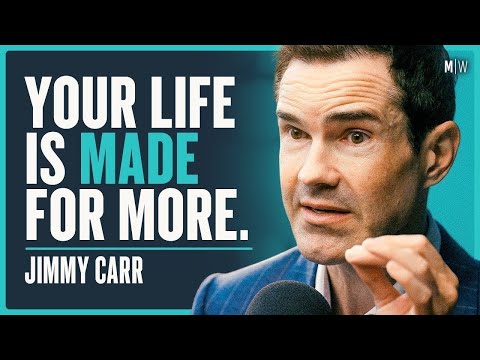
"All Self-Help Boils Down To One Truth" - Jimmy Carr (4K)
Chris Williamson (host), Jimmy Carr (guest)
In this episode of Modern Wisdom, featuring Chris Williamson and Jimmy Carr, "All Self-Help Boils Down To One Truth" - Jimmy Carr (4K) explores jimmy Carr Reveals One Core Truth Beneath All Self-Help Advice Jimmy Carr and Chris Williamson explore how agency, honest desire, and process-oriented work sit beneath almost all effective self-help. They discuss status games, mimetic desire, and the difference between wanting things versus wanting the feelings we think those things will bring. Jimmy unpacks creativity, stand-up as a societal pressure valve, cancel culture, luck, and why disposition matters more than outward success. The conversation repeatedly returns to one idea: life improves when you choose your games, your pains, and your daily actions with clear, self-authored intent.
Jimmy Carr Reveals One Core Truth Beneath All Self-Help Advice
Jimmy Carr and Chris Williamson explore how agency, honest desire, and process-oriented work sit beneath almost all effective self-help. They discuss status games, mimetic desire, and the difference between wanting things versus wanting the feelings we think those things will bring. Jimmy unpacks creativity, stand-up as a societal pressure valve, cancel culture, luck, and why disposition matters more than outward success. The conversation repeatedly returns to one idea: life improves when you choose your games, your pains, and your daily actions with clear, self-authored intent.
Key Takeaways
Clarify what you *actually* want beneath surface desires.
Instead of stopping at 'I want a Ferrari', keep asking why until you uncover the underlying need (e. ...
Get the full analysis with uListen AI
Prioritize process-driven ambitions over outcome-driven ones.
Focusing on what you want to *do* each day (the work, the craft, the conversations) is more stable and fulfilling than chasing titles, numbers, or labels, which are fragile and often anticlimactic when achieved.
Get the full analysis with uListen AI
Use the 24‑hour frame: serve your 'tomorrow self' every day.
Asking 'What would me-tomorrow want me-today to do? ...
Get the full analysis with uListen AI
Treat envy as a directional signal, not a poison.
If you’re envious of someone’s body, career, or relationship, that’s useful data about what you truly want; resentment (wanting them *not* to have it) is just bitterness and abdication of responsibility.
Get the full analysis with uListen AI
Optimize for disposition, not just position.
High status, money, or fame (position) don’t guarantee happiness; cultivating gratitude, a sunny baseline mood, and kinder self-talk (disposition) is often both more within your control and more impactful.
Get the full analysis with uListen AI
Choose your pains consciously; every pursuit has a price.
Following Mark Manson’s idea, the crucial question isn’t 'What pleasure do I want? ...
Get the full analysis with uListen AI
Separate your persona from your self-worth.
If your entire value is tied to an on-stage or online persona, criticism and cancellation become existential threats; knowing who you are off-stage lets you weather reputational hits without collapsing internally.
Get the full analysis with uListen AI
Notable Quotes
“All self-help is hard choices now, easy life later. Everything is the marshmallow test.”
— Jimmy Carr
“Ambition is when you expect yourself to close the gap between what you have and what you want. Entitlement is when you expect others to close that gap.”
— Chris Williamson
“You can have anything. You can’t have everything.”
— Jimmy Carr
“Disposition is more important than position. I know billionaires who are miserable and office workers who are very happy.”
— Jimmy Carr
“The persona is incapable of receiving love. It can only receive praise.”
— Chris Williamson (quoting Aubrey Marcus)
Questions Answered in This Episode
Which of my current goals are genuinely self-authored, and which are just mimetic desires copied from others?
Jimmy Carr and Chris Williamson explore how agency, honest desire, and process-oriented work sit beneath almost all effective self-help. ...
Get the full analysis with uListen AI
If I applied the 'serve your tomorrow self' rule, what would I change about today’s decisions?
Get the full analysis with uListen AI
Where am I confusing difficulty with value—chasing something hard to get rather than something truly meaningful?
Get the full analysis with uListen AI
What does my envy point toward that I actually want, and how can I pursue it without resentment?
Get the full analysis with uListen AI
If my public persona vanished tomorrow, what parts of my identity and daily life would still feel solid and worthwhile?
Get the full analysis with uListen AI
Transcript Preview
Jimmy Carr, welcome to the show.
Thank you very much. I'm a, I'm a big fan of it. I'm kind of nervous about talking to you, in a weird way, because I like the show. I, I really like you as a kind of cultural, um, entity. I think it's a really interesting kinda journey you've had. And I get so much from this show. You know that phrase, I think you use it probably more than any other phrase, "Does it grow corn?" And for me, this show really kinda grows corn. There's so many little things that I've taken from this, that I've kind of gone, "Oh, I'm gonna, I'm gonna do that. I'm gonna do something with that." So kind of the, the practical application of the wisdom, what you get out of people seems to be, um, very easy to integrate into life.
Right, so the bar's been set high for you today then, if you start-
Yeah, I better-
... dicking around.
Well, I mean, dicking around is sort of what I do. So the other thing is like, I, I kinda get more nervous being myself than being sort of the comedic, um, persona. The, you know, just being funny.
Mm.
Just being on things, being funny, I find very easy. It's a, it's an interesting sort of life lesson, the idea of like, what do you find easy that other people find difficult? Go for that. Do that for a living. That's, that's ... there's, there's gonna be money there, there's gonna be (laughs) , there's gonna be some gold. You're gonna be okay. If you find it easy and everyone else is going, "That's impossible," so you're standing up in front of people being funny, I find very easy. Like, these kind of conversations, I slightly, you slightly second-guess yourself.
It's what you're used to, I think. It's what you spend a lot of time becoming acclimatized to doing.
Yeah, I suppose. Uh, you know, it's just that thing of, I've always said in comedy, people sort of talk about how many years they've been doing comedy, and it seems faintly ridiculous. It's kind of, it's like when you talk to an airline pilot, they've got a really good view on it, they talk about how many hours they've got in the sky. And for me, like, there's no substitute for, um, stage time. And I'm sure for you, there's no substitute for, for this, for actually doing it. Everything else is, is kind of, uh, uh, doesn't matter how many years you've had a podcast. I think something about the frequency of your show as well.
Mm-hmm.
It's the, it's kind of, it's always there. There's always something new.
You talk about the most important question to ask yourself being, what do you want?
Yeah, I mean, I talk about that an awful lot. I, I studied a lot of, uh, studied and was very interested in sort of NLP, and that question of what do you want, in the micro, in the macro, being, um, being the absolute key in sort of life. Because people sort of, um, I suppose it's, it's, it's that thing of going, what does something represent? Peop- someone might say, "Well, I want a Ferrari." Um, but why? If you, if you sort of dig a little deeper, you can't just ask once, "What do you want?" "Well, I want a Ferrari and a Rolex and all of the trappings," but actually what they want is status. So it's kind of asking yourself, what game are you gonna play?
Install uListen to search the full transcript and get AI-powered insights
Get Full TranscriptGet more from every podcast
AI summaries, searchable transcripts, and fact-checking. Free forever.
Add to Chrome