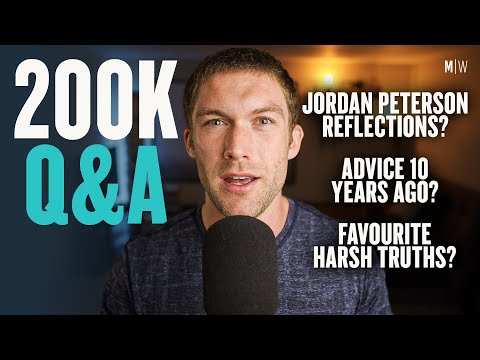
200k Q&A - Jordan Peterson, Bitcoin & Harsh Truths | Modern Wisdom Podcast 337
Chris Williamson (host)
In this episode of Modern Wisdom, featuring Chris Williamson, 200k Q&A - Jordan Peterson, Bitcoin & Harsh Truths | Modern Wisdom Podcast 337 explores chris Williamson reflects on podcasting, politics, depression, and discipline Chris Williamson’s 200k-subscriber Q&A covers his growth as a podcaster, how he prepares for high‑stakes guests like Jordan Peterson, and his philosophy on interviewing controversial figures without derailing conversations. He talks candidly about depression, emotional resilience, and why foundational habits (sleep, exercise, relationships, routines) matter more than people think. He outlines his mixed, issue‑by‑issue political views, critiques culture-war polarization and cancel culture, and explains why he avoids becoming a purely political commentator. The episode also tackles personal development topics such as sobriety, discipline, wealth-building in your 20s, and why he’s skeptical of polyamory but bullish on long-term skill acquisition and practice.
Chris Williamson reflects on podcasting, politics, depression, and discipline
Chris Williamson’s 200k-subscriber Q&A covers his growth as a podcaster, how he prepares for high‑stakes guests like Jordan Peterson, and his philosophy on interviewing controversial figures without derailing conversations. He talks candidly about depression, emotional resilience, and why foundational habits (sleep, exercise, relationships, routines) matter more than people think. He outlines his mixed, issue‑by‑issue political views, critiques culture-war polarization and cancel culture, and explains why he avoids becoming a purely political commentator. The episode also tackles personal development topics such as sobriety, discipline, wealth-building in your 20s, and why he’s skeptical of polyamory but bullish on long-term skill acquisition and practice.
Key Takeaways
Preparation for high-stakes conversations is about synthesis, not volume.
His hardest prep was for Jordan Peterson because he had to compress years of curiosity, Peterson’s recent life changes, and a new book into one cohesive episode. ...
Get the full analysis with uListen AI
Clear communication is built through intentional repetition and eliminating verbal laziness.
Williamson attributes his speaking clarity to spending hours each week podcasting while actively removing verbal tics and aiming for succinct, precise language—treating speech as a skill to be practiced, not something that just “happens.”
Get the full analysis with uListen AI
Before labeling yourself ‘depressed,’ fix the controllable basics ruthlessly.
He emphasizes that more of your mood is under your direct control than you think: consistent wake time, walking outside, training, hydration, nutrition, and maintaining relationships should be optimized before jumping straight to medication.
Get the full analysis with uListen AI
As a host, you must ‘pick your battles’ when challenging guests.
Constantly stopping guests to contest every controversial claim fragments the conversation and ruins its narrative arc; he chooses a few key areas to stress-test so the episode remains coherent while still probing ideas for the audience’s benefit.
Get the full analysis with uListen AI
Front-load wealth acquisition and avoid practicing the habits you don’t want to keep.
For people in their 20s, he advocates buying property early, avoiding debt, and building sustainable health routines. ...
Get the full analysis with uListen AI
Strong opinions should be loosely held, not loosely informed and rigidly defended.
He rejects tidy ideological boxes, holds a mix of left-, center-, and right-leaning views, and deliberately lets conversations with experts reshape his positions—treating each episode as a stress-test of his worldview rather than a platform for dogma.
Get the full analysis with uListen AI
Your long-term value can’t be built on looks or status alone.
An Achilles rupture and the end of his “Love Island era” forced him to detach self-worth from appearance and nightlife status, pushing him to invest in scalable skills (conversation, thinking, creating) that still matter if beauty or physical capability disappear.
Get the full analysis with uListen AI
Notable Quotes
“You shouldn’t be able to know someone’s view on abortion and from that predict their views on guns, immigration, tax, and everything else.”
— Chris Williamson
“Don’t practice what you don’t want to become.”
— Chris Williamson
“We’re not built to be happy, we’re built to be effective.”
— Chris Williamson, summarizing Robert Wright
“As a podcast host, you need to pick your battles. If you challenge every single thing, the conversation never has a central thrust.”
— Chris Williamson
“If you are still relying on your looks at 30 as your primary source of value, you’re turning yourself into a depreciating asset.”
— Chris Williamson
Questions Answered in This Episode
Where is the right balance between challenging a guest’s claims and preserving a coherent, enjoyable conversation?
Chris Williamson’s 200k-subscriber Q&A covers his growth as a podcaster, how he prepares for high‑stakes guests like Jordan Peterson, and his philosophy on interviewing controversial figures without derailing conversations. ...
Get the full analysis with uListen AI
How far should a host’s responsibility extend when a guest expresses views that may be harmful or conspiratorial?
Get the full analysis with uListen AI
To what extent can lifestyle interventions realistically shift clinical depression, and where does that boundary end?
Get the full analysis with uListen AI
Is the current media obsession with race-based framing doing more to illuminate injustice or to harden tribal identities?
Get the full analysis with uListen AI
How can young adults practically identify which habits they’re “practicing into permanence” and replace them before they become entrenched?
Get the full analysis with uListen AI
Transcript Preview
"Do you plan to invite Ben Shapiro on your show?" "Where do your political views lay?" That is the correct question. "Is it crazy to turn down a polyamorous lifestyle? Um." "Shave bald and wear a Tim Pool beanie at 300K." Uh, not a question. Good proposition, though. I might dress up as Malice for a million. You know he keeps on cosplaying everyone on their show. I might dress as Malice. What's happening, people? Welcome back to the show. We hit 200,000 subscribers, which means it is time for another Q&A episode. I pulled questions from YouTube and Instagram. I tried to filter out the ones that I thought perhaps needed more professional help than I can provide, but we will go through as many as I can get through today. Let's get into it. "What was the hardest podcast to prepare for?" Jordan Peterson by far. Uh, he's a very easy guest to podcast with, but the problem is when you've listened and watched so much of someone's content for years, you have to try and synthesize down all of the things that you've wanted to ask them for quite a long time into a single- single cohesive episode. And then he's got his book, and he's got obviously all the changes and the- the stuff that he's been through over the last couple of years. So, um, yeah, that was... Synthesizing everything I wanted to talk about was difficult, but I was so happy with how that episode came out. I felt so proud, and it- it really touched a lot of people. So, yeah, that was, um... It was worth the challenge. "Best life hack to date?" Speed up your trackpad. If you increase your trackpad speed on your MacBook or your- your Windows computer or whatever, just put it up to the maximum that it'll go, and you will immediately move around the screen 10 to 20% quicker. It's- it's just such an easy hack. When I go onto other people's computers now and I've got to scrape it- the mi- mouse across the screen for hours to get to the other corner, don't do that. Turn it up to the top. You'll fly around the screen for a couple of days, and then once you've got it locked in, it- it'll be a new world for you. "Least satisfying part of the job as a podcast host?" Uh, editing. Now, as much as I love the conversations and listening back, listening back and trying to... Is the bass right? And recording the intros and doing all that stuff. Soon there'll be an editor that will be able to master all of the episodes for me. But at the moment, that's something... It's just... It feels a bit laborious. It's the only bit of this job that feels like a job. Everything else just feels like fun. "Are you worried being over 30 and single?" Uh, no, not at all. I think this is the advantage that men have that we don't really have that biological clock which is ticking along. Uh, that being said, children aren't totally disgusting to me now. Up until a couple of years ago, I just didn't really like kids at all. They were just loud and annoying, and I live not too far from a primary school, so they just woke me up if I'd been at work in a nightclub the night before. Um, now, I- I'm not doting, right? I'm not at that stage. But children don't totally disgust me. Uh, but no, I'm not worried about being over 30 and single. More women had children over the age of 40 than under the age of 20 last year in the UK. Um, so if I decide to have a child over 40, then I can join that club. Uh, "How did you learn to communicate so clearly? I heard Peterson talking to Shapiro about this. Love from a semi-recent subscriber." Well, I love you too, Jason. Um, yeah, Jordan brought me up on Ben's show, which was really, uh, kind and surprising. Uh, it was like a paid advert for me for two minutes in the middle of the episode. But he was talking about the fact that I try to... I've tried over the last few years to remove verbal tics and to be precise with my speech. Um, how did I learn to do it? Was from mostly through this podcast. Now, when you do anything for three or four hours a week, you're going to get good at it. You know, if you masturbated for three or four hours a week, you'd get pretty good at masturbating after a few years. And speech is exactly the same. Also being intentional with it. You know, I want to communicate concepts as succinctly as possible in an erudite manner. I want to get what is in my head out of my mouth as plainly as I can to communicate it to other people. So you need to practice, but you need to be intentional with it. Very often, speech is just the thing that gets in the way of the thing that's in our brains reaching the person that we're trying to communicate it to. So you can be lazy with your speech in that manner, and I've tried to stop doing that. But, I mean, look at the- the absolute titans of this, right? Look at the Ben Shapiros of the world or the Sam Harris of the world. These guys are unbelievably precise. So there's- there's levels to this game, but if you practice, do it consistently, and you're intentional with the way that you speak, you'll make gains. "Congratulations on posting this in the spirit of constructive feedback. I'm still disappointed at your light-touch interview with Michael Knowles, for example, not hearing you challenge him when he said that Alex Jones was right about almost everything. Yeah, the unfounded conspiracy theories, the government creating gays to reduce population growth, his HIV conspiracy theories. Bad things happen when good people do or say nothing." This is a really interesting insight, and I appreciate, Stuart, I appreciate you bringing this up. Um, as a podcast host, or as the host of any sort of show like this, you need to pick your battles, right? I'm having a conversation with Michael. If I decide to interject every time that he says something that I think needs to be stress tested more, the conversation's never going to have a central thrust. It's constantly going to be branching off. So I can hear him bring up something that I disagree with to do with religion or that I disagree with to do with Alex Jones or anything, and if every single time that that happens I interject, you're going to have this very fragmented conversation, which actually isn't that enjoyable to listen to. And this is something that even I, as a podcast host, need to remember when I'm listening to other people's shows. I'm like, "Oh, I would have challenged him about that." And you go, well, would you have done? If the end goal of this conversation is one particular topic and you know that that's a 10-minute or 20-minute detour to fully flesh out and work out what's going on with this, you actually don't. Um...Yes, stress testing ideas and, uh, propositions by guests is really important because it gives them more reputability, right, to the, to the audience. If you push a guest hard to really make sure that they understand what they're talking about and justify their position on something, especially something which might be a little bit controversial, they either come out smelling of roses because they've got a really robust understanding or they crumble under pressure and they actually realize, "I need to reassess. If I can't communicate it robustly, I need to reassess my position." So it is a win, but as a guest, uh, sorry, as a host, you do need to pick your battles. "Shave bald and wear a Tim Pool beanie at 300K?" Uh, not a question. A good proposition, though. I don't know whether ... So I haven't reached out to Tim yet. Obviously, Malice is good buddies with him. Would I shave my head bald just for 300K? I'll probably do something fun for a million. I might dress up as Malice for a million. You know he keeps on Comic-Con cosplaying everyone on their show. I might dress as Malice for a million. We'll see. I'll dress as someone for a million, maybe. Uh, "Congratulations, Chris. You deserve every success with your hard work." Thank you. Uh, "My question is, you have openly and honestly spoken about having depression in the past. Despite the suffering you endured at the time, is there a part of you that is glad you have experienced this uniquely human part of life? What would you say to and advise others to do who are experiencing depression? What did you learn from it, if anything?" Uh, yes. It's a blessing and a curse to feel things deeply. I wonder whether the insights that I really value that I've managed to glean from life myself, I wonder whether they are the other side of the coin of suffering, right? That dread and awe are kind of the same, or that, um, I guess, sadness is a depth of insight on one, one side, but also curiosity is a depth of insight on another. I'm not really too sure, but this is ... I, I, I can't change the makeup that I have, right? 50% of everything that you are comes from your genes in terms of your psychological makeup. And although we can try and work around that and we can create situations that are better for us to exist in, we really are very much at the mercy of what we were given when we emerged into this world. And with that in mind, you need to keep on working away at stuff like that. Um, "What would you say to and advise others who are experiencing depression?" More of your mood than you think of is under your control, especially acutely. So get up on time, go for a walk, get fresh air, drink water, hydrate, train, and speak to friends. If you do that, if you're doing those things every single day and you're still suffering with a low mood, then there is a conversation to be had. But if you are suffering with depression and not looking after exercise, sleep and wake, hydration, nutrition, relationships, if you're not getting those things sorted, you're not giving yourself the best chance to get out of that low mood in any case. So really before you go and see a doctor about something or a therapist, maybe not a therapist actually, but, um, certainly a doctor to perhaps look at medicating your way out of this, if you haven't sorted the base out at the bottom, I, I feel like you're putting the cart before the horse. Uh, "What did you learn from it, if anything?" Man, so much. Like, all of the traumas that we go through in life give us unbelievable insights. And, um, yeah, for me, just the, the depth of challenge that you can come up with simply through your own consciousness, right? There, there can be ostensibly nothing wrong with life. You can be, uh, you can have nothing g- going on. There's no debt, there's no impending catastrophe, and yet the sheer weight of existence can crush you. And, um, realizing that it makes you a lot more empathetic to other people's struggles, uh, but it also means that you have a lot more faith in yourself. Like, w- when we're talking about critics, I heard Rogan talk about this the other day. He was saying he's such a, a strong critic of himself that when other critics, external critics that aren't within his own mind, say things to him, he feels bullet- bulletproof because he's like, "Well, what do you think that you can say that the best, most proficient torturer in my entire life hasn't already said to me?" He's in a monologue. Um, so it does make you very bulletproof. But, um, yeah, I'm more empathetic, man. Like, people are going through challenges even if there's "nothing to be challenged by," uh, in quotes. So yeah, it's, um ... I wouldn't advise it as a personal development strategy, but it works. "Congratulations. My question is, have you had the vaccine or are you steering clear? What will you, will you take, um, it, uh, given what Bret Weinstein's been discussing? Dave, the Clips guy from Dark Horse Podcast Clips." That's Bret's clip guy. Um, I've already had my first dose of the vaccine. This is the sort of ... Uh, for some reason, taking the vaccine or not is also attached to political views. And I haven't done a ton of digging into this. Um, I appreciate that certain people believe if you have taken the vaccine, that is some sort of a comment on your worldview at large, whether you trust Big Pharma, whether you trust Big Tech, whether you're going to be dictated to by the man. Um, but to be honest, I've taken a lot of party drugs in my life. And if the worst thing that's gone into my body isn't a bag from a random guy in a nightclub toilet, it's a vaccine, I'm gonna be fairly impressed. Uh, that being said, I've committed to it because I like to travel. I want to be able to travel. Realistically, I can see restrictions, huge restrictions being placed on people that haven't had the vaccine. And, um, you know, if we're all going down, if it is a way to reduce the fac- fertility of the entire human race, to reduce populations, then, you know, we, we're all in it together. There's a big club of us, so it'll be sweet. But thank you, Dave. I love, uh, Bret's show. I'm very glad that you're a sub on this channel as well. Uh, "Congratulations. I was wondering when are you going to have Sam Harris on your podcast? By the way, enjoyed your talk with Michael Knowles." Sam is next on the list, man. Like, Jordan was-... number one, num- numero uno, and Sam is definitely next up. Every time that I listen to him talk about consciousness or the reality of our experience, our normal conscious experience of the world, he is at his absolute best. He's such a insightful guy. And you forget because he's, it's such an obvious thing to talk about. You're always looking for what's new and what's cool. Uh, but Sam's a beast. I would love to bring him on. It'll happen soon. I said it'll, it'll never happen with Jordan Peterson, and then two years later, it was sat down, uh, sat down recording the episode. So, give me time. "When are you releasing your book recommendations?" Good question. Uh, I am doing an e-book of 100 Books to Read Before You Die, and that should be completed within a month or so. If you want to know when it's live, go to chriswillex.com/lifehacks, and you can sign up to my mailing list there. You'll be delivered that as soon as it's live. But yes, chriswillex.com/lifehacks. Uh, but I'll do, I'll probably do a video as well about some of my top ones. Um, that'll be done soon. It takes a while flushing out 100 books, all of your synthesis of why you like them and why other people should read them. It's not a simple task. "Do you plan to invite Ben Shapiro on your show?" Uh, yes, I would love to. He's got The Authoritarian Moment out now, his new book. Uh, I would love to bring him on at some point. Uh, I do think that Ben and Matt Walsh and some of the other guys, the way that America's conservatives talk about topics and the way that British sort of center and center-right people discuss topics is a little bit different. You don't really see, because it's so culturally and politically bound to their particular, um, world view, right? And also to the situations that they've got going on. What's happening in the UK and what's happening in America are actually quite different at the moment. I brought this up with Michael Malice not long ago, where we were talking about how UK Conservatives are very different to American Conservatives, and most of the comments were people saying, "Well, British Conservatives are more center than they are right now." And you go, right, okay, so we're not even... When, when I say Conservative and when Americans say Conservative, it's not even the same thing anymore. So yes, there is a, there's an interesting conversation to be had there when two different groups of people say the same thing but it means something different. I think that's a really, really interesting question. But yes, Ben's a, he is one of the most precise deliverers on the planet, and I would love to have a conversation with him at some point, see if, see who ring, runs rings around who. "Would you ever go back on a TV program (laughs) to find love?" I think twice. I think Take Me Out and Love Island. I don't think I can go on a third time in all self-love and, uh, without, without just condemning myself to a life of being a fuckboy. I'm not convinced that I can go back on. Uh, also the last... I, I nearly got canceled from my TEDx Talk for some of the stuff that's on the YouTube channel. So, the depths that the UK media would dig to, uh, th- there would be too many clips of me saying something that is just the sort of thing that would get you pulled off a, off a TV show. Not that I really care, but if you're gonna get yourself out there and... Uh, you, I don't have any desire to be part of a cancel culture, um, catastrophe. My interest and my goal is to have conversations that really engage me and engage the people that listen to this show and other people that think like me and want to improve their understanding of themselves and the world around them. Being some rabid sort of cancel culture victim vanguard, you know, sort of at the front being the guy that's the example for everyone else to follow, maybe that'll happen down the line, but I don't... I'm not seeking that. Sometimes I feel like watching some people on the internet, they're going out of their way to try and find scenarios that they can deposit themselves into the middle of so that they can be the canceled guy or girl, and, um, that doesn't really sound like fun to me. Getting caught up in that kind of a drama doesn't seem like fun. Uh, plus, yeah, thr- I think two and done, the old, the old TV shows. "Where do your political views lay?" That is the correct question. Um, I don't think that you should be able to put someone's, or at least most real thinkers shouldn't have their political views in a, a ni- a nice, tidy, neat box. You shouldn't be able to look at someone and say, "Because I know your view on abortion, I also know your view on gun rights and immigration and on tax and on whatever." It should be a multivariate, very nuanced viewpoint, because wh- I, I should take my views piecemeal, not wholesale, right? And, um, I have some views that are centrist, I have some views that are on the right, and I have some views that are on the left. As I've got older, I have noticed myself start to skew more right, but so does everyone. I, I said this to, uh, Michael Knowles, I think the other day, where they talk about every single time that there's a general election in the UK, the same map where they compare under-25 voting habits to over-65 voting habits, and you see that the under-25s are very Labour and the over-75s or 65s are super Conservative. And you think, who do you think that is there? That's you. That's you in 30 or 40 years' time. That's who you're going to be. It's not just like there was a wave of Conservatives that came through 65 years ago that were just born and happened to genetically be Conservatives. This is the path that everybody goes on. You start off more open in terms of personality traits. Jordan Peterson says, talks about this, and then as you get a little bit more closed or your openness starts to diminish a little bit as you get older, naturally, because that's what you do, you also have more wealth, which means that you're going to try and protect it a little bit more. You also have more on the line with regards to your family and the way that they're treated. So-People start, tend to, start on the left and then skew toward the right. So having a prefabricated set of beliefs that neatly fit into a box, to me, is an indicator that someone hasn't been a very real thinker. Like even Shapiro and Michael Knowles consistently disagree about nuances of stuff when they have conversations on Daily Wire backstage. So yeah, you should be very, very cautious about anyone that you can know one of their political views and from it accurately predict everything else that they believe. So mine, mine lie across the board. Uh, "What one value would you want to teach your kids, if you want any?" I do want kids. I would love to be a father. I can't wait to be a dad. Um, I think the value of practice and repetition. Uh, I think that it was something I didn't really understand until I got a lot older. So I played a lot of sports as a kid. I also did exams and stuff like that. But I didn't understand that skill acquisition, doing a thing repetitively over and over, is contributing to your capacity when it comes to game day. And game day can be an exam, it can be an interview, it can be a sports match. But I never was taught the line, the lineage that runs between your practice and your output, and I think that it's such a powerful concept to get your head around. That look, I'm not where I necessarily want to be yet, but if I work on a thing hard, if I deconstruct all of the different talents that I need to do the thing that I really want to do, and then I purpose them into little iterative games that I can continue to do over and over, you actually end up in a place where your capacity has increased, and it means that when it gets to game day that you're an absolute beast now. So yes, learn... I would teach my kids the value of practice and repetition. Uh, "When I stumbled across Modern Wisdom, you had 70K subs. My first thought was, 'Well, where the hell has this guy been hiding?' After listening to a few episodes, it became clear to me that this quite simply is one of the best podcasts on the planet." Thank you. Uh, "Chris, you're one of the most important new voices in our culture. The more people that find you, the better." Fantastic. I really... The- This is a fantastic new review, and I will use you as my, um, press manager. "When are you going to write a book, and what will it be about?" I don't know. I really don't know if I'm built to write a book or not. It's a, uh... All of my buddies that have written books, especially coming from sort of our kind of background, not someone that's a Ryan Holiday, you know, that's been working under Robert Greene and just a total freak when it comes to his ability to create long-form written content. It's a traumatic journey to go through. Ali Abdaal, who I'm good mates with, is... You know, he's one of the most productive people. He's like a professional productivity person, and he's struggling to get through the workload. It's a challenge, especially if you hold yourself to high standards, which I do. So yeah, um, it's down the line. I don't know yet. We will wait and see. Uh, one question. "Why is your channel under your name rather than Modern Wisdom, which is what I thought your channel was called until I couldn't find it in my subs list? I honestly thought it was Modern Wisdom with Chris Williamson." Well, it's never been that. Uh, it was Modern Wisdom, yes, correct. Um, but I wanted to talk more about stuff that I was interested in. I wanted to do more monologue videos like this, talking head stuff down the pipe, and also, people were landing on the podcast on YouTube and saying, "This is really good, but who's the interviewer?" And I'm like, there is no way that you should be landing on my show and not know who I am. So part of it was to give me more latitude to be able to do different bits of content, if I do want to do vlogs, if I do want to do more talking-head-style stuff and commentary. And the other half of it was just so that I get more personal brand equity pushed back toward me, that I don't refer to myself as Modern Wisdom. Like Alex O'Connor, right? He, he calls himself Cosmic Skeptic. That's what he, that's what he's called. It's a, an alias that he works under. But I was never called Modern Wisdom. It was just the name of the show. So yes, it is now Chris Williamson, and uh, no more name changes, hopefully. "Your blurred background, does or does not contain a totem pole? I must know." Uh, that is that thing there, I think that you're referring to. That is a vertical bookcase, which I got from Connox, uh, some European supplier, and it's a seven-foot, seven-foot-high-ish vertical bookcase. And you can stack books up like that. But there is a huge pile of them that are just on the floor, uh, because I now need another one, because the publishers continue sending me out more books. "How do you not become black-pilled being so close to this cancel... to this culture war cancer?" Um, I don't get affected by the culture war stuff, to be honest. Um, I enjoy discussing it, and I think that it's a fascinating insight into human nature, but I'm not actually personally invested that much. I don't want untruths to be spread on the internet. Uh, I don't want people to malign groups or political parties or people with particular beliefs or religions or anything. Um, but I'm not super invested emotionally in the culture wars. Um, I think this is one of the really important things that comes from me not always discussing whatever the next cancel culture or pop culture politics issue of the day is. You know, I'm having three conversations of personal development or philosophy or insights or a conversation with a porn star, uh, for every one that I have about politics.... and that gives me perspective. And hopefully, you guys as well, right? You're not just constantly being fed by the Modern Wisdom podcast or by Chris Williamson on YouTube. You're not just constantly being fed this rabid culture war stuff. It's a broader world view than that because it can feel, especially if you're caught up in the news cycle, and if you enjoy l- thinking about how this impacts our culture and stuff like that, you can go down a really deep rabbit hole that doesn't ... You don't ever feel like there's anything else happening except for that, but there is. There are more (laughs) far, far more books coming out and bits of content being created and interesting people who talk about things that aren't politics than are, and hopefully, I continue to try and, uh, bring those people to you. So you can see this as a, a nice vacation from culture wars. "What's your number one tip for not drinking alcohol long-term?" That is a good question. Um, I would say that picking an end date is really important. Um, I found that it's easier for me to stick to a period of focused sobriety where I can go monk mode and really work hard on myself and be productive if I know that there's a, an end goal that I'm working toward, even if I then extend it. So a couple of times, I've had a six-month stint that I've then extended out, "Okay, well, I'll do nine months, or a year, or 18 months," one of them ended up being. But not having an end goal is just as open-ended, really difficult to define challenge. You don't know when you're going to finish being sober, and that can cause you to lose motivation. There was this, uh, study that I really love to cite where they had two flights leaving Dubai at the same time. One went to Paris, one went to, uh, New York. So the New York one was about six hours longer, I think, than the Paris flight, but all of the air hostesses that were smokers who were on that, they got them to rate their cravings from departure. Now what we would presume is that because the flight going to New York was longer that their cravings would, on both flights, would've tracked at the same rate, and then the one that went to New York would just continue to go up. But that wasn't what happened. What they found was that the length of time before arrival was what the cravings depended on. So the people flying to New York didn't even notice that they had cravings until a couple of hours before they landed. Whereas the people going to Paris also didn't realize until a couple of hours before they landed, but they'd only set off more recently. And what it teaches us is that cravings, your next hit of whatever it is that you're, you're after, has far more to do with when the next opportunity to get it is coming than when the last time that you had it was. And with that in mind, having a goal that you work toward, knowing when it's going to be helps with that, right? You can start to regulate your level of motivation and craving and all that sort of stuff, purpose, based on the target. And also, it lets you say, "Look, I'm doing it for this time." It gives you a set point, a flag in the ground that you're moving toward. Uh, "What advice would you give to someone who finds it hard to discipline themselves physically and mentally? What steps should they take? What books would you recommend?" Hmm. Mm, David Goggins, Can't Hurt Me, is pretty good for this. I think if you're struggling to find discipline, um, part of it is a habit setting challenge, right? So it's a James Clear Atomic Habits solution that you need to understand how habits are made and the process within which you can build them, and I think the other half of it is just giving yourself a kick up the arse, especially if it's a mental challenge, you know? If you've got a physical and a mental struggle with discipline, you just need to see people that have been through hell and come out the other side. So a David Goggins, Can't Hurt Me, a Ross Edgley, uh, The Art of Resilience, also awesome. A Man's Search for Meaning by Viktor Frankl or, um, The Forgotten Highlander by Alasdair Urquhart. These are, those two are both stories about men that have been through awful prisoner of war, um, experiences and come out the other side not perfectly balanced humans, but they survived trauma that none of us can even imagine. Uh, Endurance by Sir, uh, Alfred Lansing about Sir Ernest Shackleton's trip across the Arctic. It's called Endurance. Again, another story of just these men who lived in the most brutal conditions that you can imagine, and they made it through. And what it reminds you is that what you're going through isn't that bad, that the capacity that you have inside of yourself is so much greater than you have any idea it could be, and you can tap into that. So I think it's a two-pronged approach, right? You get the Atomic Habits, you understand the habit setting, and then you get this sort of David Goggins, the Man's Search for Meaning, Forgotten Highlander, A- Alfred Lansing-type stuff, and you combine those two together. You've got the motivation that comes from the kick up the arse, and then you've got the understanding that allows you to deploy that motivation in a, a successful way, because if you don't actually understand how your habits are built, you're just kind of like throwing coal onto a fire that's going nowhere, just an open fire, as opposed to directing it into something that's gonna actually funnel all of that effort and get the most bang for your buck. Uh, where are we? "My question for you is, how can you separate that feeling of genuinely not wanting to do a certain thing versus conquering your inner bitch? It feels like I cannot trust my own ego." This is a really cool question, actually. Um, yes, it's very difficult. W- we're such self-deceptive creatures, right? It's very difficult to work out whether you're not doing a thing because you genuinely don't want to do it or because you are falling short of standards that you should set yourself. It's the same question that people ask to do with training, "How hard should I go? When do I know when stopping is because I'm falling short of full effort or I'm saving myself from getting injured?" And to be honest, it's a, it's a very difficult line because you only know when you've crossed over it and gone too far when you go too far.Um, so I think it's an experience thing. I would also say that making a plan in advance and sticking to the plan as if it was a boss that wrote it down for you is a really good way to do it. So separate out the planning and the execution, right? The same as going for a run. You need to know how far you're going to run. Now you can run a little bit more than that, but you need to know the minimum of how far you're going to go on the run because if you say, "Okay, I'll start off on this," you get two miles in, it sucks, everything hurts, you haven't had your second wind yet. You, you... That's it, you just done it two miles. If you say, "Right, I'm going to do at least five miles today," that's your motivation to get through. Um, so I would separate planning and execution. I think that's important. Uh, and then your execute- your executing, uh, situation should be reliant on the planning one, so you should just treat it as if it's a boss that said, "This is what you're doing today." Work through that, and then see where you're at. If you can overshoot, fantastic. But you don't need to if you're not going to. Uh, where are we here? (clicks tongue) (sighs) "What kind of music do you listen to? How does your Spotify look? Who are your favorite artists?" Um, so I'm basically a 2007 emo that's been stuck in a time chamber since then. So I've still listened to a lot of Bring Me the Horizon and Memphis May Fire, a lot of kind of, like, poser emo post-hardcore stuff. Uh, but then, being a club promoter for ages, I love Anjunadeep. Anyone that needs new music to work to, just Google the Anjunadeep edition. A-N-J-U-N-A-deep. Anjunadeep. Um, it's phenomenal. So I love deep house, melodic stuff, really sort of beautiful, ethereal sounds. And then the other side of me is kind of this, uh, latent emo with a, a dyed-in quiff and a studded star belt. Um, it's somewhere between the two. "Consistency or hard work, which is more important?" (sighs) Um, I, I think that a lot of the time consistency can be hard work, and it's very difficult to do hard work without it being consistent, so I do think that they're quite similar. I would prefer someone to be consistent than to work hard because consistency works over a long period of time. So it's a long-term game. Whereas hard work can cause you to burn out. So I would prioritize for consistency, but I would also pat yourself on the back if you are being consistent and say, "I've worked hard." Because you have. There is no way that you can be consistent without working hard. I keep on dropping this stat about podcasts that by getting to the 21st episode of a show, you're in the top 1% of all podcasters ever. That's... Yeah, it's gonna take some hard work to get there, but the reason that you've got to episode 21 is because of consistency less than hard work. "Is it crazy to turn down a polyamorous lifestyle?" Um, I think it's quite crazy to, to accept one, to be honest. I think the people that go non-monogamous or poly and make it work I am incredibly impressed by because there is an awful lot of genetic programming to stop you from doing that, as far as I can see. Like, permitting the partner that you are invested in as a man or a woman, slightly easier for a woman to let a man do it than it is for a man to let a woman do it, if, if we're talking physical relationships here. I- I'm blown away by it. I mean, think about Aubrey Marcus, you know? He was one of the guys that popularized poly, non-monogamous relationships, and he explains about in his book where he's... The first time that his fiancee or his missus at the time brings home another man and he's retching on all fours in the middle of the bathroom, and was adamant that this is, uh, resistance that I need to overcome, does so, and then is now happily married to his new missus. Uh, so I, I think that it is crazy to consider a polyamorous lifestyle the starting point. I would start at, am I the sort of person that can have a monogamous relationship long-term? If not, what are the options down the line? But (sighs) I don't know. The po- the whole poly thing to me is, um... I don't know whether it's just that I'm not built for it, but I would very much struggle to let someone else bang my missus and feel like, well, this is fine because at least I get to bang other people too. I feel like the discomfort would be greater than the reward in that situation. "What was the biggest motivation to help start your journey?" I was just sick of being someone that I wasn't impressed by. I wa- I didn't like the person that I was, I didn't like the values that I held, and I thought something needs to change. I was on this TV show for a while and then came off and just thought, "What, what am I doing?" Like, "Is this really the pinnacle of what I'm supposed to achieve?" And, um, not that there's anything wrong with that being where you get to, but I just felt like I was built for something else. And, um, yeah. Uh, not many people go on a reality TV show to be catapulted toward a life of integrity and sort of higher calling. Uh, but I definitely was. "I think it'd be interesting to know who was the speaker you've had on the show who had changed your mind about a subject the most?" (sighs) That's interesting. Well, I mean, a speaker that I had on the show that changed my mind before I spoke to him was Robert Wright. So he taught me that humans are built to be effective, not happy. And this is an insight from evolutionary psychology that being happy isn't adaptive. It doesn't help you survive or reproduce. But even if you are made to be miserable as a human being by your genetic programming and the way that you're...... forced to perform in your day-to-day duties, you can be perfectly successful in terms of evolution's eyes. And, um, that, uh, that insight that we're not built to be happy, we're built to be effective, helps you to understand that a certain level of dissatisfaction is a feature rather than a bug of being human. And it helps us to reframe when we feel dissatisfied or sad or down or angry or frustrated or jealous or anything that we don't want to feel. That stops being a bad emotion. It's not a bad emotion. It's just built in. And you could say through non-attachment if you were going the Buddhist route, that there is no such thing as a good or bad emotion in any case. But for most people that aren't enlightened, you feel attached to whether or not the way that you feel day to day is appropriate, it's optimal, it's something that you wish that you could have done, as opposed to something that you wish you hadn't done. And, um, yeah, just realizing that we're built to be effective, and effectiveness can often make us miserable. So okay, here is an emotion that I wish that I wasn't feeling at the moment. That's fine. Like, these will come. They will always come. How can we get through them? How can we deal with them more effectively than last time? It's a much more equanimous way to be to realize that happiness isn't the default, dissatisfaction is. Okay. Congratulations, were you always interested in learning or when did that develop? What are the tips for people who want to speak as well as you do? So the speaking well thing, um, again, intentionality and repetition, just practice. Were you always interested in learning and when did that develop? So I was in uni for five years. I did a master's, a bachelor's and a master's. Uh, I was in full-time education for 18 years, and I hated learning. Like, I, I ... it was just a purely transactional relationship for me, and I'm not super passionate about, "We need to upend the, the education system, bro." Not yet, at least. Uh, I've got other insights and interests, I guess, to get through before that. But I would definitely say that the education system didn't fully utilize my inherent curiosity and perhaps even dampened it down. So i- i- only when I was able to learn the things that I chose to learn did I actually get a passion for learning. Even though I got to choose my university degree, but as a lot of people, you don't, you don't necessarily choose the thing that you're interested in. You choose the thing that you think you can monetize once you've got the qualification that it gives you. And yeah, it just leads people ... The problem with university is that because it's a signal on a piece of paper on the other end, you're not necessarily pursuing the thing that you're going to be the best at or the most interested at. You're pursuing the thing that you think permits you to monetize it once you've got the qualification, which can put people in, in quite backward situations, and I would say so for me. But definitely, the last sort of four or five years, I've just been, uh, blown away with h- it feels like the internet really did, you know, turn a corner. Podcasts and YouTube and long-form content and such a, a, such a variety. There is, in ... essentially an endless number of interesting people that you can watch or read or listen to now. And, um, no matter whether you are the sort of person that can chew through books. You know, again, for me, before because I'd not read ever, non-fiction, other than forcing it down me to just scrape through an exam at uni, um, I wasn't able to go straight into reading non-fiction and interesting deep books that weren't super accessible. I needed the front end of the funnel of, you know, a 30-episode series of Jordan Peterson lectures or listening to Joe Rogan or listening to a Sam Harris video, because that got me thinking in the right kind of way, and that slowly brought me back in. I think a lot of the time, these superhuman intellectuals that everybody gets exposed to on the internet, they're so untouchable, you know. Like, Jordan was writing that Maps of Meaning book for what? A decade, two decades or something? And it's so deep and it to- it, you know, it literally took everything he had to do it. Uh, who is supposed to be able to empathize with that? Like, who else is dedicating two decades of their life to writing one of the most deep, awe-inspiring insights into the world of Jungian psychology, you know. No one else is doing that. For me, I think I'd come at this world of intellectual insight from a much more normal place, just a guy that was partying and drinking and kind of thought, "Eh, is this all there is?" And then slowly just thin end of the wedge, what's the, what's the lowest investment? You know, like, I remember The School of Life, Alain de Botton's, uh, YouTube channel. There's some videos on there that are three minutes long and five minutes long. I used to listen to those or watch those and reflect on them for a bit. And then over time, you're like, "Okay, well, maybe I can get onto a 10-minute video or maybe I can get onto a 20-minute video or podcast, or maybe I can do a podcast and then actually write, write a couple of things down as I go through about what I really enjoyed. And maybe I can read a blog post or maybe I can start following some different people on Twitter." Uh, that's another life hack, actually. Unfollow as many people as you can on Twitter. So I've got a limit now of 99 people. I will not follow more than 99 people, at least for the time being. And, um, it just means that everything that I see on my Twitter feed is something that I want. They're not people that constantly retweet memes and, and useless stuff. Um, and it's just such a nicer place to be. That's a second life hack. I should have put that one in earlier. Uh, where are we? Discovered your podcast after the JP episode. Absolutely love your backstory. What would you say are the top five pieces of advice you would tell someone in their early 20s? Um, I would frontload wealth acquisition. So I would get wealthy as fast as possible. That means-... I would say, purchase a house as quickly as you can, and do not rack up debt, credit card debt. Um, you can spend money when you're still relatively young, in your 30s, and have tons of assets underneath you. But if you do it the other way around, and you start buying fancy assets when you're 22 years old and you've got no wealth behind you, you're just putting off compounding, right? I think Warren Buffett has generated 95% of his wealth after his 65th birthday because all of that time leading up to then was just acquisition. You think he's the richest guy in the planet, but 95% of his wealth came after he was 65 years old. So, um, front-load wealth acquisition. I would avoid developing bad habits. Once they're in there, they're in there, right? Do not practice what you don't want to become. Uh, I would develop a good health and fitness routine, one that you can stick to for five to 10 years' time. Find a sport or a training methodology that speaks to you, understand the basics of nutrition, and just get into the rhythm of doing it, because you need this to carry you through the next decade. Um, I would say yes to adventures as much as you can, but I would also ... So this is a two-part one. This is number four and five. Yes to adventures and yes to work opportunities. So, I think that you need to explore more when you are younger and exploit more when you are older, and the people that I know who are the best exploiters in their 30s and 40s are people that were explorers in their 20s. So they tried little things, they started a business here and they decided to do a project there, and, "Maybe I'll begin a blog and maybe I'll start a YouTube channel and maybe I'll begin this partnership with a friend," helping him out with whatever it is that he does. All of these are learning opportunities that allow you to zero in on where your value is. And I was very fortunate that I got exposed to so much in nightlife, accounts, marketing, finance, customer, uh, interactions, B2B, B2C, uh, HR, everything, full works, right? And it means that I can go, "Okay, I'm good at this. I suck at this. I'm good at this. I suck at this." Without that experience, how do you know? You just don't... Y- you come into the world with all of these presumptions or, you know, stories that your parents told you about how you were a people person or not, or good at maths or not, and you never stress test that if you're not doing stuff. So yes, I can't remember the five, but those are the five. (laughs) Uh, "Wasn't it like yesterday that you reached 100K? Congrats, Chris. Your work is valuable and much needed." Thank you. "As for a question, do you have any recommendations for a book about financial planning, debt, student loan management?" Yes, I do. Uh, Morgan Housel's The Psychology of Money. As far as I'm concerned, that's really the only book on finance that you need. Uh, debt/student loan management, ugh. Student loan management, I don't even know how you manage it. Th- They just tell you that you need to take money out of your wage if you're not self-employed. Uh, debt management, I would just avoid it and pay it off as quickly as possible. Um, Video Guy Dean, perfect example of this. Had needed to use his credit card last year, and as we started racking up some more money on the show, I was like, "Cool, dude. The first place that this needs to go is not into you buying anything. It's into you buying back your freedom from the debt that you'd accrued." Uh, and that wasn't ... You know, I wasn't even paying interest on it, but I was like, "You know, in however many months' time, six months' time, you're going to be paying X number of pounds per month on this." So I would get out of debt as fast as possible and then in terms of financial planning, Morgan Housel's The Psychology of Money. Uh, Robert Kiyosaki, Rich Dad Poor Dad, is also pretty good and, uh, The Naval Almanac, so, Almanack of Naval Ravikant by Eric Jorgenson is great. A little bit less immediately applicable. That's more about wealth acquisition, but yeah, those are three really good ones. "How many episodes have you recorded but never released?" So I, I think it's about seven now out of 330 or so, so it's like a 2% failure rate, which I'll take. I reckon that's not too bad. And the only times that I don't ever release them are just if they reflect poorly on the guest. You know, if, uh, the guest has come on and had a particularly bad day or doesn't communicate their ideas tremendously well, it doesn't make for a fantastic listening experience for the audience. And as the platform grows, you know, couple of 100,000 to a couple of million people a month listening to something, you need to have a standard that the guests meet, and if they don't meet it, then, you know, unfortunately the ... Maybe they can come back on in, in a couple of years' time and, and see if they've changed their delivery method or maybe they just had a bad day. Um, but if you're going to put someone out to reach a couple of 100,000 people, you need to be sure that it's going to reflect well on them as well, because a lot of the time this is a, a relationship that I've got with a publisher or maybe even the person personally, and if, if they weren't on form, like, cutting an e- cutting an interview is something that I- we never do. We almost never do it apart from dropouts and people coughing and sneezing and, like, the gas man walking in and stuff like that. We don't do it because of someone's performance there. But if their global performance within the entire episode is poor, I just don't think it's a ... I don't think it's a very good ... I- it's not good for the audience, it's not good for me and my platform, and it's not good for the guest, so why would you, why would you put it out? "Have you ever changed your opinion due to an interview?" Literally every single time that I speak to someone, every single time that I do. Strong opinions loosely held, not loose opinions strongly held. That's what every single interview that I do feels like. And I think being exposed to it and hopefully for you guys as well listening to it, we're constantly speaking to people about topics that you've never even really considered your opinion on before. Like what, what is your opinion about the mindset of elite athletes? Or what is your opinion about trans rights within sport? Or what is your opinion on whether or not we live in a simulation? Every single episode, you are getting your worldview stress-tested along with me and you hear the...... challenge and the discomfort and the total ignorance that I have, 'cause I don't know. I- I've got an idea about what I think, and then you speak to an expert and you're like, "Oh my God, that's- that's fairly compelling. I'm gonna have to reassess my worldview." So every single episode, I, uh, I get my opinion changed. And I think it's a very, very good thing for everyone to have happen. (pop) "How could I get a session with Dr. Peterson? For real though, I get trauma zone-outs." Uh, the number, uh, this is a bizarre side effect of doing an episode with, uh, Jordan, that the number of people that try and get in touch with him via you, I have an article that I've written for him, I have a- a- a video that he needs to see, I have this- this concept that he- he has to learn about, or I need to get a message to him. Um, it's obviously flattering for him because these people are- have been so touched by his work that they're desperate to get in touch with him. Uh, that being said, I'm, it's not like I'm no longer ... I'm not his PA, right? I'm not sending him carrier pigeons to do stuff. Uh, "For real though, I get trauma zone-outs." Adam Lane-Smith @TheBrometheus on Twitter, he came on the show. He s- uh, is a specialist in trauma, he's a trauma counselor, uh, and I'm sure that if you spoke to him, um, he may be able to either deal- work with you himself or he might be able to get someone, uh, who can. If not, betterhelp.com/modernwisdom, 10% off for the first month. (inhales) (pop) "Uh, congratulations bro. I found out about you and the Modern Wisdom podcast only like three months ago, but you have brought such an incredible amount of change into my life. For that, I am forever grateful. My question is, other than the obvious one, Love Island era, what has been the biggest inflection point in your life so far? I'm not too good at formulating the question, but I'm sure you get me, you know, that moment in life." Being honest, it was that one. It was being on Love Island surrounded by people who are full-time extroverting party boys and party girls, and going, "I thought this was me. This is th- this is the situation and th- I thought these were my people and I've got nothing to talk to them about." I can't- I can't hold a conversation, I feel like, I- I felt like a black sheep in that situation. And, um, that was it. It was- it was a dose of contrast so refined and so nuclear grade that I couldn't ignore it anymore. Um, so it was really useful. But other ones, uh, another big inflection point was rupturing my Achilles last year. So that really sort of made me think, "Okay, so what do I value in myself?" You know, as a- a model and a- a young guy that was a club promoter for a long time, my looks were a big part of, um, still are a big part of kind of my appeal and- and what I valued in me. But when you can't train anymore and when you're sat on the couch and you're on opiates to deal with having the back of your leg opened up and pulled back together or sutured back together in, you know, a- a moderately intense, um, mechanical surgery, you- you can't really rely on that anymore. And it reminded me again that looking at developing, um, capacities that are scalable and work long term over time, that isn't just the way that you look. And this is something that I think all girls need to really, really try and remember. If you get to 30 years old and you are still utilizing your looks as the primary source of value that you bring to the world, you are heading for, uh, to become a depreciating asset. And it's harsh to say, but you need to have something which is going to work long term for the rest of your life. What's it going to be? Is it going to be how loyal you are, how caring you are, your insight, your ability to look after other people, your ability to help other people, your ability to help yourself? It can't be your looks because your looks are only going in one direction. They're not going in (laughs) , they're not going in, eh, eh, th- they're not going to increase. No one's are. You know, n- very, very few people, very few people get fitter after the age of 35, right? So if you are still relying on your looks, it's- it's a very dangerous position to be in. And that was what the rupture taught me, it was like, "Look, you can't rely on this anymore. You need to make sure that you're happy and you're able to add value in other ways." Because what happens if your looks get taken away? What happens if you can't train for four months? Which is what happened. How do you feel then? Do you still have value? Do you feel like you're still worth something in the world? And I did, and that was really nice, that was a nice realization. But if I hadn't had the podcast, if it'd still been Love Island Chris, I d- I don't know whether, I don't know whether I would have had that. So yeah, I'm very glad about that. (pop) "What an accomplishment, but what a constant gift you give. Thank you. I followed you for two years under a former account name, A Blessing. My question, how do you manage yourself emotionally when you are worn, tired, beat down, or otherwise spent around the politically triggered and aggressive? I find it hard in social settings sometimes and with people who distribute harmful lies or even vicious manipulations of the truth." Yet again, this is kind of like the, um, not getting blackpilled thing, right? Uh, if you are very, very heavily invested in the direction of the culture wars, I can imagine that it's, uh, you're getting ragged around as the culture gets ragged around, right? You know, you will have whiplash from the whiplash that comes out of the media because there's flip-flopping around all sorts of policies and it's very, very extreme and the language is super, super inflammatory. Um, I would say have strong opinions loosely held. You know, don't invest yourself personally into a particular position too much, because at the moment, you are- you are going to be suffering orders of magnitude more because of where the culture's at at the moment. This doesn't mean that you don't care about stuff or you can't have causes that you genuinely believe in, but pick your battles, right? Don't believe in everything, because I- I do sometimes think that the people who... are concerned about culture are just concerned about it wholesale, across the board, as opposed to, okay, what i- what are the things that you really, really want to care about? Or else, if you do care about everything, that's a weakness because you're going to be at the mercy, you're going to be so ruthlessly pulled about by the vicissitudes of the, the tide that comes in and out with media, legacy media, manipulation of the truth, all that sort of stuff at the moment. Pick your battles. Uh, question, "Who's a guest that changed your thinking most deeply/sustainably?" Um, so I'd said Robert Wright, he was a big one. Aubrey Marcus was, uh, you know, it's nearly two years ago now and the guy is such a beast. I thought he was just a, this sort of psychedelic warrior dude who'd got first mover advantage, and was mates with Rogan and done whatever. And I'd listened to his show and I thought he was really competent. But you never know. It's like watching ... It's the same reason that people find it interesting to debate about who's gonna win fights, right? You can watch someone else fight other people, but until you've seen them fight you or fight your guy, you don't know because you haven't stress tested them as directly as you can. And it was the same with Aubrey. Um, him saying, "You do not serve people from your cup. You serve them from the saucer that overflows around your cup." And, "The ego is incapable, or the persona is incapable of receiving love. It can only receive praise." Those two quotes have still stuck with me two years later. I can still remember him saying them. I remember where he was sat. I remember the way he looked. I remember what I thought. Stuff like that, it makes the hairs on the back of your neck stand up. You're having these conversations with people and the penny drops and they've done it. It was because of them, because of an insight that they've gleaned and now you've got it. It's crazy. It's crazy the way that it happens. "My question is, given your success as an interviewer, self-help guru in your own right, and an abnormal human being (laughs) all around, what has been your biggest struggle that you have yet to find a way to mitigate to your satisfaction?" I am not a self-help guru, Adam. Thank you. It's very kind, but I'm such an idiot at all of this stuff. I have podcast smarts, right? So I've got a couple of lines that I can say about a few different things, but it- it goes no deeper than that for the most part, apart from in a couple of very, very narrow domains. Um, the biggest struggle for me is probably, uh, the same one actually that Rogan has, um, which is being too harsh on yourself. All of the different issues that you come up against, the conversation that you have, you trip up a word or you start to say a di- and then, sorry, no, that one, and you move in a different direction, or you accidentally stumble over a particular pronunciation, or you forget a quote that you really thought would be interesting. It's so hard to let go of that because you're just constantly ruminating about, "I could have done that. I should have said that." Or you have a, an interaction with someone and then as you go and say goodbye, you say, "See you," instead of saying goodbye. And you're like, "Why did I say see you? Maybe I should have said goodbye. Maybe I need to find a course about how to teach me about how to say goodbye." And it just kind of doesn't really stop. Um, it's good because it pushes you to be as much as you can be. Right? It pushes you to constantly be working on your craft. But the discomfort of that is associated. You know how far you are all the time. The reason that you're good is because you are checking, "Where could I have been and where did I get to? And what's the gap between those two things? And how can I start to close that more and more and more?" Um, and there's a very, very small number of people, I think, that have that worldview where they want to be all that they can be, but don't lambast themselves when they don't meet it. Um, that is a, a very unique human. There, there will be out there, but it's not me. So yeah, I need to... And it's assisted, to be honest, it's assisted very much by you guys, by hearing people give me support, uh, on this show, it makes me feel good, right? It makes me think, "Yes, like I'm doing it." It's really, really adding value to people's lives, because it i- I didn't have that before. You know, no one went into one of my club nights, had some Jagerbombs and came out and told me how profoundly it impacted their life. But it does happen with this show. And, um, yeah, that, that helps me to say, "Okay, maybe, maybe there's still headroom above what you could be doing with speech, with insights, with research, with guests, with work rate, with productivity, with whatever it might be. But y- y- you're doing okay. You're doing okay." And that's, that's really nice actually. Uh, "My question is, what are some advices ... Advises? What are some advises, uh, you'd give to someone in their 20s and some good habits to be doing from your experiences?" So the five that I gave earlier on, I really think not building bad habits when you're young is super important. Do not practice what you don't want to become because once you lay down that myelin, right, once you've got those neural networks put in, they don't go away. There's this awesome story. This, uh, girl, 16 years old, started horse riding and, um, her and her friends used to smoke while they were horse riding because that's when their parents weren't watching them so they could smoke and then come back and it would be all hidden by the smell of the horses, uh, and their mum wouldn't know. And then she stops horse riding when she has a kid. 10 years later, her daughter is 10 years old and she wants to start horse riding with her daughter because she thinks this would be a beautiful thing for mother and daughter to do together. Gets on the horse, immediately wants a cigarette for the first time in 10 years because she has associated the act of riding a horse with smoking a cigarette. And that's what everything is like. You have triggers, you have responses, but they do not go away. Don't practice what you do not want to become. You don't get to pick to not lay down a habit. You just get to pick which habit you want to lay down. And with that in mind, you need to be incredibly careful about what it is that you are spending your time doing, what behaviors you're embedding. Because if you're not careful, you can push yourself into a cul-de-sac.... that essentially, you're always going to be able to go back down. Um, what have we here? "What are the most profitable ways to be investing $10,000? (laughs) Preferably by ra- percentages to be invested for generating more sources of future income." (breathes deeply) Um, personally for me, I'm a huge fan of property. Uh, I just bought my fifth house, and I am a huge, huge proponent of getting out of the renting game and purchasing a property which you can live in and which can generate you revenue. So ideally, you want three letable rooms, one of which can be yours. Another two can be to housemates, and you will essentially live for free if you can do that. Now, you probably need a little bit more than $10,000. You need about, around about 25%, uh, in the UK if you want to get a 20%, 25% loan-to-value LTV, uh, mortgage. So, you might need 30 grand, which isn't an insignificant amount of money. But if you can do it, and if you can do it young, it will make such a profound change to the way that your finances are set up. You're no longer paying money into someone else's mortgage. You're paying your own and it's appreciating in capital value and other people that are staying in the rooms are also paying you for it. It's such a game changer, unbelievable game changer. "If you could go back 10 years and give yourself advice, what would it be?" Buy Bitcoin, obviously. Who, who else, who else doesn't want to have put 10 grand into Bitcoin 10 years ago? Buy Bitcoin, hodl, sell whatever it was end of April. Sell just before Elon Musk tweets, new suite. Uh, "Which hard truth, if any, do you wish that you'd never come to learn and stayed ignorant to?" This is someone who knows the show very well. I love harsh truths, uncomfortable insights about human nature. Um, I don't, there's none. I've never learned anything that I wish I'd stayed ignorant to. The choice in life is between becoming aware of the afflictions that are associated with it or the discomfort of being ruled by them. For me, there is no red pill that you shouldn't swallow. Like, all of them, you should know everything. You should just be gobbling them up like, uh, what did Mario ride? What was that thing, that big turtle? Whatever, him, him, gobbling them up like him. Uh, just because the more insights that you have, the more that you can start to account for the way that your brain works and the way that the world works and the way that cognitive biases in other people work and everything. So, uh, there's none. There are none that I wish that I'd stayed ignorant to. "Have you met new friends through doing the podcast?" Yes, tons. Malice, obviously, really, like, a unbelievably close mate now. Morgan Housel, Douglas Murray, like, uh, Andrew Doyle, Sargon, uh, these are people that you message for just, uh, for craic. For y- it doesn't have to be about anything. "How's your day going? How was your week going? Oh, I saw you'd done this thing recently." And, um, they're incredibly different people as well. You know? Like, there isn't really a single m- Like, what, what does Malice, what do Malice and me have in common? Essentially nothing, other than the fact that we both are in this creator space. Um, yeah, it's a- it's one of the best things. You know, and the same goes for, if you're thinking, "I'm really struggling to find people that I resonate with," just try producing content around whatever your biggest interests are, because other people that are also interested in that will gravitate toward you. And before you know it, you will have a huge network of people who are all on the same path, who hold similar values to you, that care about similar things. Uh, yeah, it's phenomenal. "How often do you get recognized in real life?" Uh, well, I haven't been out of the house a massive amount over the last year, obviously because of COVID. But, uh, f- moderately. It's no longer about Love Island, which is nice, but I look a bit different to how I did when I was on Love Island. Um, it's a, a couple of times a day or whatever, especially in Newcastle, 'cause it's- the podcast still got quite a big following up here. Um, a, a few times, but it's always nice stuff. I've never had, and this is, um, I can't remember who said this, it might have been Nicole Arbour, but haters never say it to your face. I'm sure that there are people out there, eh, even in this city that would love to tell me what they think of me, but they never do. So, you get a very disproportionate experience of the people that come up and say things to you. It's on- the only people that come up and speak to you are the ones that have nice stuff to say, which means that you can probably grow an ego pretty quick. But it's also a really nice, lovely experience. "How often do you read?" Uh, about 15 minutes every morning and maybe 15 to 30 minutes every night. Uh, it's not much. I really still struggle, especially with recall. Uh, I just, you read a thing, you read 15 minutes, and you try and get, you know, one concept out of what you've just read. You try and recall it. I'm not some unbelievable second brain, personal knowledge management system guy. I think I have to pick my battles. And, um, one of the battles is not creating a beautiful index of every book that I've ever read. I really wish that I did. Uh, that would, uh, uh, it would make me incredibly happy. But I just don't think I'm built that way. And I've tried, and it doesn't work. So, I just read and then the good shit sticks. Uh, and right now, I am reading, uh, Enlightenment: The Damnedest Thing by Jed McKenna, and it is awesome. Uh, "Would you ever go into politics?" No way. I, I do not have the temperament for it. I am far too quick to call out the elephant in the room, which I think there's a, there's a big element of game-playing in politics, right, where there's, uh, beyond the pure formalities of the way that the debates and the discussions occur, um, the level of bureaucracy means that there's so much game-playing. There's so many structures that you need to stick to. Whereas I think the advantage that you have from doing this sort of stuff is you find the...... obvious, but as yet unnoticed elephant in the room. You say, "Why is that there?" And everyone goes, "Fuck yeah, why is that there?" But if you do that in politics, that compulsion for curiosity I think is just going to get you into trouble. And I've partied a lot. You know? If- if someone wanted to dig deep into my history as a professional politician, I- I think I would be in- in trouble. But Barack Obama did blow, right? So, did a bit of blow, uh, so maybe I'd be fine. "How much did academic education contribute to your current success?" Uh, almost none. Not at all. Um, I found good friends at university and I learned a lot through building my business at university, but learned essentially nothing while I was there. "Do you think the focus on a person's race in the media is making people more racist?" Yes. Yes, I do. I think that constantly talking about whiteness or Blackness or BME people or BAME people or ... It is pushing polarization in a way that is very, very unhelpful. I- I- I don't see why anyone that wants to reduce racism would put race at the front of their discussion over and over again. This isn't to say that you can't have discussions about race, but when the first thing that is brought up about a particular situation is the race of the person that was involved in it, I- I don't understand how that helps anyone. I don't think it does. "How do you get influential people to be your friends at a young age?" This is a really good question, um, because for a long time I've been in a situation where what I've done has been beyond the age that I was at. So I was a club ... Me and my business partner were club promoters, young, you know, 18, 19, 20, 21, uh, and we were going and sitting down in meetings with the directors of huge leisure companies worth multimillion pounds, and we were just these two kids. You know, you've got a 20-year-old sat in front of you saying, "You need to seriously negotiate with me," or, "You need to look and deal with me, uh, on a level," as opposed to, like, someone's just brought their nephew into work day. Um, similarly, in the podcasting space, most people that do this are re- Like, I'm at the young end of this at sort of 33 years old, up to you get to- toward the absolute top of the game when you're around about 50 because you have more life experience and your delivery is more accurate and your network effect means that you've got better access. Um, it's a challenge. Okay? Being beyond the curve with regards to your age is always going to be a challenge. The way that I would advise you to get influential people to be your friends is to do something that puts you around people who are influential. So you can't just ... Uh, for instance, if you enter into an interaction with someone and you have something to offer, seriously have something to offer them, they're not going to turn you down no matter how old you are. You can be a two-year-old. If you're (laughs) a two-year-old who happens to know Elon Musk or happens to be really, really smart at programming or whatever your chosen field is, people aren't gonna turn you away. So, I would be more concerned about developing the sort of talents and abilities and cultivating the kind of networks that people who are influential people will want to be associated with, as opposed to worrying about your age. Also remember that there are influential people that are at your age, and in 10 years time, those are going to be the really influential people that you look up to now. So yes, would it be good to jump the queue and be able to latch onto someone that's compounded on network effects for another 10 years? Yes. But don't forget, the ones that are with you now are going to be those people in 10 years time. So, look around you. Who are the people that you would invest your money in if all of your friends were a stock market, or all the people that you know on the internet were a stock market? Who are the people that are your age that you would put a grand in now? Because you think that they're going to go to the moon in 10 years time. Find them. Speak to them. "How many friends have you lost by having a conservative view?" Um, I only have a conservative view on certain topics, but I'm more outspoken around being critical of cancel culture. As far as I can see, almost none. I- I don't think that I've lost any. Uh, that's not necessarily because I don't have views that by some people are seen as something they disagree with, but I think that if you show you're a good faith actor, if you show that you're coming at this not as someone that's made a knee-jerk reaction, but it's a considered viewpoint, strong opinion, loosely held, if you come into an interaction with that, I don't think that anyone can see you as anything other than a good faith actor. "This is his position. Maybe I disagree with it, but I understand why he understands it, and I understand that he's not just ruthlessly, blindly passionate to it. He's prepared to change his mind." Maybe that's my job to do it. So, basically none. And, um, if anyone did, I mean, if someone decides to no longer be friends with you because of your political viewpoint, I don't think that they were a real friend. That is it. There are so many questions that I didn't have time to get to, but it was what, four months since the last one? So it could be ... Share the episodes more. If your question didn't get answered, share the episodes a bit more, drive me some more subs, and in a couple of months' time, I will do it again. For real though, thank you so much. Um, this show is everything to me. It's so rewarding and the fact that you guys are here, the most radically sensible, unbelievably insightful audience on the internet. Uh, I will have your babies. I thank you very much, and I'll see you next time. Thank you very much for tuning in. If you enjoyed that, then press here for a selection of the best clips from the podcast over the last few weeks. And don't forget to subscribe. It makes me very happy. Peace.
Install uListen to search the full transcript and get AI-powered insights
Get Full TranscriptGet more from every podcast
AI summaries, searchable transcripts, and fact-checking. Free forever.
Add to Chrome