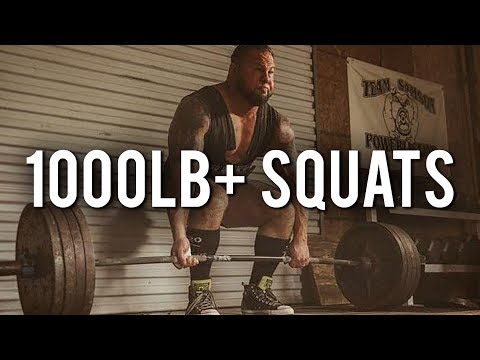
What Does It Feel Like To Squat 1000lbs? | Brian Carroll
Chris Williamson (host), Brian Carroll (guest)
In this episode of Modern Wisdom, featuring Chris Williamson and Brian Carroll, What Does It Feel Like To Squat 1000lbs? | Brian Carroll explores from Broken Back To 1,185lb Squat: Brian Carroll’s Redemption Blueprint Brian Carroll, one of the strongest powerlifters alive, describes what it feels like—physically and mentally—to squat over 1,000 pounds and how that pursuit almost destroyed his spine and career. He explains his reckless early training, the serious spinal injuries that led surgeons to recommend fusion, and how Dr. Stuart McGill instead rebuilt him from daily agony back to world‑class lifting. The discussion covers the mental state under maximal loads, the evolution of powerlifting (equipped vs raw), and the discipline required to overhaul movement, training, and ego to become pain‑free. Carroll now blends McGill’s spine mechanics with smarter programming, nutrition, and recovery to chase an unprecedented 1,200lb squat at a relatively light bodyweight.
From Broken Back To 1,185lb Squat: Brian Carroll’s Redemption Blueprint
Brian Carroll, one of the strongest powerlifters alive, describes what it feels like—physically and mentally—to squat over 1,000 pounds and how that pursuit almost destroyed his spine and career. He explains his reckless early training, the serious spinal injuries that led surgeons to recommend fusion, and how Dr. Stuart McGill instead rebuilt him from daily agony back to world‑class lifting. The discussion covers the mental state under maximal loads, the evolution of powerlifting (equipped vs raw), and the discipline required to overhaul movement, training, and ego to become pain‑free. Carroll now blends McGill’s spine mechanics with smarter programming, nutrition, and recovery to chase an unprecedented 1,200lb squat at a relatively light bodyweight.
Key Takeaways
Maximal performance requires rehearsed mental states and detailed visualization.
Before squatting 1,000+ lbs, Carroll deliberately goes to a “dark place,” visualizing the entire lift and crowd reaction from both first‑person and third‑person perspectives, then executing on “default mode” with everything else tuned out.
Get the full analysis with uListen AI
Cumulative abuse without planned recovery will eventually bankrupt even elite athletes.
Carroll’s early career was built on ‘whatever it takes’ training—ignoring pain, skipping deloads, and constantly pushing heavy—which led to multiple disc losses, endplate fractures, and a nearly split sacrum despite world‑record success.
Get the full analysis with uListen AI
Removing the cause of pain and fixing movement habits is more powerful than surgery.
With surgeons pushing fusion and predicting he’d never lift again, McGill instead diagnosed Carroll’s pain triggers (constant flexion, ‘silly’ stretches, reverse hypers) and rebuilt him via spine‑sparing movement (hip hinge, lunge, golfer’s pick‑up), McGill Big 3, carries, and walking—rapidly dropping pain from 8/10 to near zero.
Get the full analysis with uListen AI
Ego must be subordinated to biology if you want long-term performance.
Carroll accepted starting over as a beginner under McGill, stepping away from heavy lifting and swallowing public and personal ego, keeping only one non‑negotiable: he would return to competition—everything else became negotiable in service of healing.
Get the full analysis with uListen AI
Smart programming hinges on autoregulation, planned deloads, and clear exercise purpose.
He now uses a four‑day split with at least five days between heavy squat/deadlift exposures, planned light weeks before overtraining hits, and RPE‑based loading; every movement must answer the question ‘why am I doing this? ...
Get the full analysis with uListen AI
Equipped powerlifting is a distinct skillset demanding nervous system adaptation and technical mastery.
Modern squat suits, briefs, wraps, and shirts can add huge poundage but also change bar paths, depth perception, and pressure; Carroll argues gear lifting requires a higher technical ceiling and that few raw lifters successfully transition and dominate equipped.
Get the full analysis with uListen AI
Performance nutrition for strength is about function, not aesthetics.
Carroll emphasizes ‘eat to perform’—largely steak, rice, eggs, yogurt, fruit, and vegetables, akin to the Vertical Diet—balancing body fat for joint support and core girth while maintaining excellent blood work, rather than chasing leanness.
Get the full analysis with uListen AI
Notable Quotes
“I go to a dark, dark place in my head where I don't care about anything else.”
— Brian Carroll
“Fact is stranger than fiction… how do two men from totally different worlds… merge and write a book that helps people all over the world?”
— Brian Carroll
“Biology is very binary. It doesn't care about your mental state… Either you're giving yourself enough stimulus to build and be better, or you're tearing your body down.”
— Brian Carroll
“I went into his lab as a complete beginner. The only thing I held tight to concerning my ego and my pride was that I'm gonna compete again.”
— Brian Carroll
“You have to be able to ask yourself and answer, ‘Why am I doing this exercise?’ And if you can't answer that, you need to remove it.”
— Brian Carroll
Questions Answered in This Episode
How can a non-elite lifter apply McGill-style spine hygiene and Carroll’s approach to remove their own back pain without access to world-class clinicians?
Brian Carroll, one of the strongest powerlifters alive, describes what it feels like—physically and mentally—to squat over 1,000 pounds and how that pursuit almost destroyed his spine and career. ...
Get the full analysis with uListen AI
Where is the practical line between ‘pushing through discomfort’ and ‘ignoring serious warning signs’ in strength training, and how can athletes learn to sense it earlier?
Get the full analysis with uListen AI
Given the pervasive but often hidden use of performance-enhancing drugs in sport, what would a fully transparent, no-limits strength federation look like in practice?
Get the full analysis with uListen AI
How should coaches balance an athlete’s psychological need to train hard with the biological reality that healing often requires stepping completely away from heavy work?
Get the full analysis with uListen AI
In an era where raw powerlifting dominates culturally, what might be lost if fewer athletes learn the technical art and nervous-system demands of equipped lifting?
Get the full analysis with uListen AI
Transcript Preview
What do you do before a lift and what is the inside of your head like before you're about to put 1,000 pounds on your back in a meet?
It's, uh, it's really focused and I go to a dark, dark place in my head where I don't care about anything else. And the last thing I want in the world to happen when I'm under the bar is to miss the lift and embarrass myself. So everything is extremely tight. I visualize and see the lift being completed effortlessly before I even approach the platform. I already see it happen. I see the crowd's reaction. And I strive for that feeling to happen before it even happens. So I get out there and I just go to my default mode. I tune everything out, I tune everyone out, and I go and lift and I fight for my life for a couple seconds then I put it back down, then I try to breathe and relax. So you turn it on, you turn it off. You turn it on, you turn it off. Kinda like a fighter, UFC fighter, between rounds. You gotta chill. (exhales) Breathe and relax, then you go, you turn it back on, and then you relax.
(wind blowing) I am joined by, without a doubt, the strongest man that I have ever had on this podcast, Mr. Brian Carroll. Welcome to the show.
Thank you for having me, Chris. I appreciate it. I'm looking forward to having a chat with you.
Yeah. Me too. Uh, recently had mutual friend of ours, Dr. Stuart McGill, on the show and, uh, he was s- singing your praises. And we also briefly discussed the work that you two did together, so I'm excited to hear the other side of that story as we get through today.
Yes. It's been a very interesting journey the last six years that I've known Dr. McGill. And I met him in May of 2013, where I went to see him for a very complicated back injury that I had. Uh, the actual injury was, uh, basically I had no disc at L4, L5, L5, S1. It was flattened just the same at L5, uh, or L4, L5, L5, S1, th- both the discs were gone. And I had a couple endplate fractures working down to the sacrum where it was almost s- split in half. So I was in a bad spot where surgeons were wanting to do a spinal fusion on me. They were talking all this crazy stuff about how I'd never be outta pain. And Stu right away said that, "I can get you outta pain, but your lifting is done. You have absolutely no athleticism left in your back and I'm telling you this as, if you were my son, I would urge you to retire and never consider lifting heavy again." And I said, "Well, you just said that you could help get me outta pain." So I looked at him and I looked at my wife and I very calmly said, "I'm gonna lift again, so let's get me outta pain." And he said, "Well, you know my thoughts on this. First things first, let's get you outta pain and then we'll proceed. You come back in six months. We'll, we'll see where you are and then who knows? Maybe you're right and maybe we end up writing a book about it." And that was the first meeting that we had, May of 2013, and, uh, we wrote the book in 2017. And I held him to th- his feet to the fire when he said this-
Install uListen to search the full transcript and get AI-powered insights
Get Full TranscriptGet more from every podcast
AI summaries, searchable transcripts, and fact-checking. Free forever.
Add to Chrome