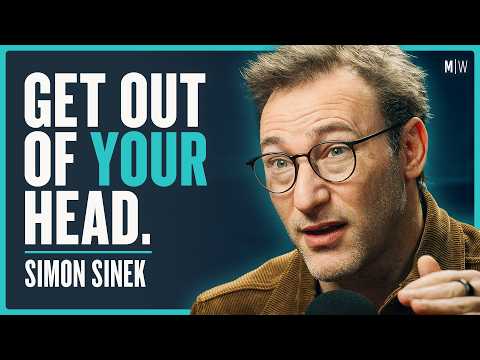
What To Do When Life Feels Empty & Overwhelming - Simon Sinek (4K)
Chris Williamson (host), Simon Sinek (guest)
In this episode of Modern Wisdom, featuring Chris Williamson and Simon Sinek, What To Do When Life Feels Empty & Overwhelming - Simon Sinek (4K) explores simon Sinek Explains Finding Purpose, Real Friendship, And Embracing Failure Simon Sinek and Chris Williamson explore today’s widespread crisis of purpose, driven by the collapse of traditional community structures and the overburdening of work and romantic partners to supply meaning, identity, and belonging.
Simon Sinek Explains Finding Purpose, Real Friendship, And Embracing Failure
Simon Sinek and Chris Williamson explore today’s widespread crisis of purpose, driven by the collapse of traditional community structures and the overburdening of work and romantic partners to supply meaning, identity, and belonging.
Sinek argues that purpose is discoverable, relatively stable across life, and distinct from goals; many people confuse big achievements with their ‘why’, which leads to emptiness, burnout, and post-success depression.
A large part of the conversation focuses on emotional skills: how to sit with others in their pain instead of rushing to fix them, how to meet emotion with emotion, how to communicate hard feelings, and how to stop living in victimhood by practicing accountability.
He reframes friendship and self-relationship as commitments to “grow together,” contends that real connection is the ultimate ‘biohack’, and insists that embracing failure, seeking help, and serving others with the same struggles are essential paths out of paralysis and loneliness.
Key Takeaways
Stop asking work and one partner to be ‘everything’.
With church, neighborhood, and community structures weakened, people now expect jobs and romantic partners to provide purpose, politics, social life, therapy, and stability—an unrealistic load that almost guarantees disappointment and relationship breakdown.
Get the full analysis with uListen AI
Purpose is stable; goals are temporary vehicles.
Many high achievers mistake big goals (Olympic medals, careers, titles) for their purpose; when the goal is reached or lost, they crash into depression. ...
Get the full analysis with uListen AI
When someone is emotional, meet emotion with emotion, not facts.
Logic and advice rarely land when a person is in a highly emotional state. ...
Get the full analysis with uListen AI
Accountability is the gateway from victimhood to growth.
You can acknowledge unfairness and bad luck, yet still ask, “How did I contribute? ...
Get the full analysis with uListen AI
Real friendship (and self-friendship) means agreeing to grow together.
Sinek defines friendship, romantic relationships, and communities the same way: two or more people who commit to mutual growth, accountability, and support. ...
Get the full analysis with uListen AI
Failure and catastrophe are brutal but often pivotal gifts.
Most meaningful lessons and later successes come from crises—addiction, job loss, heartbreak, business collapse—if you’re willing to learn. ...
Get the full analysis with uListen AI
If you’re stuck and afraid to move, go help someone with the same struggle.
Instead of endlessly optimizing yourself in isolation, openly admit your struggle to a trusted person, create space for “me too,” and then over-index on helping them move forward. ...
Get the full analysis with uListen AI
Notable Quotes
“When you're lost and you keep it to yourself, you stay lost.”
— Simon Sinek
“A friendship is when two people agree to grow together. A community is a group of people who agree to grow together.”
— Simon Sinek
“I would rather fall short of a big goal and consider myself a failure than lower the goals so I can feel like a success.”
— Simon Sinek
“Friendship is the ultimate biohack.”
— Simon Sinek
“The victim has to go first, because the ‘oppressor’ will never go first.”
— Simon Sinek, recounting Dia Khan’s insight
Questions Answered in This Episode
How can I practically distinguish my enduring ‘why’ from the big goals I’m currently chasing?
Simon Sinek and Chris Williamson explore today’s widespread crisis of purpose, driven by the collapse of traditional community structures and the overburdening of work and romantic partners to supply meaning, identity, and belonging.
Get the full analysis with uListen AI
In my closest relationships, where am I unfairly expecting one person or one role (like my job) to meet all my needs?
Sinek argues that purpose is discoverable, relatively stable across life, and distinct from goals; many people confuse big achievements with their ‘why’, which leads to emptiness, burnout, and post-success depression.
Get the full analysis with uListen AI
What would it look like to become a better friend—to others and to myself—over the next 90 days?
A large part of the conversation focuses on emotional skills: how to sit with others in their pain instead of rushing to fix them, how to meet emotion with emotion, how to communicate hard feelings, and how to stop living in victimhood by practicing accountability.
Get the full analysis with uListen AI
Which recent setback or ‘failure’ in my life am I resisting learning from, and what lesson might it be offering?
He reframes friendship and self-relationship as commitments to “grow together,” contends that real connection is the ultimate ‘biohack’, and insists that embracing failure, seeking help, and serving others with the same struggles are essential paths out of paralysis and loneliness.
Get the full analysis with uListen AI
If I admitted my current struggle to someone, who might say ‘me too’, and how could we commit to growing through it together rather than alone?
Get the full analysis with uListen AI
Transcript Preview
Do you think we're in a crisis of purpose right now?
Uh, I mean, I think it's pretty obvious that we are. I mean, it's embarrassing that I have a career, right? (laughs) Um, there should be no demand for my work. (laughs) Um, yeah, I, I think that the... In general, I think people would admit it. I think the, the, you know... Who can say whether it's a, that it's the first time it's ever happened, but I think people are more open to say that they either want it or are missing it, so.
Mm-hmm.
Um, but I think, uh, we've definitely seen the workplace change over the past few decades. Um, we've definitely seen the decline in church membership over the past few decades. We've definitely seen, um, you know, increased rates of loneliness and, and anxiety and depression. And, um, so, uh, and I think there's a lot of... And this, and the significant rise of sort of retreats and purpose, you know, events and things like that. So yeah, I've-
Men's groups.
Yeah. Well, yeah. So I think there's a, a... I think it's safe to say yes. (laughs)
Yeah. Where... What are the areas that have fallen away? You mentioned work, you mentioned church, community.
Yeah.
These are things that perhaps 50 years ago-
Yeah.
... 100 years ago would have been more prevalent.
Well, we... W- what's interesting is the, what we've seen in the world, like we... People used to get their sense of purpose from church, you know, s- or things like that. Um, we had bowling, uh, leagues, uh, and s- and, and, you know, extracurricular activities, where people had their friends group. Um, uh, you socialized with your neighbors. And work was a place you went to to make a living. It wasn't supposed to be this end all, be all of everything. And as those things fell away, we started to put more and more pressure on the workplace to provide those things. So now we're looking for our work to provide our sense of purpose, to provide our sense of community, to pro- e- to provide our social life, and, and now, and now we're also saying that work should be the place that agrees with my politics. That never used to happen. And so for better or for worse, there's a tremendous amount of pressure on the workplace and leaders in the workplace to be able to successfully offer all of those things. And people are quitting their jobs because they're not getting those things. Um, uh, and it never used to be a thing. Um, I think also we're doing the same thing in our relationships. There's, there's a correlation, which is, you know, you had your friends, you had your, your spouse, or your girlfriend, your boyfriend, and, uh, and, um, you didn't expect your partner, your romantic partner, to be able to provide everything. Be my rock, be my best friend, be my lover, be, you know, m- m- my stability, be the pers... And yet now we put overwhelming amounts of pressure on one person to be everything, the same way we're putting overwhelming amounts of pressure on our workplaces to be everything. We're setting both up to fail, by the way.
Install uListen to search the full transcript and get AI-powered insights
Get Full TranscriptGet more from every podcast
AI summaries, searchable transcripts, and fact-checking. Free forever.
Add to Chrome