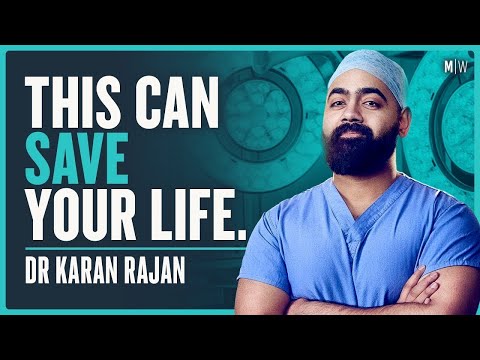
Debunking The Internet’s Biggest Health Myths - Dr Karan Rajan
Chris Williamson (host), Dr Karan Rajan (guest)
In this episode of Modern Wisdom, featuring Chris Williamson and Dr Karan Rajan, Debunking The Internet’s Biggest Health Myths - Dr Karan Rajan explores surgeon Debunks Digestive Myths, Sleep Rules, Stress And Brain Aging Dr. Karan Rajan joins Chris Williamson to dismantle popular health myths around digestion, gut health, sleep, stress, and sensory health, grounding each topic in physiology rather than wellness hype.
Surgeon Debunks Digestive Myths, Sleep Rules, Stress And Brain Aging
Dr. Karan Rajan joins Chris Williamson to dismantle popular health myths around digestion, gut health, sleep, stress, and sensory health, grounding each topic in physiology rather than wellness hype.
They dig into how gas, IBS, probiotics, and the gut–brain axis actually work, and why most over-the-counter gut supplements are overpromised but fermented foods are underrated.
The conversation then moves to sleep needs, naps, light, screens and caffeine, along with practical protocols to protect hearing, eyes, and manage pain through understanding and attention control.
Finally, they explore how stress, social connection, awe, routine movement, and sleep hygiene influence long‑term brain health and cognitive decline, emphasizing simple, consistent habits over biohacking fads.
Key Takeaways
Understand digestion beyond the stomach to improve gut decisions.
Most digestion happens in the small intestine with the help of the liver, pancreas, gallbladder and microbiome; seeing it as a coordinated ‘factory line’ rather than just a ‘stomach blender’ clarifies why whole‑diet patterns matter more than single foods or quick fixes.
Get the full analysis with uListen AI
Rely on fermented foods over generic probiotic supplements.
Off‑the‑shelf probiotics usually contain low, poorly regulated bacterial doses that rarely colonize your gut, whereas kefir, live yogurt, sauerkraut and other fermented foods provide richer, more viable microbes with better real‑world benefit for most people.
Get the full analysis with uListen AI
Treat IBS and ‘gut health’ as highly individual and lifestyle-driven.
IBS is an umbrella of subtypes with varied triggers, strongly influenced by microbiome, ultra‑processed diets, sedentary behavior, stress and sleep; personalization and lifestyle changes generally matter more than any single ingredient or supplement.
Get the full analysis with uListen AI
Ditch the rigid eight‑hour sleep dogma and focus on consistency.
Genetic ‘clock’ differences mean most healthy adults fall somewhere between ~6–8. ...
Get the full analysis with uListen AI
Use structured habits to protect hearing and vision in a digital world.
You’re born with a finite set of inner ear hair cells and chronic loud exposure irreversibly destroys them, while constant near‑focus on screens promotes eye strain and myopia—so custom earplugs and 20‑20‑20 eye breaks (every 20 minutes, look 20 feet away) are worthwhile baselines.
Get the full analysis with uListen AI
Change your relationship to pain by understanding and reframing it.
Explaining the physiology of pain and reducing visual focus on a painful procedure can measurably lower pain perception; practices like deliberate cold exposure or infusions become powerful labs for noticing how story, fear and attention amplify or reduce discomfort.
Get the full analysis with uListen AI
Start protecting your brain decades before symptoms of decline.
Alzheimer’s pathology begins many years before it’s obvious, and is strongly shaped by chronic sleep loss, inactivity, poor diet, and social isolation, whereas regular movement, good sleep, social meals, stress management, and even everyday ‘awe’ experiences support brain washout and resilience.
Get the full analysis with uListen AI
Notable Quotes
“If you hold in a fart, a tiny percentage will diffuse into your blood, go to your lungs, and you’ll literally breathe out fart fumes.”
— Dr. Karan Rajan
“Probiotics from the supermarket for the average person are like pissing in the wind.”
— Dr. Karan Rajan
“The eight‑hour, one‑size‑fits‑all sleep dogma is incorrect actually—and it drives a lot of sleep anxiety.”
— Dr. Karan Rajan
“Your friend is a unicorn; that’s the 0.01% of people who are the golden poopers.”
— Dr. Karan Rajan
“When you’re awed by something, nothing else is in your field of focus except that one awe‑inspiring act.”
— Dr. Karan Rajan
Questions Answered in This Episode
Given how individual IBS and microbiomes are, what practical steps can someone take to systematically identify their own specific food and lifestyle triggers?
Dr. ...
Get the full analysis with uListen AI
If psychobiotics are 10–15 years away, what current, evidence‑based interventions come closest to leveraging the gut–brain axis for mood in a reliable way?
They dig into how gas, IBS, probiotics, and the gut–brain axis actually work, and why most over-the-counter gut supplements are overpromised but fermented foods are underrated.
Get the full analysis with uListen AI
How should people realistically balance investing in advanced diagnostics (like full‑body MRI and microbiome mapping) versus getting the basics of sleep, diet and movement right?
The conversation then moves to sleep needs, naps, light, screens and caffeine, along with practical protocols to protect hearing, eyes, and manage pain through understanding and attention control.
Get the full analysis with uListen AI
For knowledge workers on screens all day, what would an ideal, science‑based daily protocol look like to protect both eye health and sleep quality?
Finally, they explore how stress, social connection, awe, routine movement, and sleep hygiene influence long‑term brain health and cognitive decline, emphasizing simple, consistent habits over biohacking fads.
Get the full analysis with uListen AI
What are the earliest realistic signals of harmful chronic stress or subtle cognitive decline that non‑experts can watch for, before problems become obvious?
Get the full analysis with uListen AI
Transcript Preview
Why should you never hold in a fart?
(laughs) You know what? Uh, a patient did once ask me this, and this was an inspiration for me to make a statement or an explanation about this. And, you know, a fart is a gas, you know, it's a chemical, it's a bunch of chemicals, and when you hold in a fart, there's a percentage of that fart vapor which will diffuse through the walls of the colon, through the walls of the intestine, and eventually it will go to your bloodstream, and all the blood circulates and eventually goes to the lungs where the waste products are then exhaled out. So there's a tiny percentage of your fart which, if you hold it in, will go to your bloodstream, go to the lungs, and then be exhaled out, so you will have fart effects.
You're gonna breathe it- you're gonna breathe it instead of farting it if you don't fart it.
You will exhale farts, so you will literally-
(laughs)
... breathe out fart fumes if you hold it in.
(laughs)
It's physiology. It's science. (laughs)
Science, baby! This is what we're here for. Uh, I've always thought this: where does the gas from burps come from, and why does it never go away? You know, like, you keep needing to burp over and over again, so what, i- if I'm not adding any gas in there, is that gas that you breathe in that somehow ... ?
Uh, a lot of the burps are a byproduct ... well, there's a couple of ways. Uh, a byproduct of air swallowing, so if you chew a lot of gum, you are swallowing a lot of air. You drink a lot of sodas and fizzy drinks, you are again swallowing a lot of air and the sort of carbonated gas that you're in- eh- sort of ingesting. And lastly, there will be a percentage of gas that your bacteria or the various microbes in your gut microbiome will produce, and they can may their- make their way upstream, as it were. And they'll c- also be a result of acid reflux as well, so if you have acid reflux, there's basically a floppy sphincter between where your stomach attaches to the first bit of your small intestine, and you get reflux of some of the gases and juices, and you get sort of excessive burping.
Yeah, it does seem, you know, if you've eaten a little bit too much or a little bit too quickly and you're a little bit full, it's like, it just is just not stopping. I just keep on burping over and over again. It's just gonna happen until I guess I've- my stomach levels finally settle down.
Yeah, and there's actually a couple of hormones, uh, one hormone in particular called cholecystokinin, and we can call it CCK for short. And CCK actually delays gastric emptying and slows down how much your stomach empties into your small intestine, so that hormone is increased if you eat foods that are high in fat or spicy foods. So if you eat spicy foods, the chemical capsaicin in spicy foods or chilis actually increases the production of CCK, cholecystokinin, so there's more stomach content and there's more likelihood that you can burp or have reflux. Same with fatty foods. That stimulates CCK production, more burping, more reflux.
Install uListen to search the full transcript and get AI-powered insights
Get Full TranscriptGet more from every podcast
AI summaries, searchable transcripts, and fact-checking. Free forever.
Add to Chrome