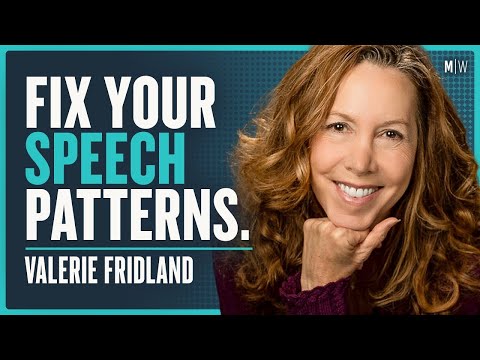
Why Does Everyone Say ‘Like’ and ‘Um’ All The Time? - Valerie Fridland
Valerie Fridland (guest), Chris Williamson (host), Narrator
In this episode of Modern Wisdom, featuring Valerie Fridland and Chris Williamson, Why Does Everyone Say ‘Like’ and ‘Um’ All The Time? - Valerie Fridland explores why ‘Um,’ ‘Uh,’ and ‘Like’ Reveal How Language Really Works Sociolinguist Valerie Fridland explains how language constantly changes under two main forces: cognitive/articulatory pressures that make speech easier to produce, and social pressures tied to identity, status, and group belonging. She shows that features we criticize—like filler words, “like,” vocal fry, and dialect traits—are actually systematic tools that aid planning, comprehension, nuance, and social signaling. Large, global languages tend to shed certain grammatical complexities while gaining new kinds of complexity, such as stricter word order or richer discourse markers. The conversation also covers how social media spreads, rather than invents, linguistic trends and how biases against certain ways of speaking have real social and legal consequences.
Why ‘Um,’ ‘Uh,’ and ‘Like’ Reveal How Language Really Works
Sociolinguist Valerie Fridland explains how language constantly changes under two main forces: cognitive/articulatory pressures that make speech easier to produce, and social pressures tied to identity, status, and group belonging. She shows that features we criticize—like filler words, “like,” vocal fry, and dialect traits—are actually systematic tools that aid planning, comprehension, nuance, and social signaling. Large, global languages tend to shed certain grammatical complexities while gaining new kinds of complexity, such as stricter word order or richer discourse markers. The conversation also covers how social media spreads, rather than invents, linguistic trends and how biases against certain ways of speaking have real social and legal consequences.
Key Takeaways
Filled pauses like “um” and “uh” are cognitive tools, not incompetence.
They appear most when speakers are doing harder mental work (complex sentences, rare or technical words), signaling ongoing processing and helping listeners predict, process, and remember upcoming information—despite being socially stigmatized.
Get the full analysis with uListen AI
“Um” and “uh” carry different meanings and timing signals.
Research shows “uh” typically precedes short delays while “um” tends to signal a longer pause, so speakers use them in a relatively intentional way to manage turn-taking and listener expectations.
Get the full analysis with uListen AI
Silent pauses are not equivalent to filler words.
Experiments replacing “uh/um” with silence or coughs show that comprehension benefits disappear or worsen; listeners treat filled pauses as useful cues that speech will continue, whereas silence can suggest anxiety, forgetting, or turn completion.
Get the full analysis with uListen AI
The much‑hated “like” serves specific, nuanced functions.
Modern “like” marks approximation, personal stance, emphasis, or non-verbatim quoting (“He was like…”), letting speakers signal subjectivity and imprecision; younger speakers use it heavily, but often systematically, and can substitute forms like “about” once they understand its roles.
Get the full analysis with uListen AI
Language simplification is selective and traded for other complexity.
Large languages like English have lost many inflectional endings and irregular plural patterns due to adult learners and transmission issues, but gained complexity in fixed word order and pragmatic devices, so they’re not “dumber,” just differently structured.
Get the full analysis with uListen AI
Vocal fry is a strategic adaptation, not a “female flaw.”
Creaky voice arises from low, irregular vocal fold vibration; younger women often use it to sound both competent (lower pitch) and still socially attractive, yet older listeners disparage it—mirroring broader bias against women’s professional speech even though men use fry heavily in some dialects.
Get the full analysis with uListen AI
Stigmatized dialect features reflect social prejudice, not linguistic inferiority.
Traits like glottal stops, R-dropping, or African American English grammar are fully rule-governed, but courts, employers, and the public often treat them as signs of low credibility or intelligence, producing measurable harms (e. ...
Get the full analysis with uListen AI
Notable Quotes
“Languages change because we’re always under linguistic pressures and we’re always something socially—those forces constantly swirl together.”
— Valerie Fridland
“Um and uh are basically the little loading wheel of the internet for your brain.”
— Valerie Fridland
“Most of the things we think of as bad speech aren’t bad at all—it’s just social and historical accident that we don’t like them.”
— Valerie Fridland
“As a sociolinguist, I love like…but as a mother, I understand why people worry about it.”
— Valerie Fridland
“Social media doesn’t really innovate language; it disseminates changes that were already there in communities.”
— Valerie Fridland
Questions Answered in This Episode
Given the cognitive benefits, should public speaking training consciously integrate well-timed ums and uhs instead of trying to eliminate them entirely?
Sociolinguist Valerie Fridland explains how language constantly changes under two main forces: cognitive/articulatory pressures that make speech easier to produce, and social pressures tied to identity, status, and group belonging. ...
Get the full analysis with uListen AI
How can educators and employers be trained to distinguish between genuine incompetence and merely non‑prestige dialect features or filler usage?
Get the full analysis with uListen AI
If social media mainly spreads existing linguistic innovations, where and how are the most influential new features actually emerging?
Get the full analysis with uListen AI
What would a fairer legal system look like in terms of handling non‑standard dialects, hip‑hop lyrics, or emojis as evidence?
Get the full analysis with uListen AI
How might awareness of the real functions of “like” and vocal fry change the way we evaluate young women’s intelligence and professionalism in everyday life?
Get the full analysis with uListen AI
Transcript Preview
One thing that we do notice is when people are more dynamic speakers, when they say something that's more interesting and they're more engaging, people actually don't tend to note their uhs and ums as much as people that give sort of a monotonous, boring delivery and maybe don't have content that's really interesting. So a lot depends on what you're saying. (wind blows)
What do you study?
I am what's called a sociolinguist. Don't try to say that after a few drinks at cocktail parties. It's a hard one. Um, but it basically means that I study how the underlying linguistic patterns that we take for granted and we don't even notice anymore vary not just by language or dialect, but by social facts about us that are much smaller than these things that we tend to think of as language differences.
Why do languages change at all, then? Why isn't it just that we have a language and then people use it, and people use it, and it gets locked in for the rest of time?
Well, that's why I make the big bucks. Or actually not, but that's why they pay me some salary. (laughs) That's a big question, actually, and, you know, that is what keeps ling- linguists and psychologists and, uh, cognitive scientists employed because we don't understand all the forces, but the short answer to that big question is we have underlying cognitive and articulatory pressures that constantly affect us as speakers. So an example of that would be the fact that, um, take a word with a lot of consonants on it that's a single syllable, like whisks, which is, you know, a word we use every day when we're cooking, and notice that when you say it in fast speech, or just really any time you say it in speech, you're going to naturally just delete some of the consonants off that. So you'll say, you'll whisk it fast. Um, you're not going to say all the whisks, because it's a hard thing to say. Or fifths, that's another word. Sixths. Those are all tricky words. Well, the reason you delete those consonants is there's a natural inherent pressure, a cognitive preference we think for languages to have very minimal syllable structures, and that means no consonants at the end if possible. Some languages actually prohibit all consonant clustering, but English allows a lot. I call it a promiscuous language for that reason. And, uh, so it's natural to delete them. That's sort of a cognitive, trying to get back to this cognitive preference we have. There's also some articulatory issues. So for example, words like the, or, or words that begin with the, that, that consonant cluster that's r- it's a T-H, but it's actually a single sound. Many, many languages don't have that sound. So for example, my mother's a French speaker and I used to make endless loads of fun of her because she would say, "One, two, three," 'cause she couldn't make the T-H sound, right? And she loved it, of course. Um, that was her favorite aspect of our relationship I'm, (laughs) I'm sure. But she couldn't say that because it's not a sound in French. That also tells us that it's either articulatorily a dispreferred sound or cognitively a dispreferred sound. So languages will naturally, if they have that sound, try to move towards not having it anymore, which is why a lot of dialects of English say things like, um, bruvva or teef, because they're trying to get back to that more natural consonant structure. So those are natural tendencies we have that exist all the time, pressure on us, all speakers, all languages, all the time. The part that I'm interested in is the other pressure, which is social pressure. So how is my social identity a factor in which of those pressures I succumb to? So if I'm a female, if I'm a young person, if I'm an African-Ame- American, if I'm a second language speaker, a non-native speaker, what do those pressures coupled with those linguistic pressures create in terms of dialects? And it's because these things swirl around us all the time. We're are, always having these natural pressures. We're always something socially. We're always changing who we are socially, and that has a big impact on which of those pressures that we allow in our speech and which we don't. And in the end, it's the cosmic language change that results. So language has always had these pressures on it. It hasn't changed. The language might change, but the pressures don't. We've always been social, right? You know, back in caveman days I'm sure they did some social fun stuff. Um, so you know, it's always been there, and we just kind of interact and engage and then that creates language change over time. Obviously it's a lot more complex, but that's sort of the short long answer.
Install uListen to search the full transcript and get AI-powered insights
Get Full TranscriptGet more from every podcast
AI summaries, searchable transcripts, and fact-checking. Free forever.
Add to Chrome