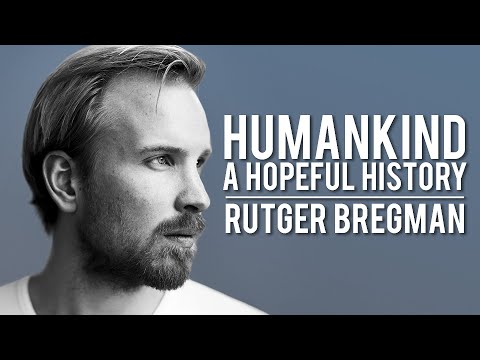
Humankind: Are We Good Or Evil? | Rutger Bregman | Modern Wisdom Podcast 181
Rutger Bregman (guest), Chris Williamson (host), Narrator
In this episode of Modern Wisdom, featuring Rutger Bregman and Chris Williamson, Humankind: Are We Good Or Evil? | Rutger Bregman | Modern Wisdom Podcast 181 explores rutger Bregman Argues Most Humans Are Kind—Power Is The Problem Rutger Bregman discusses his book *Humankind*, arguing that humans are fundamentally cooperative and friendly, and that our cynical view of human nature is historically and politically constructed. He contrasts this optimistic perspective with long‑dominant ideas from Hobbes, the Christian tradition, capitalism, and popular culture (e.g., *Lord of the Flies*).
Rutger Bregman Argues Most Humans Are Kind—Power Is The Problem
Rutger Bregman discusses his book *Humankind*, arguing that humans are fundamentally cooperative and friendly, and that our cynical view of human nature is historically and politically constructed. He contrasts this optimistic perspective with long‑dominant ideas from Hobbes, the Christian tradition, capitalism, and popular culture (e.g., *Lord of the Flies*).
Bregman illustrates his case with the real-life "Lord of the Flies" story of Tongan boys who survived 15 months on an island through cooperation, as well as research from anthropology, archaeology, evolutionary biology, and military history. He introduces ideas like self‑domestication and "survival of the friendliest" to explain why we conquered the globe despite not being the strongest or smartest individually.
The conversation explores how institutions built on distrust (schools, workplaces, politics) bring out the worst in people, whereas systems designed on trust and intrinsic motivation can outperform traditional hierarchies.
Bregman’s core claim: most people are pretty decent, but power and distance (physical and psychological) corrupt, enabling atrocities, meaningless work, and misdesigned institutions.
Key Takeaways
Question the "thin veneer" theory of civilization.
Bregman argues that the idea humans are naturally selfish and only kept in check by rules and rulers is historically convenient for those in power but not well-supported by modern evidence from anthropology and archaeology.
Get the full analysis with uListen AI
Recognize cooperation—not raw intelligence or strength—as humanity’s superpower.
The self-domestication theory and "survival of the friendliest" suggest humans thrived because we became tamer, more childlike, and more socially oriented, enabling large-scale learning and collaboration.
Get the full analysis with uListen AI
Design institutions around trust to unlock intrinsic motivation.
Examples like the Dutch care organization Buurtzorg show that flattening hierarchy and trusting people to self-organize can lower costs, improve outcomes, and raise job satisfaction compared with control-heavy, metrics-obsessed models.
Get the full analysis with uListen AI
Understand that most people find direct violence psychologically difficult.
Historical data from major wars and PTSD research indicate that ordinary soldiers often avoid killing at close range; militaries have had to condition them to overcome strong empathetic inhibitions, and this conditioning increases trauma.
Get the full analysis with uListen AI
See how distance and dehumanization make atrocities possible.
Technologies (artillery, bombing, drones) and propaganda that portray others as less than human allow people to commit large-scale violence without directly confronting the moral weight of their actions.
Get the full analysis with uListen AI
Accept some "collateral damage" if you choose to live trustingly.
Bregman suggests it’s rational to be generally trusting—knowing you’ll occasionally be conned—because the societal and personal benefits of trust far outweigh the costs of a few bad encounters.
Get the full analysis with uListen AI
Assume the best in others, especially under ambiguity.
Because most people are decent and our negativity bias skews perceptions, Bregman recommends defaulting to generous interpretations of others’ actions; non-complementary kindness can break cycles of mistrust and escalation.
Get the full analysis with uListen AI
Notable Quotes
“Most people are pretty decent, but power corrupts.”
— Rutger Bregman
“The true superpower of human beings is not on an individual level, but on a group level.”
— Rutger Bregman
“If millions of kids still have to read the fictional *Lord of the Flies*, then let’s also tell them about the one time real kids shipwrecked on a real island.”
— Rutger Bregman
“If you really never want to be ripped off, the price you pay is distrusting people all the time—and that price is way too high.”
— Rutger Bregman
“Other people are just like you. You’re probably not a monster, so they’re probably not a monster either.”
— Rutger Bregman
Questions Answered in This Episode
If institutions were redesigned on the assumption that most people are kind and intrinsically motivated, what concrete changes would you make first in education, workplaces, or politics?
Rutger Bregman discusses his book *Humankind*, arguing that humans are fundamentally cooperative and friendly, and that our cynical view of human nature is historically and politically constructed. ...
Get the full analysis with uListen AI
How should we reconcile the "survival of the friendliest" narrative with the existence of genuinely cruel individuals and systemic atrocities like genocides?
Bregman illustrates his case with the real-life "Lord of the Flies" story of Tongan boys who survived 15 months on an island through cooperation, as well as research from anthropology, archaeology, evolutionary biology, and military history. ...
Get the full analysis with uListen AI
What are the biggest risks or downsides of adopting a more trusting view of human nature at scale—could it make societies naïve or vulnerable to bad actors?
The conversation explores how institutions built on distrust (schools, workplaces, politics) bring out the worst in people, whereas systems designed on trust and intrinsic motivation can outperform traditional hierarchies.
Get the full analysis with uListen AI
In a media environment built on negativity and outrage, how can individuals realistically counteract their own negativity bias without becoming uninformed?
Bregman’s core claim: most people are pretty decent, but power and distance (physical and psychological) corrupt, enabling atrocities, meaningless work, and misdesigned institutions.
Get the full analysis with uListen AI
What personal experiments could a listener run in their daily life to test Bregman’s claim that "when in doubt, assume the best" leads to better outcomes?
Get the full analysis with uListen AI
Transcript Preview
Throughout history, a cynical view of human nature has often been used by those in power to legitimize their power, right? Because if we cannot trust each other, then we need managers and CEOs and kings and monarchs and generals, right? Then we need to be kept in control. But if we can actually trust each other, if most people are pretty decent, that means that we maybe don't need them, and that we can move to a very different kind of society that is much more egalitarian, genuinely democratic, with very different kind of organizations, different kind of schools, different kind of prisons, democracies, et cetera, et cetera. So it has quite, yeah, big implications if you really think it through. (whooshing sound)
You've been breaking the internet a lot-
(laughs)
... over the last year. So last year at the Davos conference when you called out a bunch of billionaires, broke the internet. Then you riled up Tucker Carlson and broke the internet again.
Mm-hmm.
And then you've done it recently with this real life Lord of the Flies story that you've unearthed.
Yeah. And it surprises me every time that it happens. Yeah, I mean, I'm not doing it on purpose but, uh-
(laughs)
... yeah. It's a very weird experience to go viral on a skill like that, right? You, uh, sort of have your phone and your, your Twitter mentions, and then you pay a visit to the toilet and you come back and it's like 3,000 new-
(laughs)
... right? It's really crazy.
That's so cool, man. So why don't you tell us about, before we even get into your new book, Human- Humankind, which is great, why don't you tell us this real life Lord of the Flies story? That might be quite a cool way to start.
Sure. Um, so my new book is really about a sort of silent revolution that has taken place in science, right? So there are a lot of scientists now from very diverse disciplines, uh, in anthropology and sociology and psychology and you name it, who used to have a more cynical view of human beings, of who we are as a species, and are now actually more hopeful. You know, they're not saying that people are angels or, or anything. We're clearly not. But they argue that our true superpower as a species is actually our ability to cooperate and to be friendly to one another and to work together. So when I started writing this book, I s- realized that I had to take it up against, you know, so many giants in science, in Western culture, in our literature, you name it. I mean, Western culture is d- just permeated with the idea that people are selfish. You know, this goes back all the way to the ancient Greeks, the notion that our civilization is only a thin veneer and that, you know, especially during a time of crisis, during a pandemic, for example, people become very nasty and they start stealing and hoarding and blundering and you name it. So this idea goes back all the way to the ancient Greeks. You find it with the Christian Church fathers, you know, Orthodox Christianity and the idea that we're born as, uh, sinners. You also find it with, uh, the Enlightenment philosophers. You would expect some break there, you know, between Orthodox Christianity and the Enlightenment philosophers. But if you actually look at the view of human nature, it's pretty similar. You know, David Hume, um, Thomas Hobbes, you know, the famous British philosopher, all having quite a cynical view of human nature. And then again, if you look at, um, our current capitalist system, right, the central dogma seems to be people are just selfish and deal with it. That's just the way things are. Um, now one of sort of the most, uh, famous manifestations of this idea in the 20th century was this novel Lord of the Flies that, you know, especially people in the Anglo-Saxon world, in the US and the UK, you know, so many people have read it or were forced to read it (laughs) for school, right? This story about a couple of kids who are in an, in a crash of an airplane and end up on an uninhabited island. And at first, they think like, "Oh, this is wonderful. This is lovely. Um, we're gonna have a good time here." And they try to set up a democracy of sorts, but it quickly breaks down. And at the end of the novel, like most of the kids have become animals, beasts, savages, and three of the kids are dead. And the message is really here you have these, um, civilized, uh, nice kids from a good British boarding schools, but you give them freedom and this is what, what you get, right? Civilization is just a thin veneer. Now for my book, I realized that I had to do something with Lord of the Flies, right? I had to write something about it. Even though it's, it's fiction, it's often sort of used as non-fiction, right? So many people interpret that novel and say, "Oh yeah, yeah. That's what kids are like in the end." So I asked myself the question, has it ever happeneded? You know, has there ever been one instance of real kids shipwrecking on a real island and what would happen? So yeah, that's, that's what I, uh, I tried to find out.
Install uListen to search the full transcript and get AI-powered insights
Get Full TranscriptGet more from every podcast
AI summaries, searchable transcripts, and fact-checking. Free forever.
Add to Chrome