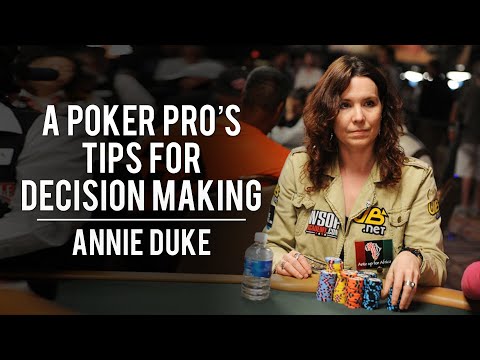
How To Make Better Decisions | Annie Duke | Modern Wisdom Podcast 233
Annie Duke (guest), Chris Williamson (host), Narrator, Chris Williamson (host)
In this episode of Modern Wisdom, featuring Annie Duke and Chris Williamson, How To Make Better Decisions | Annie Duke | Modern Wisdom Podcast 233 explores poker, Psychology, and Optionality: Annie Duke’s Blueprint for Decisions Annie Duke draws on her background in cognitive science and professional poker to explain how to make better decisions under uncertainty. She argues that good decision-making requires clearly separating luck from skill and rigorously examining the beliefs that drive our choices. Duke contrasts vague “gut feel” with explicit, testable decision processes that can be repeated, taught, and improved over time. She also emphasizes optionality, speed vs. deliberation, and productive disagreement as core tools for better outcomes in life and business.
Poker, Psychology, and Optionality: Annie Duke’s Blueprint for Decisions
Annie Duke draws on her background in cognitive science and professional poker to explain how to make better decisions under uncertainty. She argues that good decision-making requires clearly separating luck from skill and rigorously examining the beliefs that drive our choices. Duke contrasts vague “gut feel” with explicit, testable decision processes that can be repeated, taught, and improved over time. She also emphasizes optionality, speed vs. deliberation, and productive disagreement as core tools for better outcomes in life and business.
Key Takeaways
Treat decisions as paths that open and close future options.
Every choice not only selects one path but excludes others; recognizing this leads to valuing optionality—decisions that are easy to reverse or allow you to pursue multiple paths in parallel (e. ...
Get the full analysis with uListen AI
Don’t rely on your gut for high-stakes or complex decisions.
Gut instinct is where bias and noise live; it’s implicit, non-repeatable, and impossible to audit. ...
Get the full analysis with uListen AI
Separate decision quality from outcome quality to avoid ‘resulting’.
Good decisions can have bad outcomes and vice versa because of luck and incomplete information. ...
Get the full analysis with uListen AI
Spend more decision-making time where downside is large and persistent.
Use tools like the “happiness test” (Will I care in a week, month, year? ...
Get the full analysis with uListen AI
Design choices to maximize quittability and hedging.
You can go faster and learn more when you can quit easily (liquid investments, renting, trying a food you can stop eating) or hedge (indoor/outdoor wedding with a tent, testing a new career via night classes while keeping your job). ...
Get the full analysis with uListen AI
Use precise language and outside perspectives to improve reasoning.
Vague terms like “real possibility,” “spectacular,” or “great upside” hide real disagreement and make accountability impossible. ...
Get the full analysis with uListen AI
Embrace disagreement as a learning tool, not a threat.
Divergent opinions reveal where your beliefs might be wrong or incomplete; the goal of discussion is not to end in agreement but to better understand your own and others’ rationales. ...
Get the full analysis with uListen AI
Notable Quotes
“In order to be a great decision maker, you have to do two things… You have to understand and see the luck, and you have to really examine the beliefs that inform the decisions you make.”
— Annie Duke
“Your gut is where all the cognitive bias lives. Your gut is where all the noise lives.”
— Annie Duke
“The biggest thing people get wrong about decision-making is that a good decision will get you a good result, and a bad decision will get you a bad result.”
— Annie Duke
“We live our lives basically forcing more agreement than there actually is.”
— Annie Duke
“If you want to know what somebody thinks, don’t tell them what you think first.”
— Annie Duke
Questions Answered in This Episode
How can I practically build a repeatable decision process for my biggest life or career choices without overcomplicating everything?
Annie Duke draws on her background in cognitive science and professional poker to explain how to make better decisions under uncertainty. ...
Get the full analysis with uListen AI
In my own life, where am I most guilty of ‘resulting’—assuming outcomes prove whether I made a good or bad decision?
Get the full analysis with uListen AI
What decisions am I currently agonizing over that would clearly pass Annie’s happiness test as low-impact and should just be made quickly?
Get the full analysis with uListen AI
Where could I redesign my choices to increase optionality and quitting ability, so that experimenting feels safer and faster?
Get the full analysis with uListen AI
How can I cultivate a circle of people who will give me truly independent outside views rather than just agreeing with my initial opinions?
Get the full analysis with uListen AI
Transcript Preview
In order to be a great decision maker, you have to do two things, and you have to do them pretty intentionally. You have to understand and see the luck. You can't control the luck, 'cause luck by definition is outside of your control, but you wanna see it as accurately as possible. Here are, here's the spread of outcomes that can occur and here's how likely those things are to happen. But then the other thing you need to do is start really examining what are the beliefs that you have that inform the decisions that you make. (air whooshing)
Many of our listeners will be familiar with you, but for those who aren't, can you give us a bit of background what makes you an authority on decision-making?
Oh my gosh, (laughs) that sounds so very serious. Um, well, I guess it's, I, I guess it would be kind of the, the very strange path that I took, uh, as an adult. Um, so I started off after college, uh, in a PhD program at the University of Pennsylvania. I was studying cognitive psychology, um, cognitive science. Um, in particular, uh, I was really thinking about how people learn. Um, so I was, I was gonna go off and become a professor, as one would after getting that degree. Um, and as I was, uh, ABD, as we call it, b- before I, um, defended my thesis, I actually got sick and ended up, uh, needing to take about a year off before I went out to become a professor. And in the year that I took off, I started playing poker. And I did that kind of in the meantime in order to, uh, support myself until I could go and start my career. And, uh, so the meantime turned into like 18 years-
(laughs)
... as it does. Um, I kind of kept playing poker. Um, and you know, a- and then about eight years into my poker career, I actually started thinking about this very interesting conversation that cognitive science, my background in cognitive science w- could have with the real-world decision-making problem that poker presents, which is obviously very high stakes, lots of skin in the game. Uh, if you're bad at deciding, you lose all your money, um, over the long run. Um, and so you really have to be kind of thinking about, in particular, how, how do people learn in these very n- noisy environments? Meaning, um, uh, where there's lots and lots of luck, uh, in terms of influencing the outcome, and also lots of hidden information, imperfect information, which is, by the way, almost any decision you've ever made in your life, including just like whether to proceed through an intersection, um, (laughs) i- is actually very poker-like in its decision. So, um, so I did, so I played poker till 2012. In 2002, I started thinking about how these two things might converge, started speaking on that topic quite a bit. And then in 2012, I retired from poker, started really focusing this, on this full-time, spent a lot of my time consulting with companies on decision strategy, um, giving talks, writing books on the topic. Um, and then I've also gone back to academics and I'm back to doing some academic research in cognitive science. So I, I took a full loop. I, I en- I ended up getting back to where I started, but it just took me a while. It took me a while to circle back. So I mean, I guess, I guess that's kind of, you know, I guess I have some practical, some practical bonafides and some academic bonafides maybe? I don't know, trying to answer your question.
Install uListen to search the full transcript and get AI-powered insights
Get Full TranscriptGet more from every podcast
AI summaries, searchable transcripts, and fact-checking. Free forever.
Add to Chrome