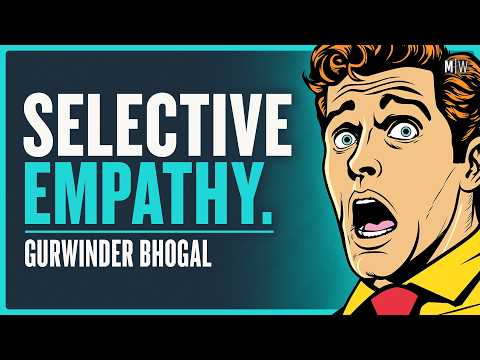
19 Uncomfortable Truths About Human Nature - Gurwinder Bhogal
Chris Williamson (host), Gurwinder Bhogal (guest)
In this episode of Modern Wisdom, featuring Chris Williamson and Gurwinder Bhogal, 19 Uncomfortable Truths About Human Nature - Gurwinder Bhogal explores uncomfortable truths about empathy, diagnosis culture, AI slop, and agency Empathy is often tribal and selective, meaning compassion for an in-group can readily coexist with cruelty toward out-groups.
Uncomfortable truths about empathy, diagnosis culture, AI slop, and agency
Empathy is often tribal and selective, meaning compassion for an in-group can readily coexist with cruelty toward out-groups.
Labels and diagnoses can make suffering feel controllable, but they become harmful when naming replaces action or personal agency.
AI-driven ‘slopaganda’ and information overload threaten society less by destroying truth than by dissolving trust and making truth feel not worth pursuing.
Social media is structurally unrepresentative (driven by a loud minority), producing distorted beliefs and reciprocal radicalization rather than reflecting real life.
Human flourishing requires ‘eustress’ and retained skills—over-automation and outsourced thinking risk cognitive atrophy and a widening agency gap.
Key Takeaways
Empathy can intensify cruelty when it’s tribal.
Bhogal argues empathy functions like a spotlight: it heightens care for a chosen target while leaving others ‘in the dark,’ which can translate into hostility toward perceived opponents (e. ...
Get the full analysis with uListen AI
A diagnosis is useful only if it creates a tractable next step.
Naming suffering can reduce shame and provide a framework for action, but it becomes an excuse when it shifts responsibility entirely to biology and replaces treatment, skill-building, or behavioral change.
Get the full analysis with uListen AI
Incentives drive pathologization and disability inflation.
Patients may seek easy, meaning-making labels; institutions and industries may benefit from broader definitions; and universities can create high-stakes rewards (e. ...
Get the full analysis with uListen AI
AI ‘slop’ threatens trust more than truth.
They argue societies can muddle through with many false beliefs, but they cannot function without trust; when verifying truth becomes too costly, people disengage and adopt ‘whatever stinks least,’ undermining the social value of accuracy.
Get the full analysis with uListen AI
Reality apathy is the real endgame of information overload.
Rather than persuading you of a single narrative, floods of conflicting content can make you stop caring what’s real, increasing cynicism and pliability—an environment where propaganda becomes cheaper and more effective.
Get the full analysis with uListen AI
Social media is not a census of humanity—it’s a selection effect.
Because ~1% of users create most content and dark-triad/cluster-B traits are overrepresented, the online ‘consensus’ often reflects obsessive, theatrical minorities; taking it as reality leads to warped risk perception and politics-by-outrage.
Get the full analysis with uListen AI
Preserve agency by resisting over-automation of core skills.
They connect learning to friction and ‘eustress’: outsourcing thinking/writing/effort to tools can prevent internalization, accelerate atrophy (‘use it or lose it’), and create a future split between amplified high-agency people and increasingly passive low-agency people.
Get the full analysis with uListen AI
Notable Quotes
“Empathy is in-group loyalty… it’s like a spotlight.”
— Gurwinder Bhogal
“Slop doesn’t just threaten the truth, but the very worth of truth.”
— Chris Williamson
“If the label replaces action, then it’s just an excuse.”
— Gurwinder Bhogal
“Automate only the skills you’re willing to lose.”
— Chris Williamson
“Confidence is not the belief that everything is gonna be all right… it’s the belief that you will be able to handle things even if they’re not okay.”
— Gurwinder Bhogal
Questions Answered in This Episode
How do you distinguish ‘healthy compassion’ from the tribal empathy that flips into cruelty—what practices broaden the spotlight without becoming naive?
Empathy is often tribal and selective, meaning compassion for an in-group can readily coexist with cruelty toward out-groups.
Get the full analysis with uListen AI
In the Rumpelstiltskin effect, what’s the best way to use a diagnosis as a ‘GPS’ toward action rather than a permission slip for inaction?
Labels and diagnoses can make suffering feel controllable, but they become harmful when naming replaces action or personal agency.
Get the full analysis with uListen AI
On disability inflation at elite universities: what specific policy changes would reduce malingering without punishing students with invisible disabilities?
AI-driven ‘slopaganda’ and information overload threaten society less by destroying truth than by dissolving trust and making truth feel not worth pursuing.
Get the full analysis with uListen AI
You claim the AI era’s core threat is trust collapse, not truth collapse—what concrete trust-building institutions (identity, provenance, reputation) do you think can scale?
Social media is structurally unrepresentative (driven by a loud minority), producing distorted beliefs and reciprocal radicalization rather than reflecting real life.
Get the full analysis with uListen AI
What personal rules do you use to prevent ‘reality apathy’ when the cost of verification feels overwhelming?
Human flourishing requires ‘eustress’ and retained skills—over-automation and outsourced thinking risk cognitive atrophy and a widening agency gap.
Get the full analysis with uListen AI
Transcript Preview
It's been too long, man. You write these awesome things on the internet. We- this is the eighth time we've done this now.
Yeah.
For the people that haven't seen you before, you come up with some of my favorite aphorisms and insights and stuff, and we just do the... We're kind of like the Bonnie Blue of interesting insights about the internet. We're just taking whatever we get. It's high velocity stuff. Uh, the first one that I want to get into, the Oxytocin paradox, this is one of yours. Oxytocin, the love hormone, can also make people spiteful. Cruelty is not simply the opposite of compassion, it's often adjacent to it. For instance, the platform most dominated by social justice activists, Blue Sky, is also the one with the highest support for assassinations. Beware of those quick to show empathy, for they are often just as quick to show barbarity.
Yeah. So this is a finding that I sort of came across quite recently, but it confirms something I've long known, which is that people who outwardly express a lot of empathy tend to also be equally capable of cruelty to that same extent. Um, and I first learned about this, uh, from a book called Against Empathy by, um, by Paul Bloom, who's a psychologist. And in this book... I think you've had him on the show. Um, in, in this, uh, in this book, he basically talks about how people tend to assume that empathy is a, just a good thing overall. You know, that it's not... That we need more empathy, that, that empathy is, like, in short supply. Um, but really empathy is in-group loyalty. That's what it is. It's, you know, because we're tribal animals, and what empathy is, is it's when you empathize with someone. The way he describes it is you don't empathize with everybody at the same time. You empathize with select people, and the way he describes it is that it's... Empathy is like a spotlight. So you shine it on people, uh, you know, a small group of people at a time or just an individual at a time. But while you have empathy shined on that person, everybody else is in darkness, which basically is, basically means that you don't have any real feelings for that person that's outside of that spotlight. So what this can mean is that if you empathize... So let's take a real-world example. Let's say you're somebody who empathizes with the plight of the Palestinians, so you'll, you'll have a lot of love for those, for those people, and you'll be very, very concerned about them. But there's a, there's a kind of yin-yang effect where because you have so much concern for them, you have negative concern for Israelis. So it's not like, you know, you just have love for one group of people and then everybody else you're, you're sort of neutral to. It can actually have a sort of almost like a zero-sum effect. The more empathy you have for one group of people, the less empathy you have for other people. And this is a, I think, a major driver of sort of cruelty and spite in the world. When you consider, like, the people that go out there and commit political violence, what you often see is that these people empathize very strongly with one group of people. So again, you know, if we go, go with the Palestinian analogy, uh, a group like Hamas, for instance. Now, Hamas have a lot of empathy for Palestinians, at least they, they do claim to, um, but then that equates also to hostility, corresponding hostility proportionate to Israelis. Uh, you see it also with, again, with the example that I gave in that, in that piece, which is about Blue Sky. So Blue Sky obviously is where all the social justice h- uh, people hang out. You know, it's basically all the refugees from Musk's X. Uh, so, you know, these are all people that you would think would be extremely compassionate, extremely sort of empathic, and they are. They are, but only to a small group of people. For example, you know, the left, when they call for empathy, they don't, they don't call for empathy for right-wingers. They call for empathy towards immigrants or towards trans people, you know. So their empathy is very selective, and this is why when, when you look at recent research, you find that the amount of support for assassinations is strongest amongst the people that you would expect to be the most compassionate, basically.
Install uListen to search the full transcript and get AI-powered insights
Get Full TranscriptGet more from every podcast
AI summaries, searchable transcripts, and fact-checking. Free forever.
Add to Chrome