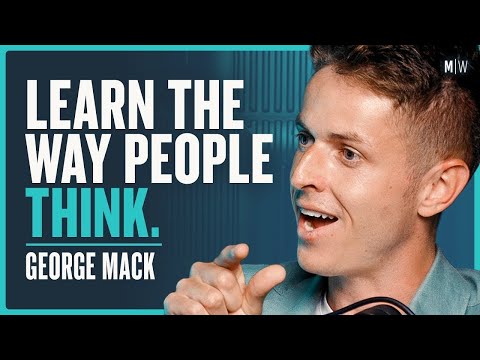
16 Wise Truths To Improve Your Life - George Mack
Chris Williamson (host), George Mack (guest), Narrator
In this episode of Modern Wisdom, featuring Chris Williamson and George Mack, 16 Wise Truths To Improve Your Life - George Mack explores optimism, Agency, and Life Design: Sixteen Mental Models Explained Chris Williamson and George Mack unpack a series of "wise truths"—mental models, razors, and stories—aimed at making life more optimistic, high-agency, and thoughtfully designed. They reframe optimism away from magical thinking toward compounding 1% daily improvements, using ideas like the placebo effect and the cocktail party effect to defend realistic optimism. A major theme is high agency: the capacity to shape life rather than be shaped by it, illustrated through historical figures like Rudolf Vrba and modern examples of creative, persistent people. They also explore hidden costs of thinking and anxiety, the dangers of cynicism, the impact of technology and media, and practical systems (like dual phones, milestones, and better questions) to regain control over attention, behavior, and long-term direction.
Optimism, Agency, and Life Design: Sixteen Mental Models Explained
Chris Williamson and George Mack unpack a series of "wise truths"—mental models, razors, and stories—aimed at making life more optimistic, high-agency, and thoughtfully designed. They reframe optimism away from magical thinking toward compounding 1% daily improvements, using ideas like the placebo effect and the cocktail party effect to defend realistic optimism. A major theme is high agency: the capacity to shape life rather than be shaped by it, illustrated through historical figures like Rudolf Vrba and modern examples of creative, persistent people. They also explore hidden costs of thinking and anxiety, the dangers of cynicism, the impact of technology and media, and practical systems (like dual phones, milestones, and better questions) to regain control over attention, behavior, and long-term direction.
Key Takeaways
Treat optimism as a compounding 1% daily edge, not magic manifestation.
The episode contrasts The Secret–style wishful thinking with data-backed optimism: if you adopt an optimistic frame, you don't summon outcomes, but you prime your brain (via the reticular activating system) to notice and exploit opportunities that would otherwise stay in the noise.
Get the full analysis with uListen AI
Aim for optimism plus high agency; optimism without action is useless.
They present a matrix of optimism/pessimism crossed with high/low agency and argue that the winning quadrant is optimistic, high-agency people who both believe improvement is possible and take responsibility for enacting change.
Get the full analysis with uListen AI
Combat cynicism by fixing “hardware” first and auditing your inputs.
When you feel yourself sliding into pessimism, start with sleep, exercise, food, and breathing rather than abstract mindset work; then deliberately surround yourself with optimistic, historically informed people to reset your default outlook.
Get the full analysis with uListen AI
Guard your mental bandwidth: every thought has an opportunity cost.
Their concepts of “thinking cost” and “anxiety cost” highlight that rumination and unresolved tasks quietly tax your brain’s single-threaded processor, stealing cycles from deeper work and creativity; front-load key tasks and ruthlessly prune drama to reclaim RAM.
Get the full analysis with uListen AI
Use razors and meta-signals instead of taking surface signals at face value.
Rules like the bragging razor (over-claimers likely have less; under-claimers often have more), Instagram razor (you’re seeing the top 1% of attempts), and narcissism razor (people think about you far less than you think) help you interpret others’ behavior more accurately and reduce envy or insecurity.
Get the full analysis with uListen AI
Design your tech environment instead of relying on willpower.
The “smartphone paradox” solution is to split usage: one ‘kale phone’ with only utilitarian apps (maps, notes, Uber, audio) and one ‘cocaine phone’ with addictive social media—checked later and briefly—so you retain functionality without constant compulsion.
Get the full analysis with uListen AI
Think like a historian about your own life and society’s blind spots.
They suggest asking, “What is ignored by the media today but will be studied by historians? ...
Get the full analysis with uListen AI
Notable Quotes
“Everyone is deluded in one form or another. If you’re going to be inaccurate about the future, you may as well choose a delusion that benefits you.”
— Chris Williamson
“Low agency is life happening to you; high agency is you happening to life.”
— George Mack
“Cynicism is a safety blanket. If everything is shit and will never get better, you’re excused from ever having to try at anything.”
— Chris Williamson
“Your brain is a supercomputer that can only run one program at a time. Every dumb thought you let in has an opportunity cost.”
— George Mack
“Most people die at 25 and aren’t buried until they’re 75.”
— George Mack
Questions Answered in This Episode
How can I distinguish between genuinely realistic pessimism and self-protective, limiting cynicism in my own thinking?
Chris Williamson and George Mack unpack a series of "wise truths"—mental models, razors, and stories—aimed at making life more optimistic, high-agency, and thoughtfully designed. ...
Get the full analysis with uListen AI
What specific habits or systems would help me move from low-agency to high-agency behavior over the next year?
Get the full analysis with uListen AI
Which areas of my life are accruing the highest hidden thinking or anxiety costs, and how could I redesign my days to eliminate them?
Get the full analysis with uListen AI
If historians looked back on this decade, what major issues would they say we’re neglecting, and how should that change my priorities now?
Get the full analysis with uListen AI
How might splitting my digital life into a “kale phone” and a “cocaine phone” change my attention, relationships, and sense of control?
Get the full analysis with uListen AI
Transcript Preview
Today we're gonna go through some of the best ideas of all time.
Yeah, well, purely subjective by, uh, me and you, so...
Y- yeah.
Who knows? Let's go.
The best ideas that we're aware of.
So the... Right now, that may change in 12 months.
(laughs) Yeah, exactly. The r-
So, let's do it. But that's the beauty of it, it's an infinite game.
Okay, so the first one, is optimism a scam? What's the, uh, skeptic...
Yes, it is.
It's the... (laughs)
It's the, "Shut down the railways, shut down the airlines, shut down electricity, shut down it all. It's all a scam. We need more nihilism. We need more pessimism." No, I, um, I wrote this essay called Is Optimism a Scam? And the pure thesis behind it was... (clicks tongue) What you had about 20 years ago was The Secret, the book that came out, and it was this idea that you could just manifest things into reality. And the cynical, skeptical crowd completely decided to, to destroy that idea. And I always use, like the... So there's three great examples of the secret. So you've got one which is Winston Churchill when he was 19 years old saying, "One day this great city will be under attack. I will be the one that saves it." So that's like 50, 40, 40, 50 years before World War II. You have Arnold Schwarzenegger saying, "I will become the greatest body builder ever and the greatest movie star," or the biggest movie star at the time. There's one which is from John Rockefeller as well which is, "One day I will be the richest man in the world." He said that to his bank teller who like rejected him for a bank apparently. So that's the kind of bull case for like ridiculous affirmations that manifest to reality, but the problem with that is, for every Rockefeller, Schwarzenegger, Churchill, there's 10,000 delusional assholes that say these things and they aren't backed up, so the skeptics are right there. Um, and the problem that the optimism crowd has in my opinion is, it's a marketing problem. They've sold it, they've oversold it, and the best, the best put down ever was Dave Chappelle where he was saying, "If the secret was true, why aren't all the starving kids in Africa manifesting food?"
(laughs)
And you go, that's, that's the ultimate win, right? So optimism as a result has kind of struggled a few outs, and the problem with optimism is, they've oversold the product is my, is my thesis. So imagine if you sold creatine as human growth hormone. That's what I see people have done with optimism. So what we need to do is appeal to skeptic's language to kinda win the optimism game, which is (clicks tongue) if you go to PubMed and search "placebo effect," 100,000 results. Everybody in the scientific community acknowledges the power of the placebo effect. There's one, uh, study where it started in World War II, I forgot the name of the doctor, where it was the US versus the Italians and there was loads of people, loads of, uh, pri- um, soldiers, sorry, struggling, and rather than give them morphine 'cause he'd run out, he started giving them salt water and they could go through surgery with it. So the placebo effect is something magical, it's something powerful, and therefore, I think you can use that a little bit to argue the skeptic's case for optimism. And ultimately, where I go down, this is what optimism is, it's to improve one percent every single day. So this... Have you heard of the cocktail party effect? Have I told you about that?
Install uListen to search the full transcript and get AI-powered insights
Get Full TranscriptGet more from every podcast
AI summaries, searchable transcripts, and fact-checking. Free forever.
Add to Chrome