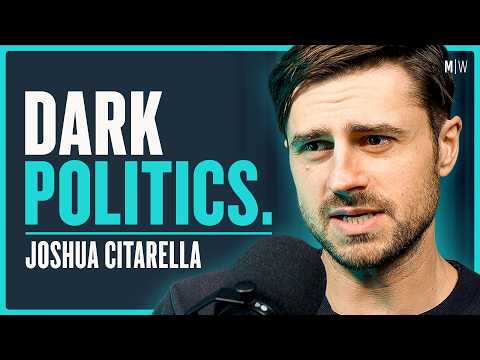
The Dark Subcultures of Online Politics - Joshua Citarella
Chris Williamson (host), Joshua Citarella (guest), Narrator
In this episode of Modern Wisdom, featuring Chris Williamson and Joshua Citarella, The Dark Subcultures of Online Politics - Joshua Citarella explores inside Gen Z Meme Politics, Radicalization Pipelines, And Power Vacuums Chris Williamson interviews artist and internet culture analyst Joshua Citarella about how fringe online political subcultures among young people prefigure mainstream politics. Citarella explains his ethnographic work tracking teen meme communities from harmless shitposting into extremist eco‑terrorism and how these spaces forecast trends like right‑wing populism and anti‑establishment sentiment. They discuss the collapse of the post‑1989 liberal consensus, the explosion of hyper‑niche ideologies, and the role of memes, irony, and ‘pipelines’ in shaping belief. The conversation also covers the left’s failure to engage young men, the politicization of masculinity, and how alternative media now rivals or eclipses legacy outlets in real political influence.
Inside Gen Z Meme Politics, Radicalization Pipelines, And Power Vacuums
Chris Williamson interviews artist and internet culture analyst Joshua Citarella about how fringe online political subcultures among young people prefigure mainstream politics. Citarella explains his ethnographic work tracking teen meme communities from harmless shitposting into extremist eco‑terrorism and how these spaces forecast trends like right‑wing populism and anti‑establishment sentiment. They discuss the collapse of the post‑1989 liberal consensus, the explosion of hyper‑niche ideologies, and the role of memes, irony, and ‘pipelines’ in shaping belief. The conversation also covers the left’s failure to engage young men, the politicization of masculinity, and how alternative media now rivals or eclipses legacy outlets in real political influence.
Key Takeaways
Fringe meme communities often forecast mainstream political shifts.
Citarella’s 2018 work following tiny Instagram and Discord ‘Politigram’ scenes showed teenagers experimenting with eco‑anarchism and post‑left ideas that later scaled into broader right‑wing populism and anti‑establishment politics seen across the West.
Get the full analysis with uListen AI
Gen Z grew up without a clear ideological default and with infinite information.
Unlike those raised under the ‘End of History’ liberal‑democracy consensus, Gen Z inherits crisis (2008 onward) plus full internet archives, so they frantically recombine ideologies—“GAN‑like” meme mashups from MAGA‑communism to libertarian neo‑monarchism—to solve unresolved systemic problems.
Get the full analysis with uListen AI
Belief systems are fluid, and ‘pipeline’ metaphors are often misused.
Citarella argues people move through beliefs and coalitions continuously, but mainstream media weaponizes the ‘radicalization pipeline’ idea to smear broadly popular alternative media as gateways to extremism, conflating antagonistic currents and missing genuine nuances.
Get the full analysis with uListen AI
Online communities now rival parties and unions in political power.
Examples like Destiny’s Georgia runoff canvassing (out‑organizing the Democratic Party on the ground) and Nick Fuentes’s America First conference show how internet‑native audiences can be mobilized into effective offline political operations.
Get the full analysis with uListen AI
The contemporary academic/activist left is structurally hostile to young men.
Citarella describes young men trying to join left groups and being met with misandry and jargon‑laden identity politics, pushing them toward right‑wing or populist figures who at least acknowledge their economic and social grievances.
Get the full analysis with uListen AI
Effective climate and social activism must respect how minds actually change.
They criticize performative stunts like throwing soup on artworks or dyeing rivers as tactics that jump people from ‘0 to 10’ emotionally, provoking backlash; durable belief change typically comes from gradual, respectful persuasion, not moral shock tactics.
Get the full analysis with uListen AI
Alternative media undermines legacy gatekeepers by addressing taboo topics.
As podcasts and online shows discuss issues mainstream outlets ignored or filtered, legacy journalists respond with moral panic about ‘pipelines’ and ‘misinformation’ largely because their historic monopoly on narrative-setting and status is collapsing.
Get the full analysis with uListen AI
Notable Quotes
“If you're 15, the acceptable parameters of political debate are not just Democrats and Republicans. It extended to primitivism and transhumanism, and before you know it, you're zoomed out to some cosmic level.”
— Joshua Citarella
“We basically just carry these stories that either a professor told us or our dad told us. We're some amalgamation of all of these little tidbits of narrative that we piece together into an ideological view of the world.”
— Joshua Citarella
“In my corner of the left, whatever we have today that constitutes today's left, I don't think that thing has room for men. I don't think it has room for much of anybody.”
— Joshua Citarella
“Most people in a democratic society are open to explanations from either right or left so long as they're not at the establishment center.”
— Joshua Citarella
“If you really care about changing minds, even though it's less sexy, you need to remember how behavior change happens: one step at a time, not by taking people from zero to ten.”
— Chris Williamson
Questions Answered in This Episode
How can policymakers and institutions ethically use ‘early detection’ from fringe online subcultures without overreacting or criminalizing experimentation and shitposting?
Chris Williamson interviews artist and internet culture analyst Joshua Citarella about how fringe online political subcultures among young people prefigure mainstream politics. ...
Get the full analysis with uListen AI
What would a genuinely broad, class-focused coalition that appeals to both disaffected young men and traditional left constituencies actually look like in practice?
Get the full analysis with uListen AI
Where is the line between ironic extremism and real radicalization, and how could platforms or educators help teenagers navigate ‘irony poisoning’ without heavy-handed censorship?
Get the full analysis with uListen AI
If alternative media now mobilizes more effectively than political parties, what does that imply for the future structure of democracy, parties, and unions?
Get the full analysis with uListen AI
How should climate and social movements redesign their tactics to be emotionally honest about urgency while still maximizing persuasion instead of backlash?
Get the full analysis with uListen AI
Transcript Preview
I really love what you do. I think it's very interesting, very unique.
That's, uh, incredible high praise from the greatest cinematic podcast that I think exists.
(laughs)
I mean, there's on- there's only so many people in the game that produce really beautiful video footage.
Mm-hmm.
And I think you seem to be in maybe the top spot there, so it's a, it's a great honor.
Thank you. Some may accuse me of all style and no substance, uh, but-
Oh, yeah. (laughs)
... uh, you know, I- I'll-
Okay.
... I'll take whatever I can get.
(laughs)
How- how do you describe what you do? You meet somebody at a cocktail party and they say, "So what is it that you're interested in?" W- what do you say?
I suppose I- I first try to avoid the cocktail party if at all possible. (laughs) But, uh, I used to say artist 'cause that was what I did, I would show work in galleries and museums. Um, now I say artist and internet culture writer. I'm a podcaster though. Most people know me for podcasting. So about a year ago, maybe a little over a year ago, I launched Doomscroll. We're now on episode 36, 35, something like that. Uh, and so it's- it's a real transformation in that I used to publish to an audience of, like, 10,000 dedicated intellectuals, and now it's, like, 100,000 weekly viewers, and it's just a very, very different game.
Mm-hmm. And what is it that you're interested in? What- what is it you focus on?
Uh, I mean, I guess it goes back to 2018. I wrote this book. It was a self-published book, really a long-form essay called Politigram and the Post Left that was looking at the memetic activity of teenagers, 12 to 17 at that time, mostly people on what we would then call the post left. Uh, that means a little bit of something different now, which you might associate with, like, post-liberal, new right, what have you, previously Bernie supporters, now people who- who've gone through the, like, Bernie to Trump pi- pipeline. That's generally what we call post left. At that time, it meant eco-anarchy, green anarchy, anarcho-primitivism, people who would reject industrial society and were 14 years old posting on Instagram, and I wrote a pretty extensive ethnography of how those people got into those politics.
That sounds niche.
(laughs)
That sounds somewhat niche.
No kidding. (laughs) Yes. Yeah. It was, uh, extremely niche. I think it has held up pretty well considering that was, uh, eight years ago now. Um, and it laid kind of the foundation for a lot of the memetic ecosystem that we live in now. So if you look at those, like, early, you know, this is all primary sources of people who were meme makers, like, teenagers who were shitposting on the bus to school, um, (laughs) there are early inklings of how our media environment exists now. So yeah, I think while it was previously niche to audiences of hundreds or thousands, we now see those same narratives, and in some cases literally the same memes-
Install uListen to search the full transcript and get AI-powered insights
Get Full TranscriptGet more from every podcast
AI summaries, searchable transcripts, and fact-checking. Free forever.
Add to Chrome